

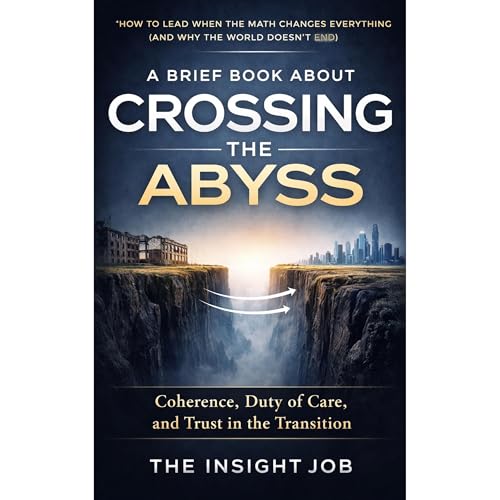
A Brief Book About Crossing the Abyss
How to Lead When the Math Changes Everything (and Why the World Doesn’t End)
Failed to add items
Add to Cart failed.
Add to Wish List failed.
Remove from wishlist failed.
Adding to library failed
Follow podcast failed
Unfollow podcast failed
Audible Standard 30-day free trial

A Brief Book About Crossing the Abyss
Buy for $3.99
-
Narrated by:
-
Virtual Voice

This title uses virtual voice narration
We are in a transition where the old order is losing authority and the new order hasn’t earned legitimacy yet. In the middle, the “monsters” multiply. Not fantasies, but symptoms leaders recognise immediately: volatility, cynicism, scapegoating, performative certainty, and the quiet diffusion of accountability.
A Brief Book About Crossing the Abyss is a concise, boardroom-ready guide for leaders and senior teams navigating the AI transition without turning technology into the strategy. It’s not another productivity playbook. It’s a leadership book about staying coherent when output becomes cheap, narratives move faster than verification, and systems scale decisions faster than organisations can scale responsibility.
Drawing on Gramsci’s interregnum, depth psychology, existential meaning-making, and modern duty-of-care thinking, the book gives you a practical way to name what’s happening and lead through it: protect shared reality, prevent “corridors of non-ownership,” and design decision-making that remains accountable, correctable, and trusted.
Inside you’ll discover how to:
recognise the Gap and the predictable symptoms that spread in “in-between” eras
lead when the math changes (capability rises while legitimacy becomes scarce)
avoid AI fatigue as meaning fatigue (when output replaces ownership)
keep truth intact under speed, uncertainty, and social pressure
translate duty into operational safeguards for high-stakes decisions
preserve legitimacy so the organisation can move faster later, not slower
If you’re tired of transformation theatre, tired of dashboards that dilute accountability, and tired of AI being treated as an end goal, this book offers a clear alternative: leadership that can hold under pressure.
Because the real risk of this era is not that machines become capable.
It’s that organisations become unowned.