

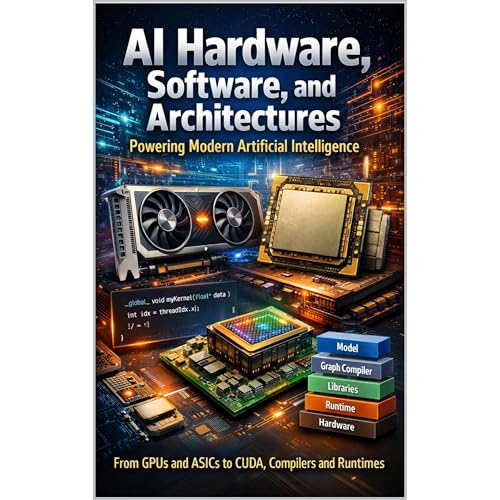
AI Hardware, Software, and Architectures Powering Modern Artificial Intelligence
From GPUs and ASICs to CUDA, Accelerators, Compilers and Runtimes
Failed to add items
Add to Cart failed.
Add to Wish List failed.
Remove from wishlist failed.
Adding to library failed
Follow podcast failed
Unfollow podcast failed
Audible Standard 30-day free trial

AI Hardware, Software, and Architectures Powering Modern Artificial Intelligence
Buy for $5.99
-
Narrated by:
-
Virtual Voice

This title uses virtual voice narration
AI Hardware, Software, and Architectures Powering Modern Artificial Intelligence
From GPUs and ASICs to CUDA, Accelerators, Compilers, and Runtimes
Modern artificial intelligence is not powered by models alone—it is driven by a carefully engineered stack of hardware, software, and system architectures working together at scale.
This book provides a clear, practical, and system-level view of how modern AI actually runs, from silicon to software. It explains how GPUs, ASICs, and emerging accelerators execute neural networks, how CUDA and alternative runtimes expose hardware capabilities, and how compilers, communication libraries, and inference systems transform models into high-performance AI workloads.
Written for engineers, architects, and technically curious professionals, this book goes beyond surface-level explanations and focuses on how real AI systems are designed, optimized, and deployed in production environments.
You will learn:
How GPUs, TPUs, NPUs, and AI ASICs are architected for training and inference
Why CUDA became central to AI—and how alternatives like ROCm, oneAPI, and Vulkan compare
How compilers, graph lowering, and kernel optimization affect performance
How distributed training systems scale across multiple accelerators
How inference systems balance latency, throughput, and cost
Where memory, bandwidth, and communication become bottlenecks
How modern AI hardware trends are shaping future system designs
The book emphasizes system thinking—connecting hardware capabilities to software abstractions and real-world performance tradeoffs. Diagrams, structured explanations, and end-to-end workflows make complex concepts accessible without oversimplifying them.
Whether you are designing AI infrastructure, optimizing performance, evaluating hardware platforms, or simply seeking a deeper understanding of how AI works under the hood, this book serves as both a learning guide and long-term reference.