

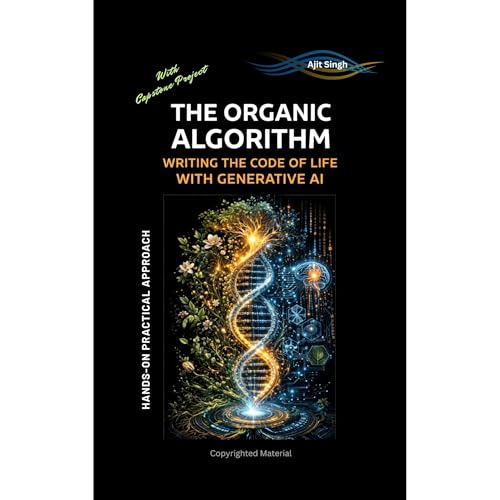
The Organic Algorithm
Writing the Code of Life with Generative AI
Failed to add items
Sorry, we are unable to add the item because your shopping cart is already at capacity.
Add to Cart failed.
Please try again later
Add to Wish List failed.
Please try again later
Remove from wishlist failed.
Please try again later
Adding to library failed
Please try again
Follow podcast failed
Please try again
Unfollow podcast failed
Please try again
Get 30 days of Standard free
Auto-renews at $8.99/mo after 30-day trial. Cancel anytime
Buy for $8.90
-
Narrated by:
-
Virtual Voice
-
By:
-
Ajit Singh

This title uses virtual voice narration
Virtual voice is computer-generated narration for audiobooks.
Philosophy
The core philosophy of this book is that biology is a programmable medium, and generative AI is our most powerful programming language. I reject the traditional separation of computer science and life science, instead treating them as two sides of the same engineering coin. My approach is fundamentally constructive. I do not stop at analysis or prediction; my goal is creation.
Key Features
1. Strict Implementation Focus: Over 70% of the book is dedicated to hands-on tutorials, code walkthroughs, and practical implementation details.
2. Step-by-Step Algorithms: Complex processes are broken down into simple, numbered algorithms, making them easy to follow and implement, even for beginners.
3. End-to-End Capstone Project: Chapter 10 provides a complete, working DIY project to design a novel enzyme, including fully-explained Python code and setup instructions for a Windows environment.
4. Focus on Open-Source Tools: All examples and projects are built using the industry-standard stack of Python, PyTorch/TensorFlow, BioPython, and RDKit, ensuring the skills learned are immediately transferable.
5. In Silico Validation: A dedicated chapter teaches computational methods for testing and validating generated biological designs, a critical step before expensive and time-consuming lab synthesis.
Key Takeaways
1. Upon completing this book, the reader will be able to:
2. Conceptualize and Frame biological design problems in a computationally tractable way.
3. Represent complex biological data (DNA, RNA, proteins) as numerical tensors suitable for machine learning models.
4. Implement foundational generative models, including Variational Autoencoders (VAEs), Generative Adversarial Networks (GANs), and Transformers, from scratch for biological applications.
5. Design and Generate novel biological sequences, such as peptides and DNA binding sites, with desired properties.
6. Construct computational models of genetic circuits that can be used to program cellular behavior.
7. Validate generated biological designs using in silico simulation and analysis tools, such as molecular docking and folding prediction.
8. Build, Train, and Deploy a complete, end-to-end generative biology application.
9. Critically Evaluate the ethical, safety, and societal implications of their work in synthetic biology.
Disclaimer: Earnest request from the Author.
Kindly go through the table of contents and refer kindle edition for a glance on the related contents.
Thank you for your kind consideration!
No reviews yet