

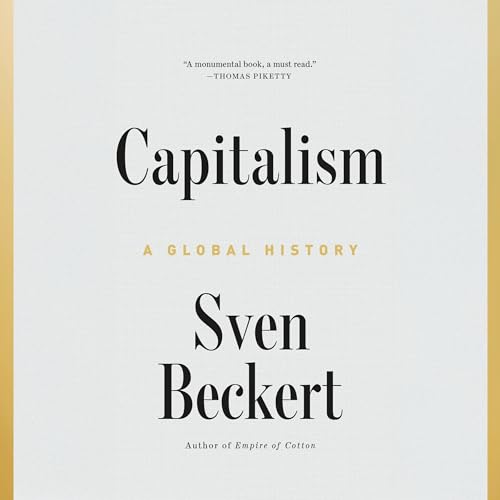
Capitalism
A Global History
Failed to add items
Sorry, we are unable to add the item because your shopping cart is already at capacity.
Add to Cart failed.
Please try again later
Add to Wish List failed.
Please try again later
Remove from wishlist failed.
Please try again later
Adding to library failed
Please try again
Follow podcast failed
Please try again
Unfollow podcast failed
Please try again
Get 30 days of Standard free
Auto-renews at $8.99/mo after 30-day trial. Cancel anytime

Capitalism
Narrated by:
Soneela Nankani, Courtney Patterson, Robert Petkoff, Mack Sanderson
Buy for $45.00
-
Narrated by:
-
Soneela Nankani
-
Courtney Patterson
-
Robert Petkoff
-
Mack Sanderson
-
By:
-
Sven Beckert
"A learned, formidable and vivid story… Readers around the world will study and ponder this monumental work of history, agreeing and arguing with it, all the while affirming its generational importance, for decades to come." — Marcus Rediker, The New York Times
“Epic… Read this book and you will learn innumerable things you did not previously know culled from places you have never been… [Readers], including me, will be genuinely grateful for exposure to this breadth of scholarship and be glad to have a valuable tool of reference on their shelves.” –John Kay, Financial Times
A landmark event years in the making, a brilliant global narrative that unravels the defining story of the past thousand years of human history
No other phenomenon has shaped human history as decisively as capitalism. It structures how we live and work, how we think about ourselves and others, how we organize our politics. Sven Beckert, author of the Bancroft Prize–winning Empire of Cotton, places the story of capitalism within the largest conceivable geographical and historical framework, tracing its history during the past millennium and across the world. An epic achievement, his book takes us into merchant businesses in Aden and car factories in Turin, onto the terrifyingly violent sugar plantations in Barbados, and within the world of women workers in textile factories in today’s Cambodia.
Capitalism, argues Beckert, was born global. Emerging from trading communities across Asia, Africa, and Europe, capitalism’s radical recasting of economic life rooted itself only gradually. But then it burst onto the world scene, as a powerful alliance between European states and merchants propelled them, and their economic logic, across the oceans. This, Beckert shows, was modern capitalism’s big bang, and one of its epicenters was the slave labor camps of the Caribbean. This system, with its hierarchies that haunt us still, provided the liftoff for the radical transformations of the Industrial Revolution. Fueled by vast productivity increases along with coal and oil, capitalism pulled down old ways of life to crown itself the defining force of the modern world. This epic drama, shaped by state-backed institutions and imperial expansion, corresponded at no point to an idealized dream of free markets.
Drawing on archives on six continents, Capitalism locates important modes of agency, resistance, innovation, and ruthless coercion everywhere in the world, opening the aperture from heads of state to rural cultivators. Beckert shows that despite the dependence on expansion, there always have been, and are still, areas of human life that the capitalist revolution has yet to reach.
By chronicling capitalism’s global history, Beckert exposes the reality of the system that now seems simply “natural.” It is said that people can more easily imagine the end of the world than the end of capitalism. If there is one ultimate lesson in this extraordinary book, it’s how to leave that behind. Though cloaked in a false timelessness and universality, capitalism is, in reality, a recent human invention. Sven Beckert doesn’t merely tote up capitalism’s debits and credits. He shows us how to look through and beyond it to imagine a different and larger world.
Listeners also enjoyed...







adbl_web_anon_alc_button_suppression_c
People who viewed this also viewed...






not belong to them in any way.
Surprising start of capitalism
Something went wrong. Please try again in a few minutes.
At the same time, Beckert skillfully integrates the political, demographic, and inequality dimensions, showing how these forces shaped—and were shaped by—institutions and social responses. The result is a nuanced, interconnected view of capitalism as a global system rather than a purely Western narrative.
In short, this is a rigorous and rewarding book that I strongly recommend to anyone interested in understanding capitalism in its full historical and global context.
Required reading to understand Capitalism!
Something went wrong. Please try again in a few minutes.
Now onto the content.
Even though he was clearly painting an unflattering portrait of capitalism, I was expecting to give this book a higher rating. It felt like a serious book and I learned a lot.
Plus, I agree with one of his main points, that capitalism can't exist without strong state support.
However, as the book began to approach modern times, when I feel a bit more confident about, I began realizing that he was doing more than painting a biased picture, he was being actually dishonest.
The first thing I noticed was that he quietly bypassed the enlightenment philosophy, iconified by Adam Smith's Wealth of Nations. If he had decided to completely ignore the philosophy of capitalism, and stick to the history, that would have been one thing, but he spent a great deal of time on Marxist and other critiques of capitalism, so this seem rather one sided. Then when, during the Keynesian reevaluation, he would say something like "the days of laissez faire were over", the reader would have to reach outside of his narrative to even know what he meant.
This was during, what he called, the Golden age, where even he couldn't dispute the effects it had on the flourishing of society, so he tried to minimize the capitalism part, and emphasize the social programs, State infrastructure, Labor Unions and Labor Laws. Yet he didn't even mention the alternative system of Soviet Communism, because it is clear to any objective observer that the Keynesian capitalism of that period was universally superior. This was most clear in Germany. The East and the West started out the same, but attempts to climb the wall only went one way.
The Second problem I had was, when it suited him he collapsed all forms of capitalism. He talked about Fascist State Controlled Markets in the same breath as the Saudi Petro State in the same breath as neo-Liberal Capitalism, which seems completely absurd. The first time, it really dawned on me that he was being dishonest was when he said that neo-liberal capitalists didn't care about forms of governments, and even admired fascists. This seemed ridiculous on the face of it, and his only evidence for this was a 1927 quote from Ludwig Von Mises that was taken completely out of context, in his book about Liberalism. He absolutely saw Fascism as a dangerous ideology, and said so throughout the book. There is no doubt that neoliberals will pragmatically work with unsavory governments to fight what they considered a bigger threat (mainly Communism), but that is a far cry from admiring them. This is when I began realizing that his history is full of distortions, and it made me not trust the rest of the history that he portrays.
Finally, he could never bring himself to admit or even tackle the argument that, as flawed as capitalism can be, it (coupled with liberal democracy) is the best way to upward mobility and flourishing (for individuals and states) ever tried. Labor Law and Unions (which the U.S.S.R. banned) are good and necessary. As are the rule of law, regulations, etc. But you can't argue with the fact that poverty has plunged, life-spans have shot through the roof, and comfortable living has never been better along with, ironically, free time and resources to have leisure time. For example, he mentioned that life expectancy went down when the Soviet Union collapsed, but he didn't mention that the Soviet life expectency was well below that of Western capitalist countries. And he never mentioned that as time went on, there was a clear divergence between the old soviet countries that embraced western style democracy and markets, and the countries that remained stuck in their authoritarian past.
Anyway, time to chase this down with some Ayn Rand (who I am also not a fan of, but need to keep it balanced) ;)
Wow. This man HATES capitalism.
Something went wrong. Please try again in a few minutes.
Essential insights, skillfully shared
Something went wrong. Please try again in a few minutes.
Enlightening
Something went wrong. Please try again in a few minutes.