

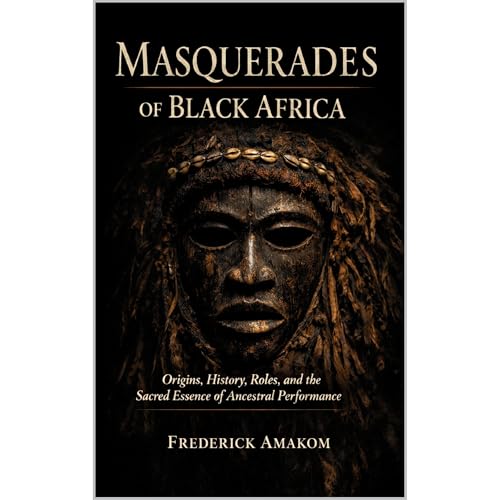
MASQUERADES OF BLACK AFRICA Origins, History, Roles, and the Sacred Essence of Ancestral Performance
Failed to add items
Add to Cart failed.
Add to Wish List failed.
Remove from wishlist failed.
Adding to library failed
Follow podcast failed
Unfollow podcast failed
Get 30 days of Standard free

MASQUERADES OF BLACK AFRICA Origins, History, Roles, and the Sacred Essence of Ancestral Performance
Buy for $9.00
-
Narrated by:
-
Virtual Voice
-
By:
-
Frederick Amakom

This title uses virtual voice narration
Masquerades are among Africa’s most powerful—and most misunderstood—institutions. Often reduced to colorful costumes, festivals, or “traditional dances,” African masquerades have in fact functioned for centuries as embodied authority: enforcing law, preserving moral order, educating society, healing spiritual imbalance, and mediating between the living and the dead.
In Masquerades of Black Africa, this groundbreaking work restores masquerades to their rightful place as serious African philosophical, political, and spiritual institutions.
Drawing on African cosmology, history, and lived cultural logic, the book explores:
- The African worldview of the seen and unseen
- The origins of masquerades as ancestral embodiment, not symbolism
- Regional expressions across West, Central, Southern, and Eastern Africa
- Masquerades as courts of law, moral enforcers, educators, and healers
- The sacred engineering of masks, costumes, music, and trance
- The role of secrecy, gender, and power in sustaining authority
- The impact of colonial suppression and modern reinterpretation
- The future of masquerades in a rapidly changing African world
This book does not romanticize tradition, nor does it demand belief. It demands seriousness—a willingness to recognize that African societies developed coherent systems of governance, psychology, and moral discipline long before colonial contact.
Written in a rare hybrid style that blends scholarly rigor with accessible prose, Masquerades of Black Africa is essential reading for:
- Scholars and students of African studies, anthropology, and religion
- Artists, filmmakers, and cultural practitioners
- Africans and members of the diaspora seeking intellectual reconnection
- Readers interested in indigenous philosophy, power, and identity
This is not a book about masks.
It is a book about how societies remember themselves, govern themselves, and refuse disappearance.