

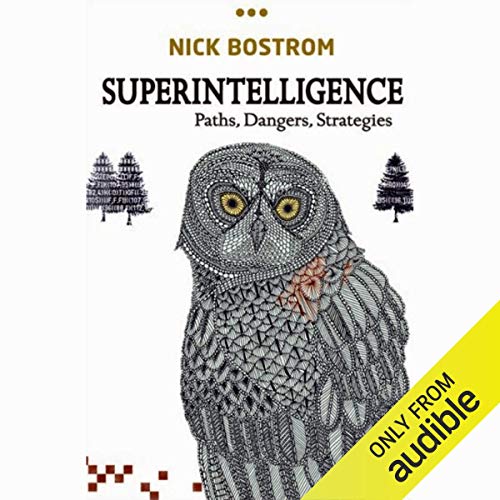
Superintelligence
Paths, Dangers, Strategies
Failed to add items
Add to Cart failed.
Add to Wish List failed.
Remove from wishlist failed.
Adding to library failed
Follow podcast failed
Unfollow podcast failed
Get 30 days of Standard free

Superintelligence
Buy for $20.93
-
Narrated by:
-
Napoleon Ryan
-
By:
-
Nick Bostrom
Superintelligence asks the questions: What happens when machines surpass humans in general intelligence? Will artificial agents save or destroy us? Nick Bostrom lays the foundation for understanding the future of humanity and intelligent life. The human brain has some capabilities that the brains of other animals lack. It is to these distinctive capabilities that our species owes its dominant position. If machine brains surpassed human brains in general intelligence, then this new superintelligence could become extremely powerful - possibly beyond our control. As the fate of the gorillas now depends more on humans than on the species itself, so would the fate of humankind depend on the actions of the machine superintelligence.
But we have one advantage: We get to make the first move. Will it be possible to construct a seed Artificial Intelligence, to engineer initial conditions so as to make an intelligence explosion survivable? How could one achieve a controlled detonation?
This profoundly ambitious and original book breaks down a vast track of difficult intellectual terrain. After an utterly engrossing journey that takes us to the frontiers of thinking about the human condition and the future of intelligent life, we find in Nick Bostrom's work nothing less than a reconceptualization of the essential task of our time.
Download the accompanying reference guide.©2014 Nick Bostrom (P)2014 Audible Inc.Listeners also enjoyed...


People who viewed this also viewed...


The book doesn't really dwell much on how the SI will be created. The author mostly assumes a computer algorithm of some kind with perhaps human brain enhancements. If you reject such an SI entity prima facie this book is not for you, since the book mostly deals with assuming such a recursive self aware and self improving entity will be in humanities future.
The author makes some incredibly good points. He mostly hypothesizes that the SI entity will be a singleton and not allow others of its kind to be created independently and will happen on a much faster timeline after certain milestones are fulfilled.
The book points out how hard it is to put safeguards into a procedure to guard against unintended consequences. For example, making 'the greater good for the greatest many' the final goal can lead to unintended consequence such as allowing a Nazi ruled world (he doesn't give that example directly in the book, and I borrow it from Karl Popper who gave it as a refutation for John Stuart Mill's utilitarian philosophy). If the goal is to make us all smile, the SI entity might make brain probes that force us to smile. There is no easy end goal specifiable without unintended consequences.
This kind of thinking within the book is another reason I can recommend the book. As I was listening, I realized that all the ways we try to motivate or control an SI entity to be moral can also be applied to us humans in order to make us moral to. Morality is hard both for us humans and for future SI entities.
There's a movie from the early 70s called "Colossus: The Forbin Project", it really is a template for this book, and I would recommend watching the movie before reading this book.
I just recently listened to the book, "Our Final Invention" by James Barrat. That book covers the same material that is presented in this book. This book is much better even though they overlap very much. The reason why is this author, Nick Bostrom, is a philosopher and knows how to lay out his premises in such a way that the story he is telling is consistent, coherent, and gives a narrative to tie the pieces together (even if the narrative will scare the daylights out of the listener).
This author has really thought about the problems inherent in an SI entity, and this book will be a template for almost all future books on this subject.
Colossus: The Forbin Project is coming
Something went wrong. Please try again in a few minutes.
On the down side the author is so committed to voicing the scholarly non-committal tone that he fails to make definite statements about any topic, even when he could do so.
At times there are logical fallacies in the arguments, and assumptions about the nature of Artificial Intelligences that appear to be groundless, and are not supported by explanation.
There is also a tendency to quote and rely on a variety of "Celebrity" Experts, who have track records in Technology that more recently have led them down allies of almost clownish obsolescence in one case, and over-confidence leading to fallacies and mistakes in their work in the other case.
I would not take this book as 'gospel' on Super-Intelligence. Rather it is a worthwhile entry into the current fieldwork on the subject, such as it is.
Thorough, With a Mix of Excellence and Other
Something went wrong. Please try again in a few minutes.
The strength of Superintelligence lies in its scope and analytical range. Bostrom examines the subject from multiple angles—philosophical, technical, ethical, and strategic—creating a genuinely panoramic view of the issue. The early chapters, which extrapolate from what is currently known about AI systems and their rate of progress, are insightful and intellectually satisfying. In these sections, his reasoning feels grounded, logical, and forward-looking.
Unfortunately, the book gradually departs from this solid foundation. Much of the later argumentation rests on hypothetical scenarios built upon further hypotheticals—a speculative chain that grows increasingly tenuous. The result is a kind of intellectual recursion: conjecture built upon conjecture, leading to an extended exercise in theoretical imagination rather than analysis. The tone drifts from disciplined foresight into speculative fiction.
Bostrom’s understanding of human society is also disappointingly superficial. His frequent references to what “we” might decide or fail to do rest on the flawed assumption that humanity functions as a unified, rational actor. In reality, global systems operate through fragmented interests, conflicting incentives, and structural constraints that make coordinated global action almost impossible. By overlooking this, Bostrom’s strategic recommendations lose much of their practical relevance.
As the book progresses, its earlier promise gives way to repetition and abstraction. The clarity and rigour of the opening chapters dissipate into increasingly speculative reflections that neither illuminate the real technological trajectory nor offer workable solutions.
Nevertheless, Superintelligence remains a significant work within the AI-safety discourse, notable for its ambition and intellectual reach. It succeeds in raising the central philosophical questions surrounding artificial intelligence and the long-term future of intelligence itself. Yet it ultimately falters under the weight of its own speculation and its author’s limited grasp of societal realities.
In conclusion: a well-written and thought-provoking book that begins with strength and depth but loses coherence as it retreats into conjecture and philosophical abstraction—an impressive intellectual effort, yet one that promises far more than it ultimately delivers.
P.S. This review was written with the assistance of ChatGPT.
Insightful but Drowns in Hypotheticals
Something went wrong. Please try again in a few minutes.
Wrong narrator
Something went wrong. Please try again in a few minutes.
Buy This. Everyone should hear this.
Something went wrong. Please try again in a few minutes.