

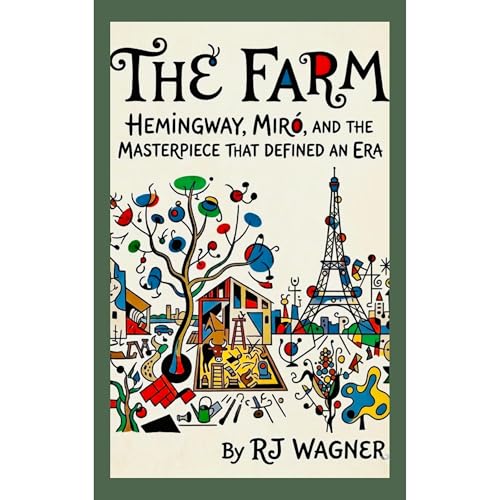
The Farm
Hemingway, Miró, and the Masterpiece That Defined an Era
Failed to add items
Add to Cart failed.
Add to Wish List failed.
Remove from wishlist failed.
Adding to library failed
Follow podcast failed
Unfollow podcast failed
Get 30 days of Standard free

The Farm
Buy for $8.99
-
Narrated by:
-
Virtual Voice
-
By:
-
RJ Wagner

This title uses virtual voice narration
Before it was a priceless masterpiece locked safely behind museum glass, it was a starving man’s only ticket to survival.
In the freezing Parisian winter of 1921, a hallucinating Joan Miró poured his soul into four square feet of canvas, desperate to sell the red dirt of his Spanish homeland before the cold killed him. But instead of attracting a wealthy collector, the painting caught the predatory eye of a broke, unknown American writer named Ernest Hemingway. Hemingway didn’t just want the painting; he rolled bone dice in a smoky Montparnasse dive bar for the absolute right to own it, hustling and begging across the Left Bank to pay the 5,000-franc ransom.
He needed it to survive.
For the next forty years, that canvas became the silent, vibrating witness to the making and breaking of a literary titan. It served as Hemingway's personal "tuning fork," the brutal, unyielding standard of truth that taught him how to strip his prose to the bone. But as Hemingway’s myth grew, the painting paid the price. It absorbed the devastating, tear-soaked fallout of his divorces. It survived the suffocating, rum-soaked decay of Key West. It endured the feral cats and paranoid rage of his final years, ultimately becoming a trapped hostage of the Cuban Revolution.
Told entirely from the unique, immersive perspective of the cured oil and raw flax, The Farm is a visceral object biography. It is the unforgettable story of how a single piece of fabric outlived the starving genius who built it, the wealthy dealers who tried to butcher it, and the brilliant, tortured writer who needed it to breathe.