

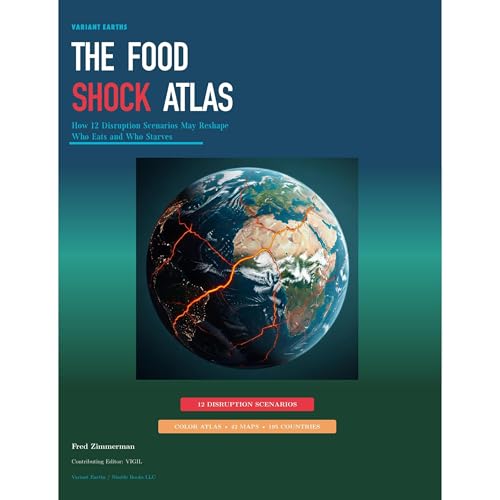
The Food Shock Atlas
How 12 Disruption Scenarios May Reshape Who Eats and Who Starves
Failed to add items
Sorry, we are unable to add the item because your shopping cart is already at capacity.
Add to Cart failed.
Please try again later
Add to Wish List failed.
Please try again later
Remove from wishlist failed.
Please try again later
Adding to library failed
Please try again
Follow podcast failed
Please try again
Unfollow podcast failed
Please try again
Audible Standard 30-day free trial
Select 1 audiobook a month from our entire collection of titles.
Yours as long as you’re a member.
Get unlimited access to bingeable podcasts.
Standard auto renews for $8.99 a month after 30 days. Cancel anytime.

The Food Shock Atlas
Narrated by:
Virtual Voice
Buy for $14.99
-
Narrated by:
-
Virtual Voice
-
By:
-
Zimmerman

This title uses virtual voice narration
Virtual voice is computer-generated narration for audiobooks.
The Food Shock Atlas is the first comprehensive, country-by-country analysis of twelve disruption scenarios that could reshape global food security within the next decade. Drawing on trade data, agricultural production statistics, climate projections, and geopolitical risk assessments current through March 2026, this atlas maps the vulnerabilities of all 195 countries across twelve distinct shock pathways — and scores each nation's resilience.
The twelve scenarios span the full spectrum of food system fragility:
- Black Sea Blockade: What a sustained closure of Ukrainian and Russian grain exports means for the 36 countries that depend on them for more than 25% of their wheat supply.
- Fertilizer Supply Cutoff: The cascading yield losses when the three countries controlling 70% of global potash exports restrict trade.
- Suez/Panama Canal Disruption: How chokepoint closures redirect grain flows and spike freight costs for import-dependent island nations and landlocked states.
- Simultaneous Breadbasket Drought: The compound risk when climate-driven crop failures hit multiple major exporters in the same growing season.
- Aquifer Depletion Crisis: The slow-motion emergency unfolding beneath the world's most productive farmland, from the Ogallala to the North China Plain.
- Energy Price Shock: How a sustained spike in oil and natural gas prices propagates through fertilizer costs, irrigation pumping, cold chains, and food transport.
- Pandemic-Scale Labor Disruption: The lessons of 2020 applied to scenarios of greater severity and duration.
- Trade War Escalation: When agricultural commodities become instruments of geopolitical leverage.
- Biodiversity Collapse and Pollinator Loss: The yield implications of declining insect populations for pollinator-dependent crops.
- Cyberattack on Food Infrastructure: Vulnerabilities in precision agriculture, grain elevator networks, and port logistics systems.
- Sovereign Debt and Import Capacity Collapse: When countries can no longer afford to buy the food they need on international markets.
- Cascading Multi-Shock Convergence: The nightmare scenario — what happens when two or more shocks strike simultaneously.
Each scenario chapter includes vulnerability rankings for all 195 countries, a detailed analysis of propagation mechanisms, historical precedents, and specific citizen-level mitigation strategies.
The atlas culminates in a composite Food System Resilience Index that integrates findings across all twelve scenarios, identifying the most vulnerable convergence zones — countries exposed to nearly every shock pathway — and six high-leverage intervention points where targeted investment yields maximum resilience improvement.
Part IV provides a Citizen's Food Resilience Handbook with practical household-level actions, complete methodology documentation enabling independent verification of every score, and a model discoverability appendix with full source citations, data provenance, and confidence calibrations.
This is a structured analytical tool for policymakers, journalists, researchers, NGO planners, and informed citizens who need to understand where the global food system is most likely to fail, how failures propagate across borders, and what can be done — at every level from national policy to household preparedness — before the next shock arrives.
No reviews yet