

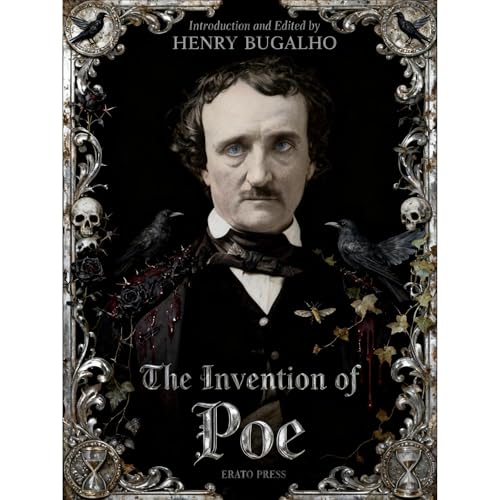
The Invention of Poe (Annotated)
The Essential Documents of a Literary Fabrication | Edited with Critical Essays by Henry Bugalho | Erato Press
Failed to add items
Add to Cart failed.
Add to Wish List failed.
Remove from wishlist failed.
Adding to library failed
Follow podcast failed
Unfollow podcast failed
Get 30 days of Standard free

The Invention of Poe (Annotated)
Buy for $5.99
-
Narrated by:
-
Virtual Voice

This title uses virtual voice narration
Edgar Allan Poe died on October 7, 1849. By October 9, he had already been invented.
The obituary published two days after his death — signed "Ludwig," later revealed as Rufus Wilmot Griswold, his literary executor and personal enemy — was not biography. It was preemptive mythology. It described a man of "scant virtues" and "numerous vices," a drunk, a madman, a moral failure whose genius was incidental to his depravity. Within weeks, Griswold had gone further: forging letters, altering texts, inserting fabricated passages into documents Poe had actually written. The archive was corrupted before the body was cold.
This is the story this volume tells — in the original documents themselves, with critical apparatus that reads them not as access to the historical Poe but as the machinery through which he was constructed.
Layer 0: The Epistolary Self — Poe's own letters to John Allan, the foster father who disinherited him; the only documents in which Poe speaks before the invention begins.
Layer 1: The Founding Defamation — Griswold's "Ludwig" obituary (1849) and Memoir of the Author (1850): the poisoned origin, with a full accounting of the documented forgeries and textual crimes.
Layer 2: The Immediate Response — Willis, Graham, and the counter-fabrications: those who knew Poe and fought Griswold's version, and why their counter-narratives are themselves constructions.
Layer 3: The European Invention — Baudelaire's New Notes on Edgar Poe (1857): how a French poet transformed the American drunk into the archetype of the poète maudit, and sent that invention back across the Atlantic to replace the original.
Layer 4: The Gendered Testimony — Sarah Helen Whitman's Edgar Poe and His Critics (1860): the silenced archive, the woman who loved him, and what her testimony reveals about who controlled the narrative.
Layer 5: The Systematic Rehabilitation — Ingram, Woodberry, Weiss: the Victorian biographers who dismantled Griswold's defamation and replaced it with a different mythology equally distant from the historical person.
Poe's Own Voice — The Philosophy of Composition and selections from The Literati of New York City: the texts in which Poe most deliberately constructed his own public persona, and what that construction reveals about the man who performed it.
✦ The complete primary documents of Poe's biographical fabrication — letters, obituaries, memoirs, critical essays, and Poe's own writings — with individual introductions, a forgeries apparatus, editorial notes, and a closing essay by Henry Bugalho.
This edition also includes:
✦ The Fabrication of a Literary Figure — Henry Bugalho's critical introduction: fourteen chapters tracing the full architecture of the Poe myth from Griswold's forgeries through Baudelaire's transatlantic reinvention to the recursive contamination of The Raven itself
✦ A Closing Essay: What the Collection Reveals — the synthesis: what happens when you read all the layers simultaneously, and why the impossibility of reaching the historical Poe is not a failure of scholarship but the central fact of his literary afterlife
✦ A full forgeries apparatus documenting Griswold's textual crimes: the specific passages altered, the letters fabricated, and the archival consequences that shaped every Poe biography written since
For readers who enjoy:
✦ Classic American literature — and the most documented case of literary mythmaking in its history
✦ Gothic fiction and the writer who invented the American dark imagination
✦ Literary biography and the archaeology of how writers become cultural myths
✦ The complete story of Edgar Allan Poe — including the parts Griswold invented and Baudelaire exported to Europe