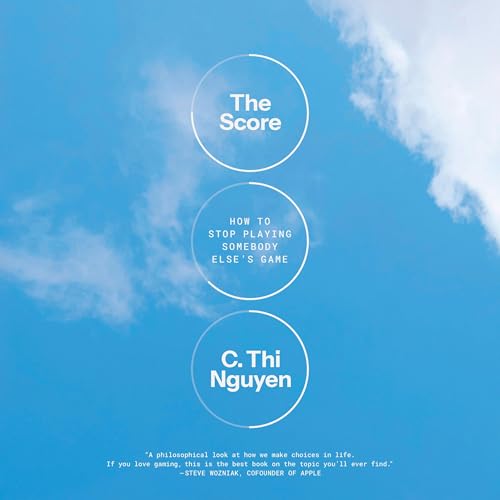
The Score Audiobook By C. Thi Nguyen cover art

The Score

How to Stop Playing Somebody Else's Game

Preview

Audible Standard 30-day free trial

Try Standard free
Select 1 audiobook a month from our entire collection of titles.
Yours as long as you’re a member.
Get unlimited access to bingeable podcasts.
Standard auto renews for $8.99 a month after 30 days. Cancel anytime.

The Score

By: C. Thi Nguyen
Narrated by: C. Thi Nguyen
Try Standard free

$8.99 a month after 30 days. Cancel anytime.

Buy for $19.80

Buy for $19.80

“Mind-expanding . . . The Score is so exuberant and readable that the depth and seriousness of its insights almost sneak up on you.” —Jennifer Szalai, The New York Times

“Brilliant and wildly original . . . The Score is socially attentive, historically literate and imbued with sensual glee.” —Becca Rothfeld, The Washington Post

“I give this excellent book five stars.”Stuart Jeffries, Financial Times

A philosophy of games to help us win back control over what we value


The philosopher C. Thi Nguyen—one of the leading experts on the philosophy of games and the philosophy of data—takes us deep into the heart of games, and into the depths of bureaucracy, to see how scoring systems shape our desires.

Games are the most important art form of our era. They embody the spirit of free play. They show us the subtle beauty of action everywhere in life in video games, sports, and boardgames—but also cooking, gardening, fly-fishing, and running. They remind us that it isn’t always about outcomes, but about how glorious it feels to be doing the thing. And the scoring systems help get us there, by giving us new goals to try on.

Scoring systems are also at the center of our corporations and bureaucracies—in the form of metrics and rankings. They tell us exactly how to measure our success. They encourage us to outsource our values to an external authority. And they push on us to value simple, countable things. Metrics don’t capture what really matters; they only capture what’s easy to measure. The price of that clarity is our independence.

The Score asks us is this the game you really want to be playing?
Career Success Decision-Making & Problem Solving Personal Development Personal Success Philosophy Game
All stars
Most relevant
The Score poses the excellent question of why rules and scoring make games fun but analogous restrictions make bureaucracies soul crushing. However, in attempting to answer this question, largely framed as the goal of the book, the author is a bit light on conclusions. This is not to say there aren’t many interesting observations throughout. The sections on real life as being nauseatingly complex, questions about whether to gamify life, considerations of selecting the right metrics to track, how most hours of engagement on Netflix isn’t the same as good art, the mechanics of bureaucracy, and how constraints paradoxically allow for heightened creativity, are all very important illuminative moments. Yet in striving to answer the premise, the author is light on specifics and calls for abstractions of the need to create structures for play and games into the fabric of life. Throughout this book veers in and out of personal anecdotes into academic meditations. Sometimes the author is a bit too self absorbed with his own identity as someone who has idiosyncratic hobbies like cooking and yo-yo-ing, but despite this the memoir approach to the subject still works well. It’s redundant in places where it feels like the same terminology is defined over and over again, and for a philosopher, the text doesn’t yield very many philosophical takeaways and kind of throws its hands up at the end, shirking a conclusion, albeit in an innovative way with a choose your adventure two ending format. And as someone who has thought a lot about games and philosophy, it is incongruous to me that the author is so critical of Civilization and cites it as the one game he regrets playing when I think it is the single best metaphor for human meaning and purpose, shouldn’t we all be pursuing the Alpha Centauri scientific victory to understand and explore the universe? Still very grateful for the read and I’m pursuing several of the cited books and games to explore these topics further.

Great questions posed, light on answers

Something went wrong. Please try again in a few minutes.

Great ideas, compelling and personal storytelling. The author is able to meaningfully convey conflicting ideas.

Amazing

Something went wrong. Please try again in a few minutes.

This is one of the most interesting books I read! I work in clinical quality metric design, and this book helped me to understand my own field better.

Metrics vs games

Something went wrong. Please try again in a few minutes.

I wanted to like this book. I listened to the author interviewed by about the topic and it sounded fascinating. Unfortunately the book did not live up to my expectations. The author did not provide enough examples to justify his assertions and he repeated his assertions ad nauseam, chapter after chapter. It felt remarkably under researched. Halfway through I was so bored and switched to “The Art Of Gathering”, another interview find, and a frankly a much more compelling listen.

Also, a much more minor issue, but it did take me out of the flow, the author asserts that the printing press was a centralized technology, but neglected to mention that prior to the printing press, books were hand drawn mostly by monks. The printing press actually democratized books and printed content. In fact there were many crack downs by authorities on underground printers writing political pamphlets. The overly truncated history of centralizing/decentralizing technologies just feels lazy. Like the author was in too much of a hurry to make his point that he was ok with a bit of hand waving.

Interesting premise, but repetitive and boring

Something went wrong. Please try again in a few minutes.

I couldn’t get through it. The florid description became unbearable. Like a high school sophomore with a new thesaurus, everything the author values must be smothered in “gorgeous” “exquisite” and “delicious” ad nauseam. The mostly obvious concepts are tortured into pseudo academic definitions designed to demonstrate the author’s cleverness. The examples are repetitive, and the chapters are containers of redundancy. Are there no editors anymore?

The Score

Something went wrong. Please try again in a few minutes.

See more reviews