AuDHD IRL Podcast By Bri Thomas cover art

AuDHD IRL

AuDHD IRL

By: Bri Thomas
Listen for free

AuDHD IRL is a podcast about what it really looks like to be autistic + ADHD, beyond the hot takes and productivity hacks. Each episode feels like a cuppa with someone a few steps ahead on the journey (who’s tripped over it a few times). We talk honestly about it all, with laughter, tasteful swearing, and lots of self-compassion. This isn’t about fixing yourself. It’s about understanding your brain, finding language for your experience, and feeling less alone while you figure things out in real life. Come as you are. Stay as long as you like. Coming to you from Ngunnawal and Ngambri lands.Bri Thomas Personal Development Personal Success
Episodes
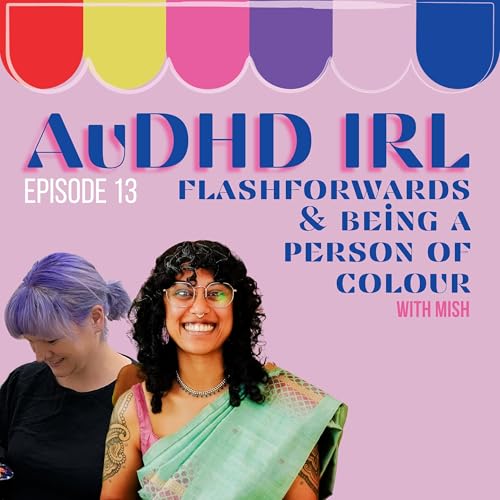
  • Ep13. AuDHD Flashfowards & Being a Person of Colour with Mish
    Mar 29 2026

    Content Warning: This episode contains discussions of...

    • Trauma and systemic oppression
    • Racism, colonisation, and minority stress
    • Misdiagnosis (including BPD) and mental health stigma
    • Brief mention of self-concept distress

    Please take care while listening and pause if needed.

    Summary: In this deeply thoughtful and expansive conversation, Bri sits down with Mish - a non-binary, neurodivergent, South Indian mental health social worker - to explore what it really means to live as an AuDHD person at the intersection of culture, identity, and systems.

    Together, they unpack the concept of flash forwards - a lesser-discussed but powerful experience of anticipatory dread - and how AuDHDers may vividly “pre-live” the future in ways that feel intensely real.

    Mish shares their lived experience of being misdiagnosed with BPD, the impact of stigma, and the relief and rage that can come with finding more accurate, affirming frameworks.

    The conversation expands into how neurodivergence is always filtered through culture, and how people of the global majority experience compounding layers of minority stress, masking, and misinterpretation.

    They explore:

    • Why safety is not universal, but can be “safe enough”
    • How identity shapes both trauma and healing
    • The role of flash forwards in burnout, anxiety, and survival
    • And what it means to move toward your “favourite self”, rather than your “best” or “most productive” self

    This episode is an invitation to stay curious, to listen deeply, and to rethink what we’ve been taught about both neurodivergence and healing.

    Takeaways:

    • Flash forwards are real and valid. Not just “overthinking”. They can feel like vividly living a feared future, with full-body responses.
    • Your brain is trying to protect you. Flash forwards are often your system attempting to anticipate and prevent harm.
    • The “where self” matters. Reorienting to where you are (not just what you feel) can help anchor you in the present.
    • Neurodivergence is shaped by culture. It is never experienced in isolation. Race, gender, queerness, and systems all shape how it shows up and how it’s perceived.
    • Minority stress compounds everything. Being neurodivergent and part of marginalised communities amplifies burnout, masking, and anticipatory anxiety.
    • Same traits, different judgments. Behaviour seen as “leadership” in some may be labelled “too much” or “intimidating” in others.
    • Masking is not the enemy. It can be a survival tool. The goal isn’t always to unmask, but to have choice.
    • “Safe enough” is the goal. Healing doesn’t require perfect safety, just moments where your system can soften.
    • Find your “favourite self”. Not your most productive, healed, or optimised self, just the version of you that feels most like you.
    • The greatest privilege is not having to know. And the invitation is to choose curiosity anyway.

    Mish can be found via email at mishma@niram.com.au and on Insta at @neuroqueer.emdrtherapist.

    Show more Show less
    54 mins
  • AuDHD Communication Preferences with Cammy
    Mar 22 2026

    Content Warning - This episode includes discussion of:

    • Experiences of being misunderstood, shamed, or corrected for communication differences
    • Neurodivergent masking and social challenges
    • Workplace and school-based communication difficulties

    Please take care while listening and pause if needed.


    Summary: In this episode, Bri sits down with AuDHD speech pathologist Cammy to explore the nuanced, often overlooked world of communication preferences in AuDHDers. Together, they unpack how communication is far more than just “talking and understanding”, it includes how we tell stories, ask for help, process language, use tone, and navigate relationships.

    Cammy shares insights from both her lived experience and clinical work, highlighting how many AuDHDers have been misunderstood or even shamed for the way they communicate. The conversation dives into directness, sensitivity, scripting, and the push-pull of AuDHD traits, while emphasising that communication is dynamic, relational, and deeply personal.

    They also explore the importance of self-awareness, collaboration, and accommodations, from communication profiles to visual supports, and how both neurodivergent people and their environments share responsibility in creating understanding.

    Ultimately, this episode is an invitation to move away from “fixing” communication, and toward honouring, understanding, and supporting it.


    Key Takeaways:

    • Communication is more than speech. It includes storytelling style, tone, pacing, literal vs non-literal language, help-seeking, and more.
    • There is no “right” way to communicate. Differences are neutral. What matters is understanding and supporting them, not correcting them.
    • Directness and sensitivity can co-exist. Many AuDHD people are both direct and deeply sensitive, which can create relational tension that needs open conversation.
    • Relationships are the foundation. Communication works best when there is reciprocity, repair, and ongoing dialogue about what works for each person.
    • Scripting is a valid and helpful tool. It can act as a starting point - “copy, paste, then personalise” - rather than something rigid or inauthentic.
    • Self-awareness comes first. Clinicians (and everyone!) need to understand their own communication preferences before supporting others.
    • Accommodations support authentic communication. Tools like communication profiles, visual supports, and environmental adjustments help people communicate the way they want to.
    • AuDHDers shouldn’t carry all the load. Communication is a shared responsibility. Environments, clinicians, teachers, and peers all play a role.
    • If in doubt… ask. The most powerful (and often underused) tool: ask the person about their communication preferences.


    You can get in touch with Cammy via email at cammy@letstalksp.com.au and over Instagram at @lets.talkneurodiversity.

    Show more Show less
    52 mins
  • Ep11. AuDHD, Chronic Health and Medical Gaslighting with Nina
    Mar 15 2026

    Content Warning:

    This episode discusses chronic illness, medical gaslighting, healthcare discrimination, trauma within healthcare systems, and brief references to medical neglect and historical misogyny in medicine. Listener discretion is advised.


    Summary:

    In this episode of AuDHD IRL, Bri sits down with provisional psychologist Nina Buchborn, who shares her lived experience of AuDHD alongside chronic, invisible illnesses. Nina’s thesis explored medical gaslighting in the healthcare experiences of neurodivergent women with chronic pain, and this conversation dives into the deeply personal and systemic issues behind that research.

    Together, Bri and Nina unpack the complex intersection between autism, ADHD, connective tissue disorders, dysautonomia, MCAS, chronic pain, fatigue, and more, and why so many people who are autistic and/or ADHD experience multiple health conditions at once. They discuss how these conditions are frequently misunderstood or dismissed in healthcare settings, particularly for women and gender-diverse people.

    Nina shares stories from her own life and research participants about the impact of medical gaslighting, the emotional toll of being repeatedly dismissed by doctors, and the hidden reality of living with invisible illness. The conversation also explores the concept of masking on steroids, where Autistic people and ADHDers' masking overlaps with the pressure to appear well despite chronic illness.

    Alongside the challenges, this episode also offers practical insights into self-advocacy in healthcare, navigating complex medical systems, and learning to trust your own body and experiences.


    Takeaways:

    1. Autism/ADHD and chronic illness often overlap.Emerging research suggests a strong connection between autism/ADHD and conditions such as connective tissue disorders, dysautonomia (including POTS), MCAS, and chronic pain. These links are increasingly recognised but still poorly understood in mainstream medicine.

    2. Medical gaslighting is a systemic issue.Many people, particularly women and autistic/ADHD individuals, report their symptoms being dismissed as anxiety, stress, or exaggeration. This can delay diagnosis for years or decades.

    3. Invisible illness creates layers of masking.People with chronic conditions often feel pressure to appear “well” in social and medical settings. For autistic/ADHD individuals, this can mean masking both their neurodivergence and their physical illness at the same time.

    4. Chronic illness often involves grief.Losing access to activities, work, social life, and identity can bring significant grief. Validating this emotional experience is an important part of both psychological care and personal healing.

    5. Self-advocacy in healthcare matters.Navigating the healthcare system can be exhausting, but asking questions, seeking second opinions, bringing support people to appointments, and requesting documentation can help patients advocate for themselves.

    6. Trust your body.If something feels wrong, it deserves attention. Nina encourages listeners to trust their own bodily experiences and keep searching for answers and support.

    7. Kindness toward yourself is essential.Living with chronic illness means adjusting expectations and recognising limits. Self-compassion is a crucial part of navigating health challenges.

    Show more Show less
    58 mins
No reviews yet