• 418 New Zealand Flying: Aero Clubs, Milford Sound, and Glowworm Caves + GA News
    Apr 7 2026
    Max talks with Russell Ladbrook about a chance meeting in New Zealand that turned into one of the most delightful episodes of Aviation News Talk. Max was taking a glowworm cave tour when Russell noticed his Cirrus jacket, struck up a conversation, and soon realized he was talking to the host of a podcast he had followed for years. By the end of the day, the two were sitting down at the Fjordland Aero Club near Manapouri Airport for a conversation about flying in one of the most scenic and demanding parts of the world. How aero clubs keep flying affordable Russell explains that aero clubs fill a role in rural New Zealand that would often be handled by a flight school or FBO in the United States. In smaller towns, there may not be enough demand to support a traditional aviation business, so clubs become the way local flying survives. The Fjordland Aero Club has about 85 members, a hangar, and club-owned aircraft, along with privately owned airplanes brought in by members. What makes the model especially interesting is the economics. Russell says the club rents its aircraft wet for about 150 New Zealand dollars per hour, plus GST, and that includes fuel. The airplanes are microlights rather than larger certified aircraft, which helps reduce costs. Even more striking, much of the labor is donated. Club members help with maintenance, instruction, and field work. Russell himself mows the runway, and the club also earns revenue by mowing airport property and baling hay from the surrounding grass. It's a practical, community-based approach that makes flying accessible in a part of the world where a normal commercial model might fail. Flying near Milford Sound The conversation then shifts to the geography of New Zealand's South Island and the challenges of flying there. Russell describes the area around Te Anau and Manapouri as farmland on one side and steep mountains on the other, right on the edge of a huge national park. The terrain is beautiful, but it also makes aviation more demanding. ADS-B coverage can be spotty because mountains block signals, some aircraft operate without transponders, and local knowledge matters enormously. Russell gives an example of a nearby valley where 4,500 feet might provide a smooth ride while 3,500 or 5,500 feet can be rough. That local knowledge becomes even more important around Milford Sound, where tourism flying is a major part of the aviation scene. Russell says many of the flights into Milford use Cessna Caravans from Queenstown, and that it is not unusual to see dozens of aircraft lined up there. Helicopters are also everywhere, supporting sightseeing and practical work in remote terrain. Russell talks about helicopter flights into the mountains, helicopter barbecues in remote valleys, and the many ways rotary-wing aircraft are woven into daily life in the region. Weather, waterfalls, and helicopter work One of the strongest parts of the episode is Russell's description of the weather around Milford Sound. He confirms that many planned flights never happen because low clouds, wind, avalanche danger, and poor visibility can shut things down completely. He describes Milford as one of the wettest places in New Zealand and says it can receive astonishing amounts of rain, with conditions that may be dramatically different only a short distance away on the other side of the mountains. On wet days, entire mountainsides fill with temporary waterfalls, while only a few permanent waterfalls remain visible when the rain stops. Russell also explains that helicopters in New Zealand do far more than scenic flights. They recover deer, resupply backcountry huts, and haul waste out of remote wilderness areas where it would be impractical to carry supplies in and out by hand. That operational detail gives the episode a more grounded feel. This is not just a postcard version of New Zealand. It's a working aviation environment where flying is both practical and essential. Glowworm caves and an unexpected connection The final section of the episode brings the story back to where it started: the glowworm caves. Russell says his first full-time job in the mid-1980s involved both flying Cessna 172s and working as a cave guide, and that decades later he is once again guiding visitors through the same cave system. He explains that glowworms are tiny insects that live in dark, damp spaces and use light to lure prey into sticky threads. The cave tour includes a boat ride, narrow walkways, an underground waterfall, and a final passage through deep darkness where the glowworms shine overhead. Russell's description of guiding the boat through the cave is especially memorable. He compares it to a kind of cave IFR, navigating in darkness by feel and by markers on chains overhead. It's a funny comparison, but also a revealing one. The whole episode is built on that same blend of aviation mindset, local knowledge, and sense of wonder. Russell also shares his own story of returning to ...
    Show more Show less
    1 hr and 13 mins
  • 417 Cirrus SR22, Vision Jet and SR20 Design with Mike VanStaagen
    Mar 11 2026
    Max talks with Mike VanStaagen about the design philosophy behind the Cirrus SR20, SR22, and SF50 Vision Jet, and how Cirrus rethought what pilots and passengers should experience inside an airplane. Mike explains how his architectural mindset helped him bring together competing ideas at Cirrus and turn them into aircraft that felt modern, spacious, intuitive, and comfortable. They discuss why Cirrus focused so heavily on easier entry and exit, better visibility on the ground and in flight, and a roomier cabin than traditional GA airplanes. Mike describes how ideas borrowed from the auto industry shaped the Cirrus cockpit, from the pilot-centered layout to the center console and cleaner instrument panel design. He also shares the story of how a tiny clay model helped convince Cirrus leadership to move away from a conventional flat panel toward the now-familiar Cirrus interior. The conversation then turns to the Vision Jet, including the secret garage project where the concept first took shape, why the aircraft ended up with a distinctive V-tail, and how hours spent inside an early mockup led to key design breakthroughs. This is a fascinating look at how thoughtful design changed modern personal aviation. If you're getting value from this show, please support the show via PayPal, Venmo, Zelle or Patreon. Support the Show by buying a Lightspeed ANR Headsets Max has been using only Lightspeed headsets for nearly 25 years! I love their tradeup program that let's you trade in an older Lightspeed headset for a newer model. Start with one of the links below, and Lightspeed will pay a referral fee to support Aviation News Talk. Lightspeed Delta Zulu Headset $1299NEW – Lightspeed Zulu 4 Headset $1099 Lightspeed Zulu 3 Headset $949Lightspeed Sierra Headset $749 My Review on the Lightspeed Delta Zulu Send us your feedback or comments via email If you have a question you'd like answered on the show, let listeners hear you ask the question, by recording your listener question using your phone. Mentioned on the ShowBuy Max Trescott's G3000 Book Call 800-247-6553 BeechBash in Kentucky The Flight Academy Adventure Tours +V Advisory glide slopes with less than 250 feet clearance from obstacles Free Index to the first 282 episodes of Aviation New Talk So You Want To Learn to Fly or Buy a Cirrus seminars Online Version of the Seminar Coming Soon – Register for Notification Check out our recommended ADS-B receivers, and order one for yourself. Yes, we'll make a couple of dollars if you do. Get the Free Aviation News Talk app for iOS or Android. Check out Max's Online Courses: G1000 VFR, G1000 IFR, and Flying WAAS & GPS Approaches. Find them all at: https://www.pilotlearning.com/ Social Media Like Aviation News Talk podcast on Facebook Follow Max on Instagram Follow Max on Twitter Listen to all Aviation News Talk podcasts on YouTube or YouTube Premium "Go Around" song used by permission of Ken Dravis; you can buy his music at kendravis.com If you purchase a product through a link on our site, we may receive compensation.
    Show more Show less
    1 hr and 6 mins
  • 416 Airline Pilot Career Path: Part 61 vs Part 141, R-ATP & Getting Hired (Jason Blair)
    Mar 5 2026
    Airline pilot career path roadmap with Jason Blair: Part 61 vs Part 141, R-ATP, and what matters most for getting hired. Max talks with Jason Blair about building an airline pilot career path that gets you to the right seat faster—without expensive detours. If you're comparing Part 61 vs Part 141, wondering whether R-ATP changes your strategy, or trying to figure out what actually helps with getting hired, this episode is a practical roadmap. Jason explains how to think backwards from your target job (regional, major airline, charter, corporate) and make training decisions that protect your timeline and seniority. They start with the gatekeeper: the FAA medical. Jason shares how to "preflight" potential medical issues, avoid self-inflicted paperwork delays, and choose the right AME strategy. Then they break down training options: where Part 141 structure can reduce total hours and accelerate progress, and where Part 61 flexibility makes more sense for career changers balancing work and family. Jason also clarifies restricted ATP (R-ATP) pathways and a common mistake that can eliminate eligibility if you do training in the wrong order. Finally, they cover the hiring reality: why airlines are becoming more selective again, how checkride failures and training history show up, and how to present your story like a professional. They close with the unglamorous stuff that wins careers: clean logbooks, backups, and smart training finances. If you're getting value from this show, please support the show via PayPal, Venmo, Zelle or Patreon. Support the Show by buying a Lightspeed ANR Headsets Max has been using only Lightspeed headsets for nearly 25 years! I love their tradeup program that let's you trade in an older Lightspeed headset for a newer model. Start with one of the links below, and Lightspeed will pay a referral fee to support Aviation News Talk. Lightspeed Delta Zulu Headset $1299NEW – Lightspeed Zulu 4 Headset $1099 Lightspeed Zulu 3 Headset $949Lightspeed Sierra Headset $749 My Review on the Lightspeed Delta Zulu Send us your feedback or comments via email If you have a question you'd like answered on the show, let listeners hear you ask the question, by recording your listener question using your phone. Mentioned on the ShowBuy Max Trescott's G3000 Book Call 800-247-6553 Jason Blair's website Jason's Books: An Aviator's Field Guide to the Pilot Career Path Private Pilot Oral Exam Guide Instrument Pilot Oral Exam Guide Commercial Pilot Oral Exam Guide Flight Instructor Oral Exam Guide Free Index to the first 282 episodes of Aviation New Talk So You Want To Learn to Fly or Buy a Cirrus seminars Online Version of the Seminar Coming Soon – Register for Notification Check out our recommended ADS-B receivers, and order one for yourself. Yes, we'll make a couple of dollars if you do. Get the Free Aviation News Talk app for iOS or Android. Check out Max's Online Courses: G1000 VFR, G1000 IFR, and Flying WAAS & GPS Approaches. Find them all at: https://www.pilotlearning.com/ Social Media Like Aviation News Talk podcast on Facebook Follow Max on Instagram Follow Max on Twitter Listen to all Aviation News Talk podcasts on YouTube or YouTube Premium "Go Around" song used by permission of Ken Dravis; you can buy his music at kendravis.com If you purchase a product through a link on our site, we may receive compensation.
    Show more Show less
    58 mins
  • 415 Log IFR Instrument Currency in an FAA-Approved Simulator + Redbird Factory Tour
    Feb 27 2026
    Max talks with Josh Harnagel, COO of Redbird Flight, about a practical use-case that matters to almost every instrument pilot: logging IFR instrument currency and staying proficient in an FAA-approved simulator. Josh explains why many pilots buy Redbird's FAA-approved tabletop devices specifically for currency—especially to knock out the holding requirement—and why he likes shooting an approach in the simulator before flying it in the airplane. Max shares why he does the same thing before recurrent training, because simulator reps surface the "gotchas" that can spike workload in real IFR—like autopilot behavior on LNAV+V. Josh breaks down Redbird's product lineup, clarifies what's FAA approved versus "just a computer," and explains where Basic ATDs and Advanced ATDs fit in training. They also touch on Redbird GIFT (Guided Independent Flight Training), remote instruction possibilities, and why avionics emulation is hard (and expensive) to do with perfect fidelity. Then the episode pivots to a Redbird factory tour: outbound shipping and crating, assembly workflow, fabrication of honeycomb aluminum shells, wiring harness and switch panel build, PCB soldering and parts inventory, completions/testing, and even the cooling/vent system inside the sim—ending with why engineering and the shop are co-located for faster iteration and better quality. If you're getting value from this show, please support the show via PayPal, Venmo, Zelle or Patreon. Support the Show by buying a Lightspeed ANR Headsets Max has been using only Lightspeed headsets for nearly 25 years! I love their tradeup program that let's you trade in an older Lightspeed headset for a newer model. Start with one of the links below, and Lightspeed will pay a referral fee to support Aviation News Talk. Lightspeed Delta Zulu Headset $1299NEW – Lightspeed Zulu 4 Headset $1099 Lightspeed Zulu 3 Headset $949Lightspeed Sierra Headset $749 My Review on the Lightspeed Delta Zulu Send us your feedback or comments via email If you have a question you'd like answered on the show, let listeners hear you ask the question, by recording your listener question using your phone. Mentioned on the ShowBuy Max Trescott's G3000 Book Call 800-247-6553 Video Simulation of Epic E1000 Crash at Steamboat Springs, CO on Patreon Helicopter VR Flight Simulator Training podcast: Loft Dynamics Free Index to the first 282 episodes of Aviation New Talk So You Want To Learn to Fly or Buy a Cirrus seminars Online Version of the Seminar Coming Soon – Register for Notification Check out our recommended ADS-B receivers, and order one for yourself. Yes, we'll make a couple of dollars if you do. Get the Free Aviation News Talk app for iOS or Android. Check out Max's Online Courses: G1000 VFR, G1000 IFR, and Flying WAAS & GPS Approaches. Find them all at: https://www.pilotlearning.com/ Social Media Like Aviation News Talk podcast on Facebook Follow Max on Instagram Follow Max on Twitter Listen to all Aviation News Talk podcasts on YouTube or YouTube Premium "Go Around" song used by permission of Ken Dravis; you can buy his music at kendravis.com If you purchase a product through a link on our site, we may receive compensation.
    Show more Show less
    56 mins
  • 414 Epic E1000 N98FK Crash at Steamboat Springs: LNAV+V Advisory Glidepath Trap
    Feb 17 2026
    An Epic E1000, N98FK, crashed near Steamboat Springs, Colorado during a night RNAV (GPS) approach. The lateral track was almost perfect, but the vertical profile was fatal: the airplane remained on an LNAV+V "advisory glide slope" and descended below the 9,100-foot MDA into terrain. Max explains what Garmin calls Advisory Vertical Guidance, why LNAV+V can look nearly identical to an LPV on the PFD, and why it does not provide obstacle protection below minimums. He shows the airplane crossed the FAF MABKY and stepdown fix WDCHK essentially on altitude—then continued descending instead of leveling at MDA. Max reviews the three requirements in 91.175(c) for descending below an MDA, explains why many autopilots will fly any coupled glidepath right through minimums unless you intervene, and decodes chart warnings like "Visual Segment – Obstacles" / "34:1 is not clear." He also shares his own simulator experience flying the RNAV (GPS) Z RWY 32 at KSBS and hitting the same mountain when the autopilot was coupled to the advisory glidepath. If you're getting value from this show, please support the show via PayPal, Venmo, Zelle or Patreon. Support the Show by buying a Lightspeed ANR Headsets Max has been using only Lightspeed headsets for nearly 25 years! I love their tradeup program that let's you trade in an older Lightspeed headset for a newer model. Start with one of the links below, and Lightspeed will pay a referral fee to support Aviation News Talk. Lightspeed Delta Zulu Headset $1299NEW – Lightspeed Zulu 4 Headset $1099 Lightspeed Zulu 3 Headset $949Lightspeed Sierra Headset $749 My Review on the Lightspeed Delta Zulu Send us your feedback or comments via email If you have a question you'd like answered on the show, let listeners hear you ask the question, by recording your listener question using your phone. Mentioned on the ShowBuy Max Trescott's G3000 Book Call 800-247-6553 Video of the Week: Free Index to the first 282 episodes of Aviation New Talk So You Want To Learn to Fly or Buy a Cirrus seminars Online Version of the Seminar Coming Soon – Register for Notification Check out our recommended ADS-B receivers, and order one for yourself. Yes, we'll make a couple of dollars if you do. Get the Free Aviation News Talk app for iOS or Android. Check out Max's Online Courses: G1000 VFR, G1000 IFR, and Flying WAAS & GPS Approaches. Find them all at: https://www.pilotlearning.com/ Social Media Like Aviation News Talk podcast on Facebook Follow Max on Instagram Follow Max on Twitter Listen to all Aviation News Talk podcasts on YouTube or YouTube Premium "Go Around" song used by permission of Ken Dravis; you can buy his music at kendravis.com If you purchase a product through a link on our site, we may receive compensation.
    Show more Show less
    40 mins
  • 413 Cirrus G3 Vision Jet: CPDLC Datalink + 6-Adult Cabin (Matt Bergwall) — AOPA President Job + GA News
    Feb 10 2026
    Max talks with Matt Bergwall, Executive Director of the Vision Jet Product Line at Cirrus, about the just-announced Cirrus SF50 G3 Vision Jet—and before that, he offers an unusually personal look at what the AOPA President's job actually requires. Max opens by explaining that he interviewed for the AOPA President role twice and uses that experience to outline what makes the position difficult and consequential. In his view, the job is not simply "being the public face of GA." It demands relentless travel to connect with members, lawmakers, regulators, and stakeholders—while still maintaining a strong day-to-day presence at headquarters to lead a sizable staff. He also emphasizes the fundraising reality: membership dues matter, but major donors increasingly drive what's possible, especially as traditional advertising revenue has eroded across media. Max argues that regardless of opinions about leadership changes, AOPA's advocacy work and member services—like the hotline—can be meaningful to pilots, and he encourages continued support for the organization. He also describes the way top roles like this are typically filled: boards often rely on executive search firms and closed candidate pipelines rather than a standard "job posting" process. Then the focus shifts to the Vision Jet. Matt explains the G3 Vision Jet changes through a pilot-centric lens: what's different in capability, how it affects workload, and what it feels like in real use. One headline upgrade is cabin practicality. Cirrus designed the G3 so six adults can fit comfortably, while still maintaining seven seat belts. That might sound like a simple seating tweak, but Matt describes it as a serious engineering effort that required deep iteration with mockups, real-world body sizes, and attention to the small geometry problems that make the third row either tolerable or miserable. The end goal was not only more capacity, but a better experience for passengers in the back—especially when the airplane is used as family transportation rather than a four-person luxury machine. On the performance side, Matt notes that Cirrus increased the airplane's MMO by 0.01 Mach, which equates to roughly 7 knots of additional true airspeed in certain cruise conditions and can also help during descents and arrivals. He frames the gain as less about bragging rights and more about flow: small speed margins can matter when mixing with faster traffic in busy terminal environments. He also explains the "why" behind the change: rather than a dramatic redesign, the team "sharpened their pencils," did additional flight testing, and validated that the aircraft had enough performance and safety margin to raise the limit. Max asks whether that might also yield a slight range improvement, and Matt says it can—though it's hard to quantify cleanly—while still being a meaningful, felt benefit on colder days when the throttle might otherwise need to pull back. A major avionics headline is CPDLC / ATC Datalink. Matt describes it as a system long familiar to airlines, increasingly available in U.S. centers and at many larger airports for text-based clearances. The practical advantage is removing the most error-prone part of IFR communication: copying down complex clearances and route changes while juggling frequency congestion. With datalink, pilots can receive clearances as text, review them at their own pace, and—in many cases—push the routing or frequency changes directly into the avionics instead of re-typing and re-verifying everything manually. In flight, the system can reduce "did ATC call me?" uncertainty: messages arrive with a clear alert and are hard to miss. Max and Matt also touch on D-ATIS and planning advantages, including how having information in text can reduce repeated listening and make it easier to configure the airplane early. They also cover a string of real operational refinements that make the G3 feel more modern day-to-day: improved taxi situational awareness features, taxiway routing guidance, and more capable visual-approach tools that help pilots set up patterns beyond the common "straight-in" workflow. Inside the cabin, Matt describes seat mechanism improvements that make entry and adjustment easier and more intuitive, plus passenger comfort refinements aimed at making the airplane more usable across a wider range of missions. The result is a G3 that's less about one giant breakthrough and more about a stack of changes that compound: a truer six-adult cabin, modest but useful speed flexibility, and datalink and avionics upgrades that reduce friction during the highest workload moments of an IFR trip. Max closes with the practical ownership layer—what this means for buyers thinking about price and programs—so listeners can translate "new features" into real-world value. If you're getting value from this show, please support the show via PayPal, Venmo, Zelle or Patreon. Support the Show by buying a Lightspeed ANR ...
    Show more Show less
    53 mins
  • 412 Cirrus SR22T N17DT Stall Crash: Flaps Retracted on Low-Power Approach + GA News
    Feb 1 2026
    Max talks with Rob Mark about the fatal crash of Cirrus SR22T N17DT near Shelbyville, Indiana, and why this accident is so instructive for any pilot who flies approaches at low altitude with high workload. The NTSB's probable cause centers on inadequate airspeed and an aerodynamic stall, but the real value is in the flight data that shows how the airplane got there: low power held for an extended period, repeated stall warnings, multiple ESP interventions, and flaps that ultimately remained retracted until impact. This episode matters because it's rare to have this level of detail. The NTSB recovered onboard data that captures dozens of parameters multiple times per second—far more than you usually get from ADS-B alone. Max describes how the NTSB published extensive graphs and also released a spreadsheet of recorded parameters. The spreadsheet didn't include position data, so Max combined it with ADS-B track points and interpolated the missing locations to create a second-by-second reconstruction. The result is a cockpit-style view that shows airspeed, pitch attitude, power, flap position, stall warning activations, and ESP engagement together—so you can see the chain of events, not just the endpoint. The key factual finding: the engine was operating normally. The "partial engine failure" theories that circulated right after the crash don't hold up against the final report and recorded parameters. Instead, power was pulled back to a very low setting—about 15%, roughly 10–11 inches of manifold pressure—and held there. That's close to a landing-power setting, which means airspeed and energy must be managed carefully to avoid drifting toward stall, especially if configuration changes. The second key finding is configuration. The flap record shows the flaps briefly at about 50% and then transitioning to 0%. Later, the data shows the flaps again toggling, but ultimately the airplane ends up with flaps retracted and stays that way until the crash. That detail is not cosmetic—stall speed is strongly affected by flap setting. In a low-power approach, retracting flaps increases stall speed and requires a different pitch picture and energy plan. If the airplane is flown as if it has more lift available than it actually does, airspeed can silently bleed away. As the airplane slowed, the recorded data shows repeated stall warning activations in the final minute, and ESP (Envelope Stability Protection) engaging multiple times. ESP is designed to help discourage pilots from exceeding the envelope by nudging pitch and roll back toward safer values, but it can't create airspeed or altitude. It's a guardrail, not an autopilot that can save a low-altitude slow-speed situation once the margin is gone. In the reconstruction, stall warnings and ESP engagement cluster around the periods when the airplane is slow, pitched up, and operating near the edge of the envelope. Witness observations align with a low-altitude stall sequence. A driver on a nearby interstate described the airplane as very low, appearing to "hang," then making a sharp turn. The witness observed a wing drop and rapid rocking from one wing vertical to the other before the aircraft disappeared behind trees and a fireball was seen seconds later. The NTSB's recorded data similarly shows the airplane slowing near stall speed followed by a loss of control consistent with a stall at low altitude. The practical lessons are direct and transferable to any airplane, not just a Cirrus. First, treat any stall warning on approach as a command—not a suggestion. You don't troubleshoot while the airplane is approaching the critical angle of attack. Your first move is to reduce angle of attack (unload) and regain airspeed. Second, make configuration errors harder to commit and easier to catch. Flap position is not a "set it and forget it" item when workload is high. Use callouts, verify indications, and confirm the pitch picture matches the configuration you think you have. Third, recognize that "low-power" plus "slow" plus "turning" is the classic trap. Bank increases stall speed, and when you're low, you don't have the altitude budget to recover from a stall break and wing drop. Finally, this episode reinforces a mindset: the accident wasn't one bad second; it was a sequence of small choices and small drifts that added up to zero margin. The data shows multiple warning opportunities—stall horn and ESP events—before the final loss of control. The goal for listeners is not to judge the pilots. It's to build habits that make this chain harder to start, easier to detect, and easy to abandon early. When the airplane is telling you it's running out of margin, believe it—then reset the approach while you still have altitude to spare. If you're getting value from this show, please support the show via PayPal, Venmo, Zelle or Patreon. Support the Show by buying a Lightspeed ANR Headsets Max has been using only Lightspeed headsets for nearly 25 years! I...
    Show more Show less
    1 hr and 13 mins
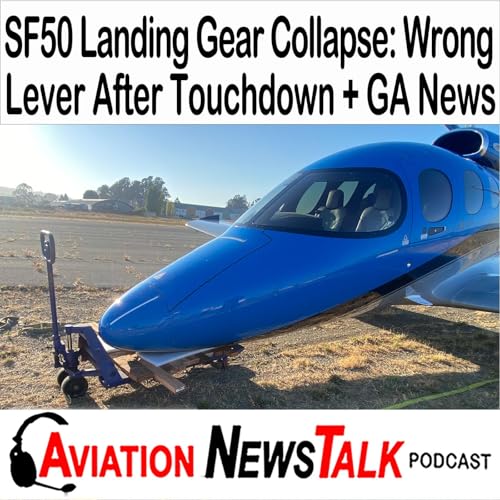
  • 411 Vision Jet SF50 Landing Gear Collapse: Wrong Lever After Touchdown +GA News
    Jan 24 2026
    Max talks with Rob Mark about a classic "simple mistake with big consequences" scenario: a pilot who possibly raised the landing gear handle instead of selecting flaps up during the landing roll in a Cirrus Vision Jet. The event looks minor on the surface—no injuries and the airplane stayed on the runway—but it exposes a human-factors trap that can bite any retractable-gear pilot, especially when you're trying to be quick and efficient right after touchdown. The discussion centers on the NTSB's final report for a Cirrus SF50 Vision Jet that landed at Watsonville Municipal Airport (Watsonville, California) on August 9, 2024. The pilot reported a normal approach and landing. Before touchdown, he had the flaps set to 100% and saw three green landing gear indications. Touchdown itself was uneventful. But during the landing roll—right about when braking began—the nose landing gear collapsed. Max and Rob walk through what the data showed. On short final, the airplane was properly configured: flaps at 100% and the landing gear down and locked. During rollout, both weight-on-wheels switches were briefly "unloaded," and the landing gear handle was raised and then lowered. That sequence unlocked the nose gear and allowed it to collapse. The main gear also unlocked, but it re-locked before collapsing. The probable cause boiled down to an inadvertent control selection: the pilot likely moved the gear handle instead of selecting the flap switch to 0%. From there, they unpack why this kind of error is so believable. The flap selector switch sits below the landing gear handle, and many pilots develop a post-touchdown habit of "cleaning up" quickly. Some of that comes from short-field technique: retracting flaps can put more weight on the wheels, increase braking effectiveness, and reduce stopping distance. But the exact moment you're tempted to do it is also the moment you have the least spare attention. You're still fast, directional control still matters, braking is being modulated, and you're managing the transition from flight to rollout. Add fatigue, distraction, or a slightly different cockpit flow than usual, and a wrong-control grab becomes completely plausible. A big takeaway is that landing isn't over at touchdown. Many pilots subconsciously relax as soon as the mains touch, as if the hard part is done. In reality, the landing roll is when you still have a lot of kinetic energy and limited margin for distraction. Looking down, changing configuration, or reaching for cockpit controls before you're stabilized is how small errors turn into big repair bills. Max and Rob emphasize that "post-landing tasks" are optional until the airplane is clearly under control and slowing. So what should pilots do differently? Their answer is intentionally boring: slow the flow down. On most runways there is no operational need to rush flap retraction during rollout. Keep your eyes outside, keep the airplane tracking straight, and let speed decay. If you choose to retract flaps on rollout, treat it like a checklist item, not a reflex. Touch the correct control deliberately, verify what you're touching, and use a short verbal callout ("flaps zero") before you move it. Better yet, tie configuration changes to safer triggers—below taxi speed, after exiting the runway, or after stopping and running the after-landing checklist—so you're not doing "extra tasks" while still managing high speed and directional control. They also discuss building habits that are resistant to error. If your technique is "as soon as I touch down, I do X," you're training your hands to move before your brain has finished verifying the right target. Replace that with a pause that forces confirmation, or a flow that keeps critical controls physically and mentally separated in time. The goal isn't to be fast; it's to be consistent and correct. If you're getting value from this show, please support the show via PayPal, Venmo, Zelle or Patreon. Support the Show by buying a Lightspeed ANR Headsets Max has been using only Lightspeed headsets for nearly 25 years! I love their tradeup program that let's you trade in an older Lightspeed headset for a newer model. Start with one of the links below, and Lightspeed will pay a referral fee to support Aviation News Talk. Lightspeed Delta Zulu Headset $1299NEW – Lightspeed Zulu 4 Headset $1099 Lightspeed Zulu 3 Headset $949Lightspeed Sierra Headset $749 My Review on the Lightspeed Delta Zulu Send us your feedback or comments via email If you have a question you'd like answered on the show, let listeners hear you ask the question, by recording your listener question using your phone. News Stories ForeFlight and Jeppesen announce Layoffs AOPA asks pilots to contact Congress to Support PAPA FAA makes permanent restrictions for helicopters near DCA House passes bill that would block ATC privatizationReport Shows Rise in DPE Supply Super Bowl LX: What General Aviation Pilots Need to Know ...
    Show more Show less
    53 mins