• Belinda Bencic’s Backhand and the Real Demands of Clay Court Tennis
    Apr 6 2026

    Clay court tennis is often described as slower, but that simplification misses the deeper reality: the surface fundamentally reshapes how players manage space, construct points, and move through contact. In this episode, we break down the technical and tactical adjustments required to transition effectively from hard courts to clay.

    A central focus is movement—specifically the difference between sliding into the ball versus sliding after contact—and how this distinction impacts balance, recovery, and court positioning. Using Charleston as a reference point, we analyze players like Jessica Pegula and Madison Keys, whose games highlight the challenges of adapting to clay’s spatial demands.

    The episode also features a detailed examination of Belinda Bencic’s backhand. While biomechanically unconventional, her open-stance execution demonstrates how timing, efficiency, and discipline can outweigh traditional technique. We close by discussing Iga Świątek’s coaching change and what it could signal for the evolution of her already dominant clay-court identity.

    Send us Fan Mail

    Show more Show less
    1 hr and 15 mins
  • Jannik Sinner and the New Tactical Standard in Men’s Tennis
    Mar 30 2026

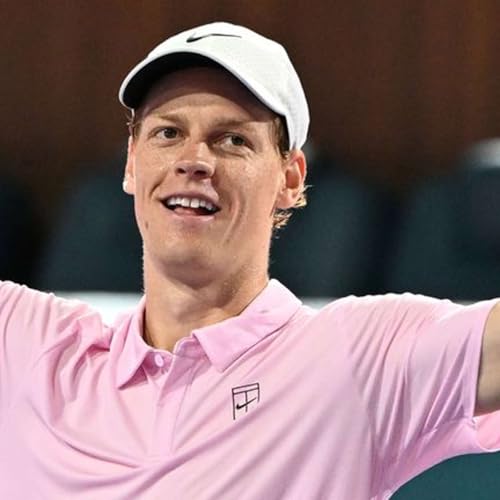
    Jannik Sinner’s Miami title completes a dominant Sunshine Double and reinforces his position—alongside Carlos Alcaraz—as one of the defining forces in men’s tennis. This episode examines not just the results, but the underlying mechanics of Sinner’s success: a blend of precise ball striking, improved serve efficiency, and real-time tactical adaptability that is reshaping what it takes to compete at the top level.

    The discussion centers on the increasing difficulty of constructing points against Sinner. Beating him now requires a layered approach—early redirection, controlled variation of pace, and well-timed net pressure. Even then, success depends on executing all three simultaneously. This framework helps explain why players like Alexander Zverev, with their physical durability and completeness, are among the few credible challengers.

    Beyond the top tier, the episode situates Sinner within a broader tour structure. A clear hierarchy is emerging: two front-runners, a veteran group still capable of disruption, and a tightening middle tier led by rising players like Arthur Fils. Looking ahead to clay, the conversation highlights the pressure dynamics shaping the next phase of the season.

    Send us Fan Mail

    Show more Show less
    1 hr and 20 mins
  • Coco Gauff, Aryna Sabalenka, and the Pressure of First-Strike Tennis
    Mar 29 2026

    This episode examines the evolving matchup between Coco Gauff and Aryna Sabalenka following Sabalenka’s Miami Open victory, using it as a lens to understand broader trends in the women’s game. Rather than framing Gauff as a player limited by technical inconsistencies, we position her as a uniquely constructed elite—an “overachieving counterpuncher” whose competitive resilience and adaptability allow her to consistently outperform the sum of her individual tools.

    In contrast, Sabalenka’s early-season form establishes her as the clear No. 1 force, defined by power, consistency, and improved composure. Yet this matchup reveals an asymmetric dynamic: Sabalenka must dictate and finish points, while Gauff thrives by extending rallies and creating discomfort. This places a subtle but meaningful psychological burden on Sabalenka, particularly in high-pressure moments.

    The conversation also explores the increasing depth of the WTA field, the instability beneath the top tier, and the tactical evolution of the modern game—especially the growing importance of return quality and the challenges of building reliable serve-plus-one patterns.

    Send us Fan Mail

    Show more Show less
    1 hr and 15 mins
  • Sebastian Korda’s Blueprint vs Carlos Alcaraz
    Mar 23 2026

    Sebastian Korda’s win over Carlos Alcaraz in Miami serves as more than a standout result—it offers a tactical framework for competing against one of the sport’s most explosive players. In this episode, we analyze how Korda’s controlled aggression, early ball striking, and refusal to concede court position disrupted Alcaraz’s first-strike patterns. The discussion frames Korda not as an outlier, but as a model for a specific, emerging player archetype.

    From there, the conversation broadens into the evolution of modern tennis. We examine how advancements in physicality and equipment are compressing time and space on court, and why the next wave of elite players may increasingly resemble this “take time away” profile. The idea of “stacking good days” is introduced as a development philosophy, connecting technical execution with psychological stability.

    The episode closes with a wider lens on the sport itself—questioning format structures, the entertainment value of doubles, and whether tennis is approaching its physical and technological ceiling. Throughout, the Korda-Alcaraz match remains the anchor point for a deeper discussion about where the game is heading.

    Send us Fan Mail

    Show more Show less
    1 hr and 20 mins
  • Alcaraz vs Fonseca, Świątek’s Confidence Dip, and Gauff’s Forehand Questions
    Mar 21 2026

    Carlos Alcaraz’s straight-set win over João Fonseca in Miami looks routine on paper, but the match offers a clearer view into the developmental gap between emerging talent and established elite. We break down what separates “competitive” from “threatening,” and why Fonseca’s current level should be evaluated with patience rather than projection.

    The conversation then shifts to Iga Świątek, who openly acknowledged her struggles following a three-set loss. We examine the tactical and psychological patterns behind her recent results, including how matches shift once opponents extend rallies and disrupt her early intensity.

    Finally, we take a detailed look at Coco Gauff’s forehand—specifically the interaction between grip, footwork, spacing, and court positioning. Rather than treating it as a single technical flaw, we outline the structural adjustments required for long-term stability at the highest level.

    Send us Fan Mail

    Show more Show less
    58 mins
  • Sabalenka vs Rybakina and the Tactical Hierarchy Emerging After Indian Wells
    Mar 16 2026

    Indian Wells offered more than just two championship matches — it provided a revealing snapshot of how the tactical hierarchy of professional tennis is evolving.

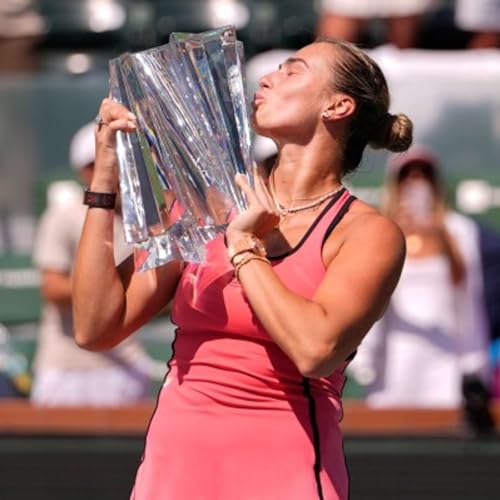
    In the women’s final, Aryna Sabalenka’s victory over Elena Rybakina became a study in modern power rivalries. Both players generate elite pace and serve at the highest level, yet they apply pressure in fundamentally different ways. Sabalenka compresses time by striking early and relentlessly, forcing opponents into rushed decisions. Rybakina, by contrast, expands the court with depth and geometry, reclaiming time through positioning and controlled aggression. Their final ultimately turned on conditioning, clutch serving, and the ability to execute deep in the third set under extreme conditions.

    On the men’s side, Jannik Sinner’s win over Daniil Medvedev reinforced his continued evolution into one of the tour’s most consistent pressure players. The discussion also revisits Medvedev’s resurgence during the event, including the tactical discipline that allowed him to disrupt Carlos Alcaraz earlier in the tournament. The larger takeaway from Indian Wells: increasingly, it is clearly defined tactical identities — not just talent — that are determining who rises to the top of the sport.

    Send us Fan Mail

    Show more Show less
    1 hr and 9 mins
  • Jannik Sinner vs João Fonseca — and the Pressure on Carlos Alcaraz
    Mar 12 2026

    Recorded during the middle of the Indian Wells tournament, this episode explores one of the most overlooked tactical questions in modern tennis: where should players actually stand on the court relative to their skill sets?

    Alvin Owusu and Torrey Hawkins begin with a coaching-level discussion of court positioning and time management. The ability to take the ball on the rise is often described as aggressive tennis, but the hosts explain that it is more accurately a product of swing efficiency, foot speed, and the ability to generate pace quickly. Using examples from the WTA Tour—including Jessica Pegula and Emma Raducanu—they illustrate how mechanics and leverage determine whether players can hold the baseline against elite opponents.

    The conversation then turns to current matches in Indian Wells, including Jannik Sinner’s win over João Fonseca. While Fonseca ultimately lost the match, the hosts discuss why the performance signaled legitimate top-tier potential. They also examine Sinner’s increasing willingness to take offensive risks in order to shorten physical matches against the sport’s best competitors.

    Finally, the episode closes with a discussion of Carlos Alcaraz and the psychological shift that occurs once a player becomes world No. 1. The challenge is no longer just winning matches—it is learning to carry the target that comes with being the benchmark for the entire sport.

    Send us Fan Mail

    Show more Show less
    1 hr and 3 mins
  • Jean-Yves Aubone on Intense Tennis and the Push to Modernize Professional Tennis
    Mar 8 2026

    In this episode of the Best of Three podcast, Alvin Owusu and Torrey Hawkins sit down with Jean-Yves Aubone, Director of Player & Coach Relations for the Intense Tennis League. The conversation explores why a new format has emerged in response to longstanding structural challenges within professional tennis—from declining viewership to fragmented governance and unpredictable match scheduling.

    Aubone explains how Intense Tennis is designed to create a more accessible and entertainment-focused experience. Matches are capped at roughly 70 minutes and feature a shot clock, music during play, simplified scoring, and a unique rule where clean winners count for two points. The league also introduces in-match substitutions, fundamentally altering the strategic role of coaches and opening the door to new tactical possibilities.

    The discussion also examines how the format may reward a different player archetype—aggressive, versatile shot-makers capable of generating scoring bursts across singles, doubles, and mixed formats. More broadly, the group considers whether team identity and community engagement could help tennis develop deeper fan loyalty in the future.


    Send us Fan Mail

    Show more Show less
    1 hr and 15 mins