• Reflexiones Católicas – viernes 03 de abril de 2026, Viernes Santo, Juan 18:1-19:42
    Apr 1 2026

    El viernes 03 de abril de 2026, conmemoramos el Viernes Santo, un día solemne en el calendario litúrgico católico. La lectura del Evangelio de hoy es de Juan 18:1-19:42, que narra la Pasión de nuestro Señor Jesucristo. Este pasaje describe con detalle el arresto de Jesús, su juicio ante el sumo sacerdote y el inicio de su camino hacia la cruz. Es una reflexión profunda sobre el sacrificio y el amor en obediencia a la voluntad del Padre.


    Reflexiones Católicas – La Pasión del Señor

    Fecha: Viernes 3 de abril de 2026

    Litúrgico: Semana Santa, Viernes Santo

    Esquema:

    • Oración inicial

    • Lectura del Evangelio (parafraseada para la reflexión)

    • Puntos clave

    • Oración final

    • Etiquetas

    Evangelio – Juan 18,1–19,42 (parafraseado):

    Jesús fue con sus discípulos a un huerto donde solía orar. Judas, que conocía el lugar, llegó con soldados y guardias para arrestarlo. Jesús dio un paso al frente voluntariamente y se identificó, permitiendo que lo prendieran mientras protegía a sus discípulos.

    Pedro intentó defenderlo con una espada, pero Jesús lo detuvo, eligiendo aceptar el sufrimiento dado por el Padre. Luego Jesús fue llevado ante el sumo sacerdote y fue interrogado. Mientras tanto, Pedro negó conocerlo tres veces.

    Jesús fue llevado ante Pilato. Aunque Pilato no encontró culpa en Él, la multitud exigió su crucifixión. Jesús habló de su reino como no perteneciente a este mundo y afirmó que había venido para dar testimonio de la verdad.

    Pilato, presionado por la multitud, lo entregó. Fue burlado, coronado de espinas y condenado a muerte. Cargando su cruz, Jesús fue al Gólgota, donde fue crucificado entre otros dos.

    Desde la cruz, Jesús confió a su madre al discípulo amado y expresó su sed. Luego, declarando que todo estaba cumplido, entregó su espíritu. En su muerte se cumplieron las Escrituras, y su costado fue traspasado, de donde brotaron sangre y agua.

    Después de su muerte, José de Arimatea y Nicodemo tomaron su cuerpo, lo envolvieron con aromas y lo colocaron en un sepulcro nuevo cercano.

    Puntos clave:

    1. Jesús se entrega libremente

    No es forzado—elige la Cruz por amor y obediencia.

    2. El reino de la verdad

    Jesús revela un reino que no es de este mundo, fundamentado en la verdad y el amor.

    3. La debilidad y el miedo humanos

    Pedro niega a Jesús y la multitud se vuelve contra Él—recordándonos nuestras propias luchas.

    4. La Cruz como cumplimiento

    Todo sucede según el plan de salvación de Dios.

    5. Amor incluso en el sufrimiento

    Jesús cuida de su madre y de otros incluso mientras está en la Cruz.

    6. «Todo está cumplido»

    La obra de la salvación se completa—Jesús lo entrega todo por nosotros.

    Oración final:

    Señor Jesús,

    en este Viernes Santo,

    nos colocamos ante tu Cruz en silencio y gratitud.

    Tú te entregaste completamente por nuestra salvación,

    cargando nuestros pecados y sufrimientos con amor.

    Ayúdanos a comprender la profundidad de tu sacrificio,

    a apartarnos del pecado

    y a vivir en la verdad que nos revelaste.

    Enséñanos a cargar nuestras cruces con fe,

    a confiar en la voluntad del Padre

    y a amar incluso en los momentos de sufrimiento.

    Que nunca olvidemos lo que has hecho por nosotros,

    y que te sigamos fielmente,

    desde la Cruz hasta la alegría de la Resurrección.

    Amén.

    Etiquetas: Católica, Viernes Santo, Semana Santa, Pasión de Cristo, Juan 18, Juan 19, Cruz, Crucifixión, Jesús, Pilato, Pedro, Judas, Salvación, Sacrificio, Amor, Redención, Cuaresma, Resurrección, Evangelio del día, Podcast católico, Reflexiones Católicas


    Show more Show less
    22 mins
  • Catholic Reflections – Friday 03 April 2026, Good Friday, John 18:1-19:42
    Apr 1 2026

    On Friday, 03 April 2026, we commemorate Good Friday, a solemn day in the Catholic liturgical calendar. Today’s Gospel reading is from John 18:1-19:42, which recounts the Passion of our Lord Jesus Christ. This passage vividly describes Jesus' arrest, His trial before the high priest, and the beginning of His journey to the cross. It is a powerful reflection on sacrifice and love in obedience to the Father’s will.


    Catholic Reflections – The Passion of the Lord

    Date: Friday 03 April 2026

    Liturgical: Holy Week, Good Friday

    Outline:

    • Opening prayer

    • Gospel reading (paraphrased for reflection)

    • Key points

    • Concluding prayer

    • Tags

    Gospel – John 18:1–19:42 (paraphrased):

    Jesus went with His disciples to a garden where He was often accustomed to pray. Judas, knowing the place, arrived with soldiers and officials to arrest Him. Jesus stepped forward willingly and identified Himself, allowing Himself to be taken while protecting His disciples.

    Peter tried to defend Him with a sword, but Jesus stopped him, choosing to accept the suffering given by the Father. Jesus was then taken before the high priest and questioned. Meanwhile, Peter denied knowing Him three times.

    Jesus was brought before Pilate. Though Pilate found no guilt in Him, the crowd demanded His crucifixion. Jesus spoke of His kingdom as not belonging to this world and affirmed that He came to bear witness to the truth.

    Pilate, pressured by the crowd, handed Jesus over. He was mocked, crowned with thorns, and condemned to death. Carrying His cross, Jesus went to Golgotha, where He was crucified between two others.

    From the cross, Jesus entrusted His mother to the beloved disciple and expressed His thirst. Then, declaring that all was fulfilled, He gave up His spirit. At His death, Scripture was fulfilled, and His side was pierced, from which flowed blood and water.

    After His death, Joseph of Arimathea and Nicodemus took His body, wrapped it with spices, and placed it in a new tomb nearby.

    Key Points:

    1. Jesus freely gives Himself

    He is not forced—He chooses the Cross out of love and obedience.

    2. The kingdom of truth

    Jesus reveals a kingdom not of this world, rooted in truth and love.

    3. Human weakness and fear

    Peter denies Jesus, and the crowd turns against Him—reminding us of our own struggles.

    4. The Cross as fulfilment

    Everything happens according to God’s plan of salvation.

    5. Love even in suffering

    Jesus cares for His mother and others even while on the Cross.

    6. “It is finished”

    The work of salvation is completed—Jesus gives everything for us.

    Concluding Prayer:

    Lord Jesus,

    on this Good Friday,

    we stand before Your Cross in silence and gratitude.

    You gave Yourself completely for our salvation,

    bearing our sins and suffering with love.

    Help us to understand the depth of Your sacrifice,

    to turn away from sin,

    and to live in the truth You revealed.

    Teach us to carry our crosses with faith,

    to trust in the Father’s will,

    and to love even in times of suffering.

    May we never forget what You have done for us,

    and may we follow You faithfully,

    from the Cross to the joy of the Resurrection.

    Amen.

    Tags: Catholic, Good Friday, Holy Week, Passion of Christ, John 18, John 19, Cross, Crucifixion, Jesus, Pilate, Peter, Judas, Salvation, Sacrifice, Love, Redemption, Lent, Resurrection, Daily Gospel, Catholic Podcast, Catholic Reflections


    Show more Show less
    18 mins
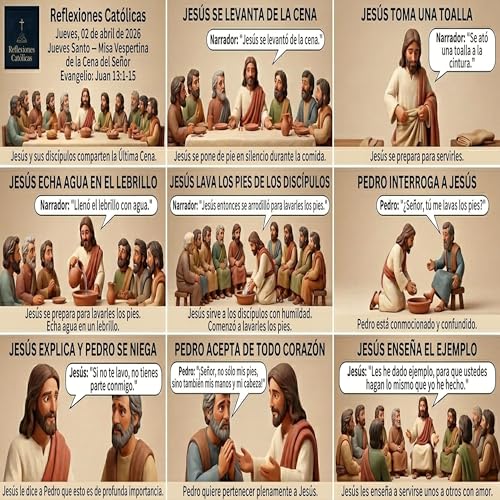
  • Reflexiones Católicas – jueves 02 de abril de 2026, Jueves Santo, Juan 13:1-15
    Apr 1 2026

    El jueves 02 de abril de 2026, reflexionamos sobre el Jueves Santo y el Evangelio de Juan 13:1-15. En este pasaje, Jesús muestra un gran amor a sus discípulos al lavarles los pies con humildad, enseñándoles a servirse unos a otros con amor. Es un recordatorio poderoso de la humildad y el servicio desinteresado en el centro del discipulado cristiano.


    Reflexiones Católicas – Los amó hasta el extremo

    Fecha: Jueves 2 de abril de 2026

    Litúrgico: Semana Santa, Jueves Santo, lecturas para la Misa vespertina de la Cena del Señor

    Esquema:

    • Oración inicial

    • Lectura del Evangelio (palabra por palabra)

    • Reflexión sobre el amor, la humildad y el servicio

    • Puntos clave para el Jueves Santo

    • Oración final

    • Etiquetas

    Evangelio: Juan 13,1-15

    Los amó hasta el extremo.

    Antes de la fiesta de la Pascua, sabiendo Jesús que había llegado su hora de pasar de este mundo al Padre, habiendo amado a los suyos que estaban en el mundo, los amó hasta el extremo.

    Durante la cena, cuando el diablo ya había puesto en el corazón de Judas Iscariote, hijo de Simón, la intención de traicionarlo, Jesús, sabiendo que el Padre había puesto todo en sus manos y que había salido de Dios y a Dios volvía, se levantó de la mesa.

    Se quitó el manto, tomó una toalla y se la ató a la cintura. Luego echó agua en una jofaina y se puso a lavar los pies de los discípulos y a secárselos con la toalla que llevaba atada.

    Llegó a Simón Pedro, quien le dijo: «Señor, ¿lavarme tú a mí los pies?». Jesús le respondió: «Lo que yo hago, tú no lo entiendes ahora; lo comprenderás después».

    Pedro le dijo: «No me lavarás los pies jamás». Jesús le respondió: «Si no te lavo, no tendrás parte conmigo».

    Simón Pedro le dijo: «Señor, no solo los pies, sino también las manos y la cabeza».

    Jesús le dijo: «El que se ha bañado no necesita lavarse más que los pies, porque todo él está limpio. Y vosotros estáis limpios, aunque no todos».

    Sabía quién lo iba a traicionar; por eso dijo: «No todos estáis limpios».

    Cuando terminó de lavarles los pies, se puso el manto, volvió a la mesa y les dijo: «¿Comprendéis lo que he hecho con vosotros? Vosotros me llamáis Maestro y Señor, y decís bien, porque lo soy.

    Pues si yo, el Señor y el Maestro, os he lavado los pies, también vosotros debéis lavaros los pies unos a otros. Os he dado ejemplo, para que también vosotros hagáis como yo he hecho con vosotros».

    Puntos clave:

    1. Amor hasta el extremo

    El amor de Jesús es completo, fiel y entregado—incluso frente a la traición.

    2. La humildad de Cristo

    El Señor se hace siervo. La verdadera grandeza se encuentra en el servicio humilde.

    3. El servicio es el camino del discipulado

    Jesús nos manda no solo admirar su ejemplo, sino imitarlo.

    4. Dejar que Jesús nos sirva

    Pedro tuvo que aceptar ser servido. Primero debemos recibir la gracia de Dios antes de poder darla.

    5. Corazones limpios, renovados cada día

    Incluso quienes pertenecen a Cristo necesitan purificación y conversión continua.

    6. El amor expresado en acción

    Lavar los pies es el amor hecho visible—práctico, humilde y personal.

    Oración final:

    Señor Jesús,

    Tú nos amaste hasta el extremo

    y mostraste ese amor a través del servicio humilde.

    Enséñanos a seguir tu ejemplo—

    a servir sin orgullo,

    a amar sin contar el costo,

    y a entregarnos por los demás.

    Limpia nuestros corazones

    y ayúdanos a recibir tu gracia con humildad.

    Luego envíanos a servir,

    para que nuestras vidas reflejen tu amor.

    En esta Semana Santa,

    mantennos cerca de Ti,

    para que caminemos contigo en el amor,

    a través de la Cruz y hacia la vida nueva.

    Amén.

    Etiquetas: Católica, Semana Santa, Jueves Santo, Última Cena, Lavatorio de los pies, Juan 13, Servicio, Humildad, Amor hasta el extremo, Discipulado, Eucaristía, Caridad, Conversión, Jesús sirve, Fe, Evangelio del día, Podcast católico, Reflexiones Católicas


    Show more Show less
    15 mins
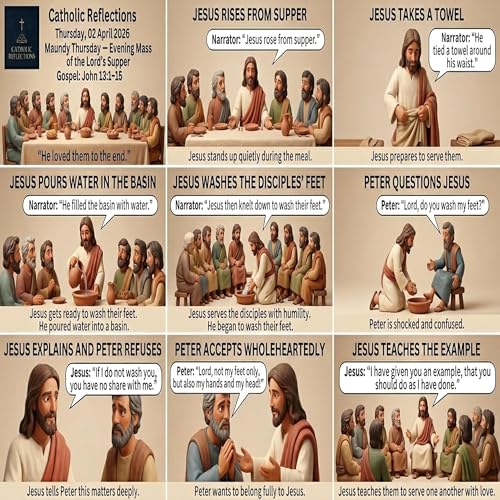
  • Catholic Reflections – Thursday 02 April 2026, Maundy Thursday, John 13:1-15
    Apr 1 2026

    On Thursday, 02 April 2026, we reflect on Maundy Thursday and the Gospel reading from John 13:1-15. This passage highlights Jesus’ great love for his disciples as he humbly washes their feet, teaching them to serve one another in love. It is a powerful reminder of humility and selfless service at the heart of Christian discipleship.


    Catholic Reflections – He Loved Them to the End

    Date: Thursday 02 April 2026

    Liturgical: Holy Week, Maundy Thursday, readings for the evening Mass of the Lord’s Supper

    Outline:

    • Opening prayer

    • Gospel reading (word for word)

    • Reflection on love, humility, and service

    • Key points for Holy Thursday

    • Concluding prayer

    • Tags

    Gospel: John 13:1-15

    He loved them to the end.

    Before the Feast of the Passover, when Jesus knew that his hour had come to depart out of this world to the Father, having loved his own who were in the world, he loved them to the end. During supper, when the devil had already put it into the heart of Judas Iscariot, Simon’s son, to betray him, Jesus, knowing that the Father had given all things into his hands, and that he had come from God and was going back to God, rose from supper. He laid aside his outer garments, and taking a towel, tied it round his waist. Then he poured water into a basin and began to wash the disciples’ feet and to wipe them with the towel that was wrapped round him. He came to Simon Peter, who said to him, ‘Lord, do you wash my feet?’ Jesus answered him, ‘What I am doing you do not understand now, but afterwards you will understand.’ Peter said to him, ‘You shall never wash my feet.’ Jesus answered him, ‘If I do not wash you, you have no share with me.’ Simon Peter said to him, ‘Lord, not my feet only but also my hands and my head!’ Jesus said to him, ‘The one who has bathed does not need to wash, except for his feet, but is completely clean. And you are clean, but not every one of you.’ For he knew who was to betray him; that was why he said, ‘Not all of you are clean.’

    When he had washed their feet and put on his outer garments and resumed his place, he said to them, ‘Do you understand what I have done to you? You call me Teacher and Lord, and you are right, for so I am. If I then, your Lord and Teacher, have washed your feet, you also ought to wash one another’s feet. For I have given you an example, that you also should do just as I have done to you.’

    Key Points:

    1. Love to the very end

    Jesus’ love is complete, faithful, and self-giving—even in the face of betrayal.

    2. Humility of Christ

    The Lord becomes a servant. True greatness is found in humble service.

    3. Service is the path of discipleship

    Jesus commands us not just to admire His example, but to imitate it.

    4. Allowing Jesus to serve us

    Peter had to accept being served. We must first receive God’s grace before we can give it.

    5. Clean hearts, renewed daily

    Even those who belong to Christ need continual purification and conversion.

    6. Love expressed in action

    Washing feet is love made visible—practical, humble, and personal.

    Concluding Prayer:

    Lord Jesus,

    You loved us to the end,

    and showed that love through humble service.

    Teach us to follow Your example—

    to serve without pride,

    to love without counting the cost,

    and to give ourselves for others.

    Wash our hearts clean,

    and help us to receive Your grace with humility.

    Then send us out to serve,

    so that our lives may reflect Your love.

    In this Holy Week,

    keep us close to You,

    that we may walk with You in love,

    through the Cross and into new life.

    Amen.

    Tags: Catholic, Holy Week, Maundy Thursday, Last Supper, Washing of the Feet, John 13, Service, Humility, Love to the End, Discipleship, Eucharist, Charity, Conversion, Jesus Serves, Faith, Daily Gospel, Catholic Podcast, Catholic Reflections


    Show more Show less
    18 mins
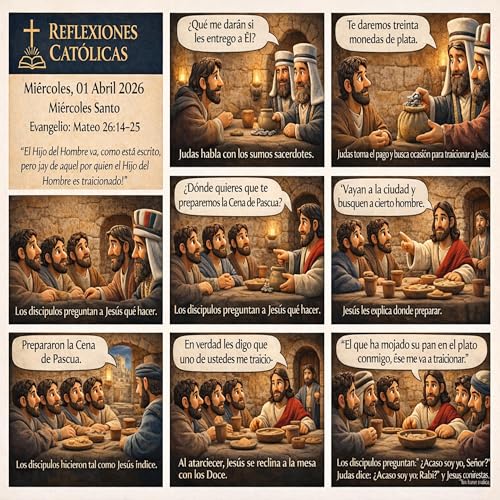
  • Reflexiones Católicas – miércoles 01 abril 2026, miércoles de la Semana Santa, Mateo 26:14-25
    Mar 31 2026

    El miércoles 01 de abril de 2026, miércoles de la Semana Santa, reflexionamos sobre Mateo 26:14-25. Este pasaje revela la traición de Judas Iscariote a Jesús, cumpliéndose lo escrito sobre el Hijo del Hombre. Jesús se prepara para celebrar la Pascua con sus discípulos, advirtiendo que uno de ellos lo entregará. Es un momento solemne que destaca la traición y los acontecimientos que conducen a la Pasión.


    Reflexiones Católicas – ¿Soy yo, Señor?

    Fecha: Miércoles 1 de abril de 2026

    Litúrgico: Miércoles de Semana Santa

    Esquema:

    • Oración inicial

    • Lectura del Evangelio (parafraseada para facilitar la escucha)

    • Reflexión sobre la traición, el examen de conciencia y la fidelidad

    • Puntos clave para la Semana Santa

    • Oración final

    • Etiquetas

    Evangelio: Mateo 26,14-25

    Texto del Evangelio:

    «El Hijo del hombre se va, según está escrito de él, pero ¡ay de aquel por quien es entregado!».

    En aquel tiempo: Uno de los Doce, llamado Judas Iscariote, fue a los sumos sacerdotes y dijo: «¿Qué me queréis dar si os lo entrego?». Ellos le ofrecieron treinta monedas de plata. Y desde entonces buscaba una oportunidad para entregarlo.

    El primer día de los Ácimos, los discípulos se acercaron a Jesús y le dijeron: «¿Dónde quieres que te preparemos la cena de Pascua?». Él respondió: «Id a la ciudad, a casa de cierto hombre, y decidle: “El Maestro dice: Mi tiempo está cerca; voy a celebrar la Pascua en tu casa con mis discípulos”». Los discípulos hicieron como Jesús les había mandado y prepararon la Pascua.

    Al atardecer, se puso a la mesa con los Doce. Y mientras comían, dijo: «En verdad os digo que uno de vosotros me va a traicionar».

    Ellos, muy entristecidos, comenzaron a decirle uno tras otro: «¿Soy yo, Señor?».

    Él respondió: «El que ha mojado conmigo la mano en el plato, ese me va a traicionar. El Hijo del hombre se va, según está escrito de él, pero ¡ay de aquel por quien es entregado el Hijo del hombre! Más le valdría a ese hombre no haber nacido».

    Entonces Judas, el que lo iba a entregar, dijo: «¿Soy yo, Rabí?». Jesús le respondió: «Tú lo has dicho».

    Puntos clave:

    1. La traición puede venir desde dentro

    Judas era uno de los Doce. Incluso los más cercanos a Jesús pueden apartarse.

    2. La llamada al examen de conciencia

    «¿Soy yo, Señor?». Cada discípulo mira hacia su interior. El verdadero discipulado requiere honestidad sobre nuestro propio corazón.

    3. El plan de Dios y la libertad humana

    Jesús cumple lo que está escrito, pero cada persona sigue siendo responsable de sus decisiones.

    4. El peligro del pecado oculto

    Judas camina con Jesús externamente, pero su corazón ya se ha apartado.

    5. Permanecer cerca de Jesús

    La Semana Santa nos invita a permanecer fieles, no distantes ni divididos en el corazón.

    Oración final:

    Señor Jesús,

    escudriña nuestros corazones

    y revela todo aquello que nos aleja de Ti.

    Danos la humildad para preguntar:

    «¿Soy yo, Señor?»

    y la valentía para cambiar.

    Protégennos de la traición,

    del pecado oculto,

    y de apartarnos de tu amor.

    Mantennos fieles en esta Semana Santa,

    cerca de Ti en cada momento,

    para que podamos caminar contigo

    a través de la Cruz hacia la vida nueva.

    Amén.

    Etiquetas: Católica, Semana Santa, Miércoles de Semana Santa, Mateo 26, Judas Iscariote, Traición, Última Cena, Examen de conciencia, ¿Soy yo, Señor?, Fidelidad, Pecado, Conversión, Discipulado, Pasión, Cuaresma, Evangelio del día, Podcast católico, Reflexiones Católicas


    Show more Show less
    6 mins
  • Catholic Reflections – Wednesday 01 April 2026, Wednesday of Holy Week, Matthew 26:14-25
    Mar 31 2026

    On Wednesday, 01 April 2026, Wednesday of Holy Week, we reflect on Matthew 26:14-25. This passage reveals Judas Iscariot's betrayal of Jesus, fulfilling what was written about the Son of Man. Jesus prepares to celebrate the Passover with his disciples, warning that one among them will betray him. It is a somber moment that highlights the betrayal and the unfolding events leading to the Passion.


    Catholic Reflections – Not I, Lord?

    Date: Wednesday 01 April 2026

    Liturgical: Wednesday of Holy Week

    Outline:

    • Opening prayer

    • Gospel reading (paraphrased for easy listening)

    • Reflection on betrayal, self-examination, and fidelity

    • Key points for Holy Week

    • Concluding prayer

    • Tags

    Gospel: Matthew 26:14-25

    Gospel Text:

    ‘The Son of Man goes as it is written of him, but woe to him by whom he is betrayed.’

    At that time: One of the Twelve, whose name was Judas Iscariot, went to the chief priests and said, ‘What will you give me if I deliver him over to you?’ And they paid him thirty pieces of silver. And from that moment he sought an opportunity to betray Jesus.

    Now on the first day of Unleavened Bread the disciples came to Jesus, saying, ‘Where would you have us prepare for you to eat the Passover?’ He said, ‘Go into the city to a certain man and say to him, “The Teacher says, My time is at hand. I will keep the Passover at your house with my disciples.” ’ And the disciples did as Jesus had directed them, and they prepared the Passover.

    When it was evening, he reclined at table with the Twelve. And as they were eating, he said, ‘Truly, I say to you, one of you will betray me.’ And they were very sorrowful and began to say to him one after another, ‘Not I, Lord?’ He answered, ‘He who has dipped his hand in the dish with me will betray me. The Son of Man goes as it is written of him, but woe to that man by whom the Son of Man is betrayed! It would have been better for that man if he had not been born.’ Judas, who would betray him, answered, ‘Not I, Rabbi?’ He said to him, ‘You have said so.’


    Key Points:

    1. Betrayal can come from within

    Judas was one of the Twelve. Even those closest to Jesus can turn away.

    2. The call to self-examination

    “Is it I, Lord?” Each disciple looks inward. True discipleship requires honesty about our own hearts.

    3. God’s plan and human freedom

    Jesus fulfils what is written, yet each person remains responsible for their choices.

    4. The danger of hidden sin

    Judas walks with Jesus outwardly, but his heart has already turned away.

    5. Stay close to Jesus

    Holy Week invites us to remain faithful, not distant or divided in heart.

    Concluding Prayer:

    Lord Jesus,

    search our hearts

    and reveal anything that leads us away from You.

    Give us the humility to ask,

    “Is it I, Lord?”

    and the courage to change.

    Protect us from betrayal,

    from hidden sin,

    and from turning away from Your love.

    Keep us faithful in this Holy Week,

    close to You in every moment,

    so that we may walk with You

    through the Cross and into new life.

    Amen.

    Tags: Catholic, Holy Week, Wednesday of Holy Week, Matthew 26, Judas Iscariot, Betrayal, Last Supper, Self-Examination, Is It I Lord, Faithfulness, Sin, Conversion, Discipleship, Passion, Lent, Daily Gospel, Catholic Podcast, Catholic Reflections


    Show more Show less
    4 mins
  • Reflexiones Católicas – martes 31 de marzo de 2026, martes de la Semana Santa, Juan 13:21-33, 36-38
    Mar 30 2026

    El martes 31 de marzo de 2026, martes de la Semana Santa, meditamos sobre el Evangelio de Juan 13:21-33, 36-38. En este pasaje, Jesús comparte con sus discípulos un momento profundo al revelar que uno de ellos lo va a traicionar. A pesar de la confusión y las fuertes declaraciones de fidelidad de Pedro, Jesús predice la negación de Pedro. Esta lectura nos invita a reflexionar sobre la debilidad humana y el amor profundo de Jesús, incluso en momentos de traición.


    Reflexiones Católicas – Traición y negación

    Fecha: Martes 31 de marzo de 2026

    litúrgico

    Litúrgico: Martes de Semana Santa

    Esquema:

    • Oración inicial

    • Lectura completa del Evangelio (palabra por palabra)

    • Puntos clave

    • Oración final

    • Etiquetas

    Evangelio – Juan 13,21–33.36–38 (lectura completa, palabra por palabra):

    «Uno de vosotros me va a traicionar… El gallo no cantará antes de que me hayas negado tres veces».

    En aquel tiempo: Jesús estaba reclinado a la mesa con sus discípulos. Se turbó en su espíritu y declaró: «En verdad, en verdad os digo: uno de vosotros me va a traicionar».

    Los discípulos se miraban unos a otros, sin saber de quién hablaba. Uno de sus discípulos, a quien Jesús amaba, estaba reclinado junto a Jesús. Simón Pedro le hizo una seña para que preguntara de quién hablaba. Entonces aquel discípulo, recostándose sobre el pecho de Jesús, le dijo: «Señor, ¿quién es?».

    Jesús respondió: «Es aquel a quien yo dé el bocado después de mojarlo». Y mojando el bocado, se lo dio a Judas, hijo de Simón Iscariote.

    Y después de tomar el bocado, Satanás entró en él. Entonces Jesús le dijo: «Lo que vas a hacer, hazlo pronto». Pero ninguno de los que estaban a la mesa entendió por qué se lo decía. Algunos pensaban que, como Judas tenía la bolsa, Jesús le decía: «Compra lo que necesitamos para la fiesta», o que diera algo a los pobres.

    Así que, después de tomar el bocado, salió inmediatamente. Y era de noche.

    Cuando salió, Jesús dijo: «Ahora es glorificado el Hijo del hombre, y Dios es glorificado en él. Si Dios es glorificado en él, también Dios lo glorificará en sí mismo, y lo glorificará enseguida. Hijitos, todavía estaré con vosotros un poco más. Me buscaréis, y como dije a los judíos, así os digo ahora a vosotros: “Adonde yo voy, vosotros no podéis venir”».

    Simón Pedro le dijo: «Señor, ¿a dónde vas?». Jesús le respondió: «Adonde yo voy no puedes seguirme ahora, pero me seguirás después».

    Pedro le dijo: «Señor, ¿por qué no puedo seguirte ahora? Daré mi vida por ti».

    Jesús respondió: «¿Darás tu vida por mí? En verdad, en verdad te digo: el gallo no cantará antes de que me hayas negado tres veces».

    Puntos clave:

    1. Jesús conoce el corazón humano

    Incluso en la traición, Jesús permanece sereno y en control, consciente de todo lo que va a suceder.

    2. La oscuridad entra silenciosamente

    Judas sale—y «era de noche». El pecado suele comenzar con pequeñas decisiones que llevan a la oscuridad.

    3. La gloria de Dios a través del sufrimiento

    Jesús habla de gloria en el mismo momento en que comienza la traición. La Cruz no es derrota, sino gloria.

    4. La debilidad humana es real

    5. Esperanza más allá del fracaso

    Oración final:

    Señor Jesús,

    Tú ves completamente nuestros corazones—

    nuestro amor, nuestra debilidad y nuestras luchas.

    Protégennos del camino de la traición,

    y fortalécenos cuando seamos tentados a caer.

    Cuando confiemos en nosotros mismos,

    enséñanos la humildad y la confianza en Ti.

    Si fallamos como Pedro,

    danos la gracia de volver con arrepentimiento y amor.

    Sácanos de la oscuridad hacia tu luz,

    y mantenos siempre cerca de Ti.

    En esta Semana Santa,

    ayúdanos a permanecer fieles,

    vigilantes y llenos de confianza en tu misericordia.

    Amén.

    Etiquetas: Católica, Semana Santa, Martes de Semana Santa, Juan 13, Última Cena, Judas, Pedro, Traición, Negación, Fe, Debilidad, Misericordia, Conversión, Luz y oscuridad, Discipulado, Pasión, Evangelio del día, Podcast católico, Reflexiones Católicas

    Show more Show less
    5 mins
  • Catholic Reflections – Tuesday 31 March 2026, Tuesday of Holy Week, John 13:21-33, 36-38
    Mar 30 2026

    On Tuesday, 31 March 2026, which is Tuesday of Holy Week, we reflect on the Gospel of John 13:21-33, 36-38. In this passage, Jesus shares a poignant moment with his disciples, revealing that one of them will betray him. Despite their confusion and Peter’s bold declarations of loyalty, Jesus foretells Peter’s denial. This scripture invites us to reflect on human weakness and the profound love Jesus shows even in moments of betrayal.


    Catholic Reflections – Betrayal and Denial

    Date: Tuesday 31 March 2026

    liturgical

    Liturgical: Tuesday of Holy Week

    Outline:

    • Opening prayer

    • Full Gospel reading (word for word)

    • Key points

    • Concluding prayer

    • Tags

    Gospel – John 13:21–33, 36–38 (full reading, word for word):

    ‘One of you will betray me… The cock will not crow till you have denied me three times.’

    At that time: Jesus was reclining at table with his disciples. He was troubled in his spirit, and testified, ‘Truly, truly, I say to you, one of you will betray me.’ The disciples looked at one another, uncertain of whom he spoke. One of his disciples, whom Jesus loved, was reclining at table at the side of Jesus, so Simon Peter motioned to him to ask Jesus of whom he was speaking. So that disciple, leaning back against Jesus, said to him, ‘Lord, who is it?’ Jesus answered, ‘It is he to whom I will give this morsel of bread when I have dipped it.’ So when he had dipped the morsel, he gave it to Judas, the son of Simon Iscariot. Then after he had taken the morsel, Satan entered into him. Jesus said to him, ‘What you are going to do, do quickly.’ Now no one at the table knew why he said this to him. Some thought that, because Judas had the money bag, Jesus was telling him, ‘Buy what we need for the feast’, or that he should give something to the poor. So, after receiving the morsel of bread, he immediately went out. And it was night.

    When he had gone out, Jesus said, ‘Now is the Son of Man glorified, and God is glorified in him. If God is glorified in him, God will also glorify him in himself, and glorify him at once. Little children, yet a little while I am with you. You will seek me, and just as I said to the Jews, so now I also say to you, “Where I am going you cannot come.” ’

    Simon Peter said to him, ‘Lord, where are you going?’ Jesus answered him, ‘Where I am going you cannot follow me now, but you will follow afterwards.’ Peter said to him, ‘Lord, why can I not follow you now? I will lay down my life for you.’ Jesus answered, ‘Will you lay down your life for me? Truly, truly, I say to you, the cock will not crow till you have denied me three times.’

    Key Points:

    1. Jesus knows the human heart

    Even in betrayal, Jesus remains calm and in control, aware of all that is to come.

    2. Darkness enters quietly

    Judas leaves—and “it was night.” Sin often begins in small choices that lead into darkness.

    3. God’s glory through suffering

    Jesus speaks of glory at the very moment betrayal begins. The Cross is not defeat, but glory.

    4. Human weakness is real

    Peter’s confidence turns into denial. We too can fall when we rely only on ourselves.

    5. Hope beyond failure

    Jesus foretells Peter’s denial, but also his future following. Failure is not the end.

    Concluding Prayer:

    Lord Jesus,

    You see our hearts completely—

    our love, our weakness, and our struggles.

    Protect us from the path of betrayal,

    and strengthen us when we are tempted to fall.

    When we are confident in ourselves,

    teach us humility and trust in You.

    If we fail like Peter,

    give us the grace to return with repentance and love.

    Lead us out of darkness into Your light,

    and keep us close to You always.

    In this Holy Week,

    help us to remain faithful,

    watchful, and full of trust in Your mercy.

    Amen.

    Tags: Catholic, Holy Week, Tuesday of Holy Week, John 13, Last Supper, Judas, Peter, Betrayal, Denial, Faith, Weakness, Mercy, Conversion, Light and Darkness, Discipleship, Passion, Daily Gospel, Catholic Podcast, Catholic Reflections


    Show more Show less
    6 mins