Difference Makers Podcast By Hosts: Pete Upton Brian Edwards Elyse Wild | Producers: Native CDFI Network Tribal Business News cover art

Difference Makers

Difference Makers

By: Hosts: Pete Upton Brian Edwards Elyse Wild | Producers: Native CDFI Network Tribal Business News
Listen for free

Difference Makers is a podcast series from the Native CDFI Network and Tribal Business News that explores how Native community development financial institutions (CDFIs) are reshaping the future of tribal economies — one loan, one partnership, one bold idea at a time.


© 2026 Difference Makers
Economics Leadership Management & Leadership
Episodes
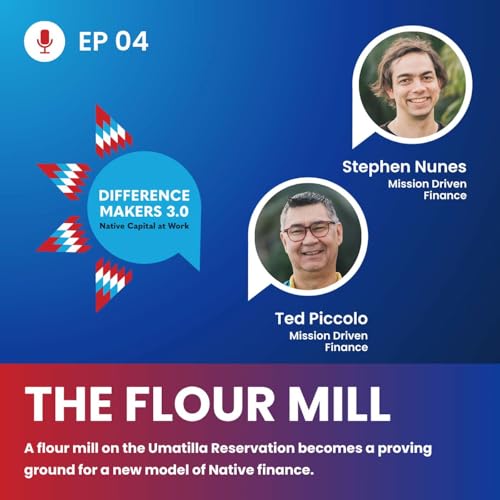
  • The Flour Mill
    Mar 26 2026

    Large-scale economic development deals in Indian Country are typically financed through complex capital stacks — combining banks, tax credits and outside investors — with Native CDFIs often left out.

    That may be starting to change.

    In Episode 4 of Difference Makers 3.0, Brian Edwards and Pete Upton speak with Ted Piccolo and Stephen Nunes of Mission Driven Finance about a $65 million flour mill project on the Umatilla Indian Reservation — and how Native CDFIs helped finance a critical piece of the deal.

    The Blue Mountain Mill project brought together tribal equity, senior debt from Native American Bank and a $9 million subordinated loan from eight Native CDFIs across the country.

    In this conversation, Piccolo and Nunes explain how that financing came together, why Native lenders were brought in early, and how a collaborative structure — what Piccolo calls a “capital weave” — could shape future Native-led projects.

    In this episode:

    • How eight Native CDFIs came together to finance a $9M gap in the capital stack
    • Why Native lenders have historically been left out of larger deals
    • How the “missing middle” can stall projects — and how it was filled
    • What a “capital weave” is — and how it works in practice
    • How participation builds capacity for Native CDFIs to take on larger deals
    • Why this model could extend to energy, infrastructure and other sectors

    Reading & Resources:

    🔗 Mission Driven Finance
    https://missiondrivenfinance.com

    🔗 Native CDFI Network
    https://nativecdfi.net

    🔗 Tribal Business News coverage of the Blue Mountain Mill
    https://tribalbusinessnews.com

    Difference Makers explores how Native community development financial institutions (CDFIs) are expanding economic opportunity across Indian Country. From small business lending and homeownership to consumer loans, financial education, and technical assistance, Native CDFIs provide the capital and support that help Native communities build stronger local economies.

    Join the Native CDFI Network and Tribal Business News as they spotlight the people, partnerships, and ideas driving economic change in Native communities.

    Show more Show less
    35 mins
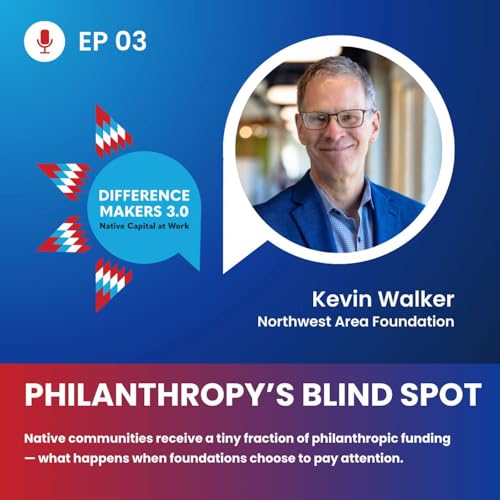
  • Philanthropy’s Blind Spot
    Mar 12 2026

    Native communities receive less than one-half of 1% of philanthropic funding in the United States — roughly four or five dollars for every thousand dollars foundations give away.

    In Episode 3 of Difference Makers 3.0, Brian Edwards speaks with Kevin Walker, President and CEO of the Northwest Area Foundation, about why Indian Country remains on the margins of mainstream philanthropy — and what changes when foundations choose to build deep relationships with Native communities.

    Under Walker’s leadership, Northwest Area Foundation made a public commitment that 40% of its grant dollars go to Native-led organizations — a level of sustained investment that stands out in the philanthropic sector.

    In this conversation, Walker reflects on how that decision emerged, what philanthropy often misunderstands about Indian Country, and why Native CDFIs represent one of the clearest opportunities for measurable economic impact.

    In this episode:

    • Why Native communities receive less than 0.5% of philanthropic funding
    • How NWAF committed to directing 40% of its grants to Native-led organizations
    • What philanthropy often gets wrong about Indian Country
    • The difference between a deficit mindset and an opportunity mindset
    • Why Native CDFIs are powerful drivers of local economic development
    • How foundations can move beyond land acknowledgments toward real accountability

    Reading & Resources:

    🔗 Northwest Area Foundation
    https://www.nwaf.org

    🔗 NWAF Native-led work approach
    https://www.nwaf.org/approach/native-led-work/

    🔗 NWAF strategy supporting Native CDFIs
    https://www.nwaf.org/approach/native-cdfis/

    🔗 Native CDFI Network
    https://nativecdfi.net

    Difference Makers explores how Native community development financial institutions (CDFIs) are expanding economic opportunity across Indian Country. From small business lending and homeownership to consumer loans, financial education, and technical assistance, Native CDFIs provide the capital and support that help Native communities build stronger local economies.

    Join the Native CDFI Network and Tribal Business News as they spotlight the people, partnerships, and ideas driving economic change in Native communities.

    Show more Show less
    32 mins
  • From Policy to Practice
    Feb 26 2026

    How Native CDFIs grew from federal study into a sovereign finance movement

    In 2001, the U.S. Treasury Department released the Native American Lending Study, identifying 17 structural barriers to capital access in Indian Country. The report helped catalyze what would become the modern Native CDFI movement.

    Fifteen years later, Treasury published a follow-up report, Access to Capital and Credit in Native Communities (2016), examining how the sector had evolved.

    In this episode of Difference Makers 3.0, researcher Miriam R. Jorgensen of the Harvard Project on Indigenous Governance and Development and the Native Nations Institute joins Brian Edwards and Pete Upton to discuss:

    • Why the 2001 study was pivotal
    • How Native CDFIs grew from roughly 10 institutions to nearly 70
    • Why capitalization remains a challenge
    • The role of tribal government investment
    • How Native CDFIs evolved from microloans to complex capital stacks
    • What happens if federal support changes

    🔗 Read the 2001 Native American Lending Study (U.S. Treasury PDF).

    🔗 Read the 2016 report, Access to Capital and Credit in Native Communities. Written by Miriam R. Jorgensen, Research Director at the Native Nations Institute and the Harvard Project on American Indian Economic Development. Funded by the U.S. Treasury’s Community Development Financial Institutions Fund, with additional support from the Morris K. and Stewart L. Udall Foundation.

    🎧 Listen now:
    https://www.buzzsprout.com/2352819/episodes/18718249

    Difference Makers explores how Native community development financial institutions (CDFIs) are expanding economic opportunity across Indian Country. From small business lending and homeownership to consumer loans, financial education, and technical assistance, Native CDFIs provide the capital and support that help Native communities build stronger local economies.

    Join the Native CDFI Network and Tribal Business News as they spotlight the people, partnerships, and ideas driving economic change in Native communities.

    Show more Show less
    31 mins
No reviews yet