Fire Science Show Podcast By Wojciech Wegrzynski cover art

Fire Science Show

Fire Science Show

By: Wojciech Wegrzynski
Listen for free

Fire Science Show is connecting fire researchers and practitioners with a society of fire engineers, firefighters, architects, designers and all others, who are genuinely interested in creating a fire-safe future. Through interviews with a diverse group of experts, we present the history of our field as well as the most novel advancements. We hope the Fire Science Show becomes your weekly source of fire science knowledge and entertainment. Produced in partnership with the Diamond Sponsor of the show - OFR Consultants© 2026 Fire Science Show Physics Science
Episodes
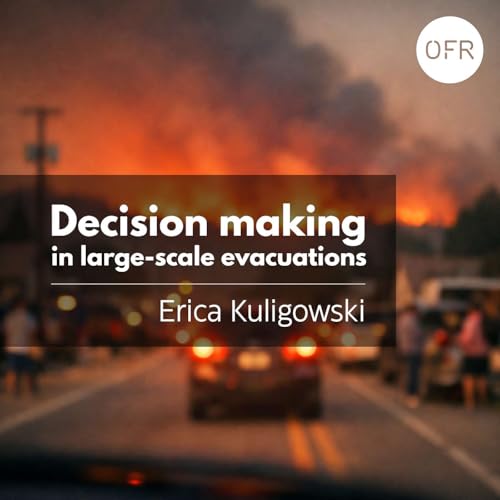
  • 244 - Decision making in large-scale evacuations with Erica Kuligowski
    Mar 25 2026

    When one takes a decision to evacuate and starts moving, this is not the end of their decision-making process.

    Which route to take? Who to contact? How to arrange a place of shelter? Where to go first? Have I forgotten anything?

    I previously discussed the decision-making with Erica Kuligowski from RMIT, and today we're meeting again to follow up on decision-making for large-scale evacuations. We focus on choices and uncertainties that make many of the evacuees take additional trips, and those trips become background traffic that interferes with your escape. In this episode, we dive deep into the decision making in this stage, the sources of data, and hypothesise how this knowledge could be used in practice.

    And of course, Erica being one of the leaders of the Human Behaviour in Fire community gives us a high level overview how this part of science looks like, and what is currently being researched.

    The HBiF conference we mentioned in the episode can be found here: https://humanbehaviourinfires.se/

    ----
    The Fire Science Show is produced by the Fire Science Media in collaboration with OFR Consultants. Thank you to the podcast sponsor for their continuous support towards our mission.

    Show more Show less
    1 hr and 6 mins
  • 243 - 20 Informal Settlement Fire Experiments with Sam Stevens
    Mar 18 2026

    A fire in an informal settlement is not just another small building fire. It can be the first domino in a fast-moving neighborhood event, and the little details like the wall material, roof material, door location, even a light breeze, can decide what happens next. I’m joined by Dr. Sam Stevens from Kindling to unpack a massive FSRI funded experimental program carried out in South Africa that burned twenty different informal and humanitarian shelter types to measure real heat flux, flame extension, and fire spread potential.

    We start repeating the uncomfortable gap: humanitarian guidance often relies on rules of thumb like a universal separation distance and vague advice to “use fire-resistant materials,” with little experimental evidence behind it. Sam explains how Kindling built a global database of shelter designs and materials, then narrowed it down to common typologies spanning sheet metal, mud, timber, bamboo mats, split bamboo, thatch, and tarpaulin tents. We dig into the field-scale test setup, why wood cribs were chosen, and how external instrumentation like thin skin calorimeters helps quantify the heat transfer that drives structure-to-structure ignition.

    Then we get into what the burns actually show. Non-combustible shelters often behave like classic compartment fires where openings dominate, but even modest wind can push flames meters outward. Add combustible walls or roofs and the hazard shifts dramatically: some materials produce short, intense exposure windows while others sustain burning long enough to threaten neighbors at greater distances. The fully thatched shelter stands out for extreme radiant heat and duration, and our discussion on tarpaulin tents reveals why common fire test methods can produce reassuring ratings that still miss real-world behavior.

    If you care about informal settlement fire safety, humanitarian shelter design, fire engineering guidance, or modeling large outdoor fires in dense communities, this conversation gives you a data-driven foundation and a clear sense of what questions still need answering.

    Learn more about the project and watch their educational videos here: https://kindlingsafety.org/projects/large-scale-fire-experiments-for-humanitarian-shelters/

    ----
    The Fire Science Show is produced by the Fire Science Media in collaboration with OFR Consultants. Thank you to the podcast sponsor for their continuous support towards our mission.

    Show more Show less
    1 hr and 12 mins
  • 242 - Learning from Earthquake Engineering with Negar Elhami-Khorasani and Justin Moresco
    Mar 11 2026

    Being a part of broader civil engineering and built environment sciences, we have the unique opportunity to learn from other "sister" disciplines, rather than coming up with everything on our own. Especially, when those disciplines have 100+ years of experience in investigating stuff that has recently emerged as one of the leading challenges in our field.

    The other discipline is Earthquake Engineering.

    The interesting stuff - community resilience and managing safety across tens of thousands of buildings exposed to the same hazard.

    Our field of application - Fire Safety of WUI communitites.

    And most importantly, my diligent guests: Negar Elhami-Khorasani from University at Buffalo, and Justin Moresco from Applied Technology Council.

    In this episode we discuss how earthquake engineering deals with hazards through four steps:

    1. Hazard assessment,
    2. System response (exposure)
    3. Damage assessment (vulnerability)
    4. Level of loss (consequences)

    You will learn what are fragility functions and how they are applied. We will also discuss building archetypes and how we can use them to increase or decrease the level of detail in our analysis.

    If you want more:

    • Conceptualizing a probabilistic risk and loss assessment framework for wildfires
    • Toward Probabilistic Risk Assessment of Wildland–Urban Interface Communities for Wildfires

    Recommended follow-up podcast episodes:

    • 156 - Trigger Boundaries with Harry Mitchell and Nick Kalogeropoulos
    • 215 - Lessons from the 2018 Camp Fire with Eric D. Link
    • 222 - Integrating WUI risk management and fire safety engineering with Pascale Vacca

    ----
    The Fire Science Show is produced by the Fire Science Media in collaboration with OFR Consultants. Thank you to the podcast sponsor for their continuous support towards our mission.

    Show more Show less
    1 hr and 4 mins
No reviews yet