• North Korea's nuclear gamble pays off, with the WSJ's Jonathan Cheng
    Apr 18 2026

    North Korea has nuclear weapons, a succession plan hiding in plain sight, and a personality cult that has outlasted Stalin's and Mao's combined. Wall Street Journal's Beijing bureau chief Jonathan Cheng argues the world keeps misreading Pyongyang because it insists on reducing it to an authoritarian state.

    North Korea is also a religious society, built on a divine rule centered on a "god-king", Cheng argues. Kim Jong Un, third generation leader of the Kim dynasty was able to consolidate his power while developping the nuclear arsenal his father had succesfully created.

    Now, with the Iran war reshaping global order, Kim's long bet on nuclear weapons looks like the smartest foreign policy call of the century. North Korea, long treated as a pariah nuclear nation on the international stage, seems to be taken seriously by top China has quietly dropped "denuclearization" from its own documents. Trump calls Kim Jong Un a friend. And Kim is already preparing a successor, his daughter, reportedly 12 years old, in plain sight.

    Subscribe to the GZERO World with Ian Bremmer Podcast on Apple Podcasts, Spotify, or your preferred podcast platform, to receive new episodes as soon as they're published.


    Hosted by Simplecast, an AdsWizz company. See pcm.adswizz.com for information about our collection and use of personal data for advertising.

    Show more Show less
    28 mins
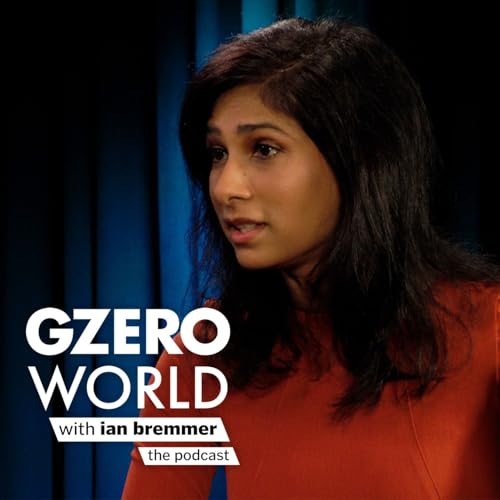
  • Assessing the Iran War's "structural damage" with Harvard economist Gita Gopinath
    Apr 11 2026

    Rising energy prices, higher inflation, and growing economic uncertainty — a Harvard economist says the fallout from the Iran war is already being felt.

    On the GZERO World Podcast, Ian Bremmer sits down with Harvard economist and former IMF Deputy Managing Director Gita Gopinath to unpack how the conflict is rippling through the global economy. As oil and gas prices surge, inflation is climbing, adding new costs for households and businesses and putting pressure on growth worldwide.

    Gopinath explains that while the immediate hit to global growth may seem modest, the bigger concern is longer-term “structural damage”—the slow-moving economic shifts caused by trade fragmentation, strained alliances, and geopolitical conflict. They also discuss why the US may be more insulated than other economies, how China is positioning itself for a more fragmented world, and whether the recent boom in AI investment can offset some of the economic drag.

    As inflation rises and global economic ties continue to shift, what comes next may matter even more than the immediate shock.

    Subscribe to the GZERO World with Ian Bremmer Podcast on Apple Podcasts, Spotify, or your preferred podcast platform, to receive new episodes as soon as they're published.


    Hosted by Simplecast, an AdsWizz company. See pcm.adswizz.com for information about our collection and use of personal data for advertising.

    Show more Show less
    32 mins
  • Viktor Orbán's last stand, and the future of Europe's far right with Ivan Krastev
    Apr 4 2026

    Ian Bremmer sits down with Ivan Krastev, Chairman of the Centre for Liberal Strategies and political scientist, to discuss Hungary's consequential upcoming election and what it means for the far right globally.

    For sixteen years, Viktor Orbán has dominated Hungarian politics, rewriting rules, consolidating power, and positioning himself as Europe's leading nationalist and Donald Trump's closest ally on the continent. But with parliamentary elections approaching on April 12th, his aura of invincibility is finally cracking. Opposition candidate Péter Magyar, a conservative former Orbán insider, is polling ahead by double digits, and the Trump administration is scrambling to help keep its favorite European in office.

    Krastev explains what most Americans get wrong about Orbán: that his real economic patron isn't Trump but China. Chinese investment in Hungary now exceeds Chinese investment in Germany and France combined, and Beijing's interest is straightforward: Orbán's willingness to veto any EU anti-China policy. Krastev also breaks down Orbán's ideological roots, arguing he is far closer to Putin than to Trump, anchored in 19th-century Hungarian nationalism and the grief of a nation that lost everything after World War I.

    Together, Krastev and Bremmer look ahead to what an Orbán loss would mean for Europe's far-right parties, for EU policy on Ukraine, and for Trump's own political brand. "For President Trump and for President Putin," Krastev says, "Orbán losing is going to be their personal loss." And if Trump's oldest, best-known European ally falls, being backed by Washington may soon be worth far less than it once was.

    Subscribe to the GZERO World with Ian Bremmer Podcast on Apple Podcasts, Spotify, or your preferred podcast platform, to receive new episodes as soon as they're published.


    Hosted by Simplecast, an AdsWizz company. See pcm.adswizz.com for information about our collection and use of personal data for advertising.

    Show more Show less
    22 mins
  • Rahm Emanuel on Trump's Iran war “of choice” and midterm implications
    Mar 27 2026

    Ian Bremmer and Rahm Emanuel discuss the deepening conflict in the Middle East, US foreign policy under Trump, and the upcoming midterms.

    Rahm Emanuel argues that this is a war of choice, one President Trump made himself, not one driven by external pressures like Israel’s influence. While the Prime Minister of Israel has long pushed for military action, Emanuel stresses that the responsibility for war ultimately lies with the US president, not foreign actors. He also highlights how America’s fractured political system has complicated decision-making, making it harder for the US to act with a unified voice on the world stage.

    Emanuel argues that Trump’s actions have eroded relationships with critical allies, particularly in Europe and the Gulf. “The price of belittling your allies is now coming home to roost,” Emanuel warns, pointing to the growing isolation the US faces at a time when global cooperation is needed most. He also discusses the broader implications of US military deployments in the region and the rising threat of Iran's growing influence.

    Emanuel also addresses the internal division within the US, explaining how China is carefully watching America’s internal dysfunction. “Nothing China does scares me,” he says. “It’s what we don’t do here at home that scares me.”"

    Subscribe to the GZERO World with Ian Bremmer Podcast on Apple Podcasts, Spotify, or your preferred podcast platform, to receive new episodes as soon as they're published.


    Hosted by Simplecast, an AdsWizz company. See pcm.adswizz.com for information about our collection and use of personal data for advertising.

    Show more Show less
    51 mins
  • Unpacking Iran’s competing endgames with Brookings Institution’s Thomas Wright
    Mar 14 2026

    Ian Bremmer sits down with Thomas Wright, Brookings Institution fellow and former Senior Director at the US National Security Council, to unpack the deepening war in Iran and the divergent strategies shaping it.

    What are the possible outcomes for the widening conflict in Iran? What began as a dramatic opening strike has evolved into a far more complex war, with Washington, Jerusalem, and Tehran all pursuing different aims. Wright argues this isn’t simply about degrading military capability; it’s about competing endgames that may pull the region in unpredictable directions.

    As Wright explains, the United States is hoping for a pragmatic partner inside Iran, while Israel pushes for full regime change. “Trump couldn’t care less if Larijani runs Iran. The Israelis do… They’re going to go full bore for regime change,” he says. At the same time, efforts to fragment the country risk creating “a much bigger problem… a Syria civil war on steroids.”

    The conversation also examines how other global players are responding. Europe has been muted, trying to accommodate the US, while China and Russia tread carefully, balancing economic and strategic interests without directly confronting Washington. Wright also discusses domestic implications, including the Pentagon’s evolving relationship with Silicon Valley and how frontier technologies like AI are intersecting with national security concerns.

    Looking ahead, Wright outlines both best-and worst-case scenarios — from the emergence of a more legitimate leadership to the specter of fragmentation that could intensify regional instability. With no clear exit ramp in sight, this conversation explores what might come next and why the endgame of this war remains so uncertain.

    Host: Ian Bremmer

    Guest: Thomas Wright

    Subscribe to the GZERO World with Ian Bremmer Podcast on Apple Podcasts, Spotify, or your preferred podcast platform, to receive new episodes as soon as they're published.


    Hosted by Simplecast, an AdsWizz company. See pcm.adswizz.com for information about our collection and use of personal data for advertising.

    Show more Show less
    36 mins
  • Tariffs: what comes next with Paul Krugman and Scott Lincicome
    Mar 7 2026

    While Washington has become more hostile to globalization, Americans continue to buy foreign goods in record numbers. Lincicome notes that economic nationalism is “about an inch deep,” with support collapsing when Americans face higher prices for domestic products.

    The conversation also explores the impact of tariffs on businesses and consumers. Lincicome explains that if certain tariffs are ruled illegal, companies could seek refunds totaling up to $175 billion, potentially through litigation rather than administrative action. Krugman emphasizes that while policy debates grab headlines, public perception and midterm politics may ultimately matter more than the details of trade law or corporate strategy.

    From the immediate fallout of legal challenges to the broader question of how the U.S. navigates trade and globalization, Bremmer, Lincicome, and Krugman explore the delicate balance between politics, policy, and the economy—and what it could mean for American consumers, businesses, and the upcoming midterms.

    Host: Ian Bremmer

    Guests: Paul Krugman, Scott Lincicome

    Subscribe to the GZERO World with Ian Bremmer Podcast on Apple Podcasts, Spotify, or your preferred podcast platform, to receive new episodes as soon as they're published.


    Hosted by Simplecast, an AdsWizz company. See pcm.adswizz.com for information about our collection and use of personal data for advertising.

    Show more Show less
    22 mins
  • Iran at war with Carnegie’s Karim Sadjadpour
    Feb 28 2026

    Ian Bremmer sits down with Karim Sadjadpour of the Carnegie Endowment for Peace to examine Iran’s precarious position on the global stage and the forces shaping the country. At the heart of the discussion is the regime’s internal fragility. Sadjadpour explains that many inside Iran, including elements of the Revolutionary Guards, are “waiting for Ayatollah Khamenei to die.”

    The conversation also explores Iran’s isolation in the international arena. While 90% of its oil goes to China at deep discounts, Sadjadpour points out that Chinese and Russian interests in Iran diverge sharply. Despite the pressures at home and abroad, Sadjadpour argues that many ordinary Iranians recognize that reconciliation with the United States is essential if the country is ever to realize its enormous potential.

    From leadership uncertainty to global isolation, Bremmer and Sadjadpour explore the delicate balance Iran faces today—and the choices that will determine its path forward.

    Subscribe to the GZERO World with Ian Bremmer Podcast on Apple Podcasts, Spotify, or your preferred podcast platform, to receive new episodes as soon as they're published.


    Hosted by Simplecast, an AdsWizz company. See pcm.adswizz.com for information about our collection and use of personal data for advertising.

    Show more Show less
    Not Yet Known
  • President Trump's power-first foreign policy with CFR's President
    Feb 14 2026

    From sweeping tariffs to threats of military action and withdrawal from international institutions, Trump has demonstrated a willingness to break with the United States' approach to international relations. When the US shifts from global order architect to challenger, what kind of system emerges, and how do other countries react? On the GZERO World Podcast, Ian Bremmer sits down with former US Trade Representative and Council on Foreign Relations President Michael Froman to discuss.

    Michael Froman tells Ian Bremmer that under Trump's second term, he’s been less surprised by a single policy shift than by how quickly other countries have adapted to them. As allies hedge and adversaries like China step into new leadership roles, they unpack how the world order is evolving and discuss the most pressing issues.

    Subscribe to the GZERO World with Ian Bremmer Podcast on Apple Podcasts, Spotify, or your preferred podcast platform, to receive new episodes as soon as they're published.


    Hosted by Simplecast, an AdsWizz company. See pcm.adswizz.com for information about our collection and use of personal data for advertising.

    Show more Show less
    35 mins