Episodes

  • EP 40: AI Analytics: From Hindsight to Foresight
    Feb 25 2026

    AI analytics represents a fundamental shift from analyzing what happened to predicting what will happen. Traditional marketing analytics was retrospective-dashboards showing last month's performance, reports explaining why campaigns succeeded or failed. AI analytics is prospective-predictive models forecasting customer behavior, propensity scores indicating conversion likelihood, churn risk signals identifying at-risk customers before they leave.

    The shift in marketing team composition is significant. Traditional teams were heavy on creative and campaign managers. AI-driven marketing teams need data scientists, analytics engineers, and marketing technologists who understand both strategy and technical implementation. The skillset evolves from "what message resonates" toward "what patterns in customer data predict behavior we can influence."

    Critical pitfalls include overfitting models on historical data, optimizing for proxies rather than actual business outcomes, and creating feedback loops where AI recommendations reinforce existing biases rather than discovering new opportunities. Privacy regulations like GDPR and CCPA create constraints on what data you can collect and how you can use it for profiling.

    The ROI is compelling. McKinsey research shows businesses using advanced analytics growing 10-15% faster than competitors, with 20-40% improvement in marketing efficiency through better targeting and resource allocation.

    Show more Show less
    16 mins
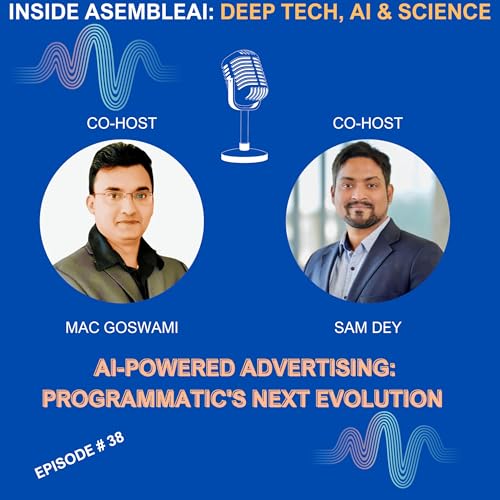
  • EP 38: AI-Powered Advertising: Programmatic’s Next Evolution
    Feb 25 2026

    Traditional ad buying involved manual targeting, static audiences, and fixed bids. AI advertising uses machine learning to optimize targeting, bidding, and creative selection in real time across millions of data points. Performance Max and Meta Advantage+ campaigns represent this evolution - algorithms handling what used to require entire teams of media buyers.

    Smart bidding algorithms adjust bids based on conversion likelihood, time of day, device type, user behavior history, competitor activity, and dozens more variables simultaneously. This dynamic approach consistently outperforms manual bid management, especially for campaigns with large audiences and multiple ad variations. However, human strategy and oversight remain necessary—marketers must set clear goals, supply quality creative assets, and analyze performance to ensure AI automation aligns with business objectives.

    Critical risks include over-optimization—AI might optimize for metrics that don't actually align with business goals. Optimizing for clicks gets clicks but might not deliver quality traffic. Optimizing for conversions without considering lifetime value might acquire expensive customers who churn quickly. The human role is defining success properly so AI optimizes toward meaningful outcomes.

    Looking at 2026, programmatic advertising moves toward full automation. For small businesses without media buying expertise, this democratizes access to sophisticated advertising. For agencies and specialists, it forces evolution toward strategic consulting rather than tactical execution.

    Show more Show less
    13 mins
  • EP 37: AI Content Creation: 3x Output, Half the Cost
    Feb 25 2026

    The numbers are staggering: 96% of companies now use generative AI for content production. Companies report 3-5x more content output, 30-50% cost savings, and 50% reductions in creation time. This isn't incremental improvement—it's transformational change in how marketing teams operate.

    AI content creation in 2025 encompasses far more than ChatGPT writing blog posts. We're talking about integrated workflows governing ideation, creation, distribution, and analytics. Tools like Jasper, Copy.ai, and ContentBot handle everything from drafting to scheduling and multi-platform distribution. The sophistication has moved far beyond simple text generation.

    Limitations remain clear: AI struggles with truly original creative thinking—breakthrough ideas that redefine categories. It excels at recombining existing concepts but genuine innovation requires human creativity. AI lacks emotional intelligence and cultural nuance, can mimic empathy but doesn't actually understand context the way humans do, and generates confidently wrong information (hallucinations), which is why human fact-checking remains non-negotiable.

    Looking ahead, the strategic implication is marketing teams shifting focus from production to strategy. When AI handles volume, humans focus on insight, positioning, and differentiation. Small teams can now compete with large enterprises because production bottlenecks disappear.

    Show more Show less
    19 mins
  • EP 36: AI Personalization: From Segments to Individuals
    Feb 25 2026

    AI personalization has evolved dramatically from basic segmentation to true individual-level customization. McKinsey's 2025 research shows businesses using advanced personalization techniques are seeing 10-15% revenue increases, with 89% of decision makers saying AI-driven personalization will be critical in the next three years. This isn't optional anymore-it's competitive survival.

    Consumer expectations have shifted dramatically. 72% of consumers say they only engage with marketing messages tailored to their interests, and 90% are happy to share personal data if the result is a smoother, more personalized experience. However, they want immediate tangible value in exchange—brands can't just collect data and hope customers will be patient.

    Looking ahead to 2026, generative AI will create not just personalized messages but personalized imagery, video, and even product configurations. Adobe's 2025 Digital Trends Report shows 58% of teams seeing GenAI ROI expect better quality customer interactions in the next 12-24 months. The winners will be brands that see personalization as a system, not just a tactic-building predictive models into planning cycles while maintaining human oversight on privacy and ethics.

    Show more Show less
    12 mins
  • EP 34: AI in Credit and Lending: Democratizing Access or Amplifying Bias?
    Feb 22 2026

    AI in credit decisions is genuinely controversial because it could either democratize lending and expand access to underserved populations or take historical discrimination and amplify it at scale. The reality is both are happening simultaneously in different institutions—it all depends on how intentionally the AI is designed and monitored for fairness.

    Sam and Mac examine how AI is disrupting traditional credit scoring. FICO scores have dominated for decades using limited data: payment history, credit utilization, length of credit history, types of credit, and recent inquiries. This approach systematically excludes millions who don't have traditional credit histories, even if they're perfectly responsible with money and would be excellent borrowers.

    The technical models include XGBoost as the industry standard and neural networks for processing more data with hidden layers. Traditional logistic regression is often a poor fit for real-world credit behavior. Banks need model governance with clear ownership, regular bias testing, robust explainability, and human oversight for complex cases. AI handles straightforward approvals and denials; humans handle the middle—complex situations requiring judgment and contextual understanding.

    Show more Show less
    15 mins