Interpreting India Podcast By Carnegie India cover art

Interpreting India

Interpreting India

By: Carnegie India
Listen for free

In Season 5 of Interpreting India, we continue our exploration of the dynamic forces that will shape India's global standing. At Carnegie India, our diverse lineup of experts will host critical discussions at the intersection of technology, the economy, and international security. Join us as we navigate the complexities of geopolitical shifts and rapid technological advancements. This season promises insightful conversations and fresh perspectives on the challenges and opportunities that lie ahead.2024 Carnegie India Political Science Politics & Government
Episodes
  • Data, AI, and the Laws Trying to Keep Up
    Mar 31 2026

    The conversation begins with a close look at India’s data protection regime, particularly the DPDP Act and its emphasis on consent. Nikhil challenges the perception that the law is overly consent-driven, pointing to a range of exemptions and alternative legal bases for processing data. At the same time, he highlights gaps in enforcement and deterrence, arguing that the current framework may struggle to address large-scale misuse of data or systemic harms.

    On AI governance, Nikhil makes a case that India does not need a sweeping, EU-style AI law, at least not yet. Given India's legislative pace, enforcement gaps, and how fast AI is evolving, he thinks strengthening existing laws and making targeted amendments is a far more practical path. He does, however, flag artificial intimacy as something that deserves serious attention soon. AI-powered companionship is supercharging the loneliness economy, building emotional dependency at scale, and raising risks that no existing framework is really built to handle.

    Closer to home, Nikhil offers a window into how AI is changing legal practice at Trilegal, where 75% of lawyers now use AI in their daily workflows. The firm is simultaneously building AI products, using them internally, and advising clients on AI risk, a position Nikhil sees as an advantage rather than a conflict. For him, the era of lawyers who write code and speak directly with engineers is not something to fear but a long overdue shift in what it means to practice technology law.

    Episode Contributors

    Nidhi Singh is an associate fellow at Carnegie India. Her current research interests include data governance, artificial intelligence and emerging technologies. Her work focuses on the implications of information technology law and policy from a Global Majority and Asian perspective. She has previously contributed to the Indian Express, The Secretariat, Medianama and HinduBusiness Line.

    Nikhil Narendran is a Partner in Trilegal’s Bengaluru office and part of the TMT practice of the firm. He is a subject matter expert in the technology, media, and telecom communication space. Nikhil focuses on the interplay of technology, human lives, and commerce. He has substantial experience in advising companies on telecom, media and technology laws in relation to their entry into India, operations, strategy, policy, regulatory issues, disputes, and business models.

    Every two weeks, Interpreting India brings you diverse voices from India and around the world to explore the critical questions shaping the nation's future. We delve into how technology, the economy, and foreign policy intertwine to influence India's relationship with the global stage.

    As a Carnegie India production, hosted by Carnegie scholars, Interpreting India, a Carnegie India production, provides insightful perspectives and cutting-edge by tackling the defining questions that chart India's course through the next decade.

    Stay tuned for thought-provoking discussions, expert insights, and a deeper understanding of India's place in the world.

    Don't forget to subscribe, share, and leave a review to join the conversation and be part of Interpreting India's journey.

    Show more Show less
    43 mins
  • Inside the Iran Conflict: Power, Strategy, and India’s Balancing Act
    Mar 25 2026

    The conversation begins with a look at where the conflict stands today and how Iran has managed to absorb significant military pressure while still responding in a measured way. Dharmendra explains how the conflict has expanded beyond immediate borders, affecting energy flows and drawing in multiple countries, while also reinforcing a sense of internal unity despite economic strain.

    It then turns to Iran’s internal system, where different power centres, from the political leadership to the security establishment, continue to function together even under pressure. The episode also reflects on the role of nationalism, suggesting that even in a deeply ideological state, a shared national identity plays a strong role in shaping public response during moments of crisis.

    In the final part, the focus shifts to India. The discussion looks at how India manages its relationships across the region, from Iran to the Gulf, and the constraints created by sanctions and global politics. It also touches on long-term projects like Chabahar and what their future might look like. The episode closes with a broader reflection on where the region may be headed and what space there is for stability after the conflict.

    Episode Contributors

    Srinath Raghavan is a nonresident senior fellow at Carnegie India. He is also a professor of International Relations and History at Ashoka University. His primary research focus is on the contemporary and historical aspects of India’s foreign and security policies.

    Gaddam Dharmendra is a nonresident senior fellow at Carnegie India. He joined the Indian Foreign Service in 1990 and served in various capacities in Indian Missions across the world and at the Ministry of External Affairs, South Block. His overseas assignments include stints at Indian Missions in Tehran, Dushanbe, Washington D.C., and Dhaka.

    Every two weeks, Interpreting India brings you diverse voices from India and around the world to explore the critical questions shaping the nation's future. We delve into how technology, the economy, and foreign policy intertwine to influence India's relationship with the global stage.

    As a Carnegie India production, hosted by Carnegie scholars, Interpreting India, a Carnegie India production, provides insightful perspectives and cutting-edge by tackling the defining questions that chart India's course through the next decade.

    Stay tuned for thought-provoking discussions, expert insights, and a deeper understanding of India's place in the world.

    Don't forget to subscribe, share, and leave a review to join the conversation and be part of Interpreting India's journey.

    Show more Show less
    1 hr and 8 mins
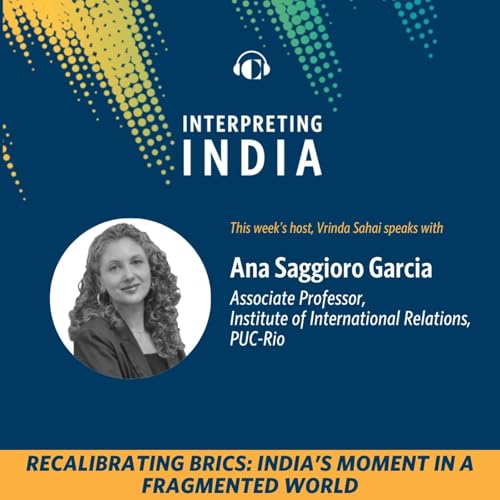
  • Recalibrating BRICS: India’s Moment in a Fragmented World
    Feb 26 2026

    The episode begins with a reflection on Brazil’s 2025 BRICS presidency, which emphasized continuity with the bloc’s original reformist agenda—particularly the push for reform of global financial institutions and greater representation for emerging economies. While Brazil focused on trade facilitation, climate finance, and taxation cooperation, progress on deeper monetary coordination and mechanisms such as the Contingent Reserve Arrangement remained limited.

    Ana Garcia also notes the gap between expectations and reality within BRICS. Despite its growing geopolitical visibility, the bloc has struggled to develop unified responses to global crises and remains economically imbalanced, with intra-BRICS trade heavily centered on China. The New Development Bank continues to expand its project financing and local currency lending but operates within global financial constraints and plays a more limited role than often perceived.

    Looking ahead, India’s presidency will focus on consolidating the expanded BRICS grouping while cautiously advancing financial cooperation, climate adaptation financing, and South-South collaboration in health. The discussion concludes that India’s success will depend on pragmatic institutional progress rather than ambitious rhetoric, as BRICS navigates a complex and polarized global environment.

    Episode Contributors

    Vrinda Sahai is a research analyst in the Security Studies Program at Carnegie India. Her work focuses on Indian foreign and security policy, particularly, India’s strategic engagement with major powers.

    Ana Elisa Saggioro Garcia is a Professor at the Institute of International Relations at PUC-Rio. Professor of the Postgraduate Program in Social Sciences at the Federal Rural University of Rio de Janeiro. PhD in International Relations from IRI/PUC-Rio and Master in Political Science from the Free University of Berlin (Germany).

    Every two weeks, Interpreting India brings you diverse voices from India and around the world to explore the critical questions shaping the nation's future. We delve into how technology, the economy, and foreign policy intertwine to influence India's relationship with the global stage.

    As a Carnegie India production, hosted by Carnegie scholars, Interpreting India, a Carnegie India production, provides insightful perspectives and cutting-edge by tackling the defining questions that chart India's course through the next decade.

    Stay tuned for thought-provoking discussions, expert insights, and a deeper understanding of India's place in the world.

    Don't forget to subscribe, share, and leave a review to join the conversation and be part of Interpreting India's journey.

    Show more Show less
    54 mins
No reviews yet