• The Power of Local Ag Events & Answers - RDA 512
    Mar 31 2026
    At the Central Oklahoma Cattle Conference, we visit with Jennifer Patterson, Payne County Extension ag educator, about how local agricultural programming comes together and why it still matters for Oklahoma producers. From cattle markets and forage fertility to weed control and producer education, Jennifer explains how Extension listens first, then builds programs around the issues producers are actually facing. This episode also offers a closer look at the day-to-day reality of county Extension work. Jennifer talks about moving from Adair and Sequoyah counties to Payne County, learning a new region, working across diverse audiences, and helping connect rural communities to research-based answers. It is a conversation about service, problem-solving, and the people helping keep agriculture informed and connected. Top 10 takeaways Extension succeeds by listening first. Jennifer makes clear that the best programs start with the real questions producers are already asking.Local conferences still matter. The Central Oklahoma Cattle Conference works because it gives producers face-to-face access to timely, practical information.County Extension work is highly local. Even within Oklahoma, the needs in Payne County differ from those in Adair and Sequoyah counties.Producer concerns drive programming. Topics like cattle markets, forage quality, fertility, and weed control shaped this event because they are the issues producers are dealing with now.Extension serves more than one audience. In Payne County, educators may help cow-calf producers, stocker operators, homesteaders, gardeners, and commercial horticulture clients all in the same week.Relationships are a major part of Extension. Whether it is with producers, community partners, or state specialists, trust helps turn questions into solutions.Hands-on programs have lasting value. Jennifer’s enthusiasm for pasture tours and the Hoof to Hook program shows how effective experiential learning can be.Youth livestock education can go beyond showing. The feedout program connects young people to cattle production, carcass outcomes, and management decisions from start to finish.Extension careers are rewarding but unpredictable. Jennifer describes the work as diverse, meaningful, and never the same two days in a row.Extension is still underused in many communities. One of the strongest themes in the episode is that many people do not fully realize how much help is available through their county office. Detailed Timestamped Rundown 00:03–00:58 Dave opens Episode 512 and introduces the conversation from the Central Oklahoma Cattle Conference, emphasizing Extension’s role in helping producers navigate real-world agricultural challenges.00:58–01:31 The team introduces the show and transitions into the live conversation recorded February 13, 2026, in Stillwater.01:31–02:15 Jennifer Patterson joins the podcast and is introduced as the organizer of the conference and Payne County Extension ag educator.02:16–03:10 Jennifer explains that she has been in Payne County about a year and a half and describes the conference as a regional, multi-county event designed around current producer concerns.03:12–04:18 The group discusses the speaker lineup, including the range of topics covered and the importance of making educational sessions approachable and interactive.04:18–06:11 Jennifer highlights the value of speakers like Derrell Peel and Megan Roth, especially with ongoing interest in cattle markets, herd rebuilding, and bull selection.06:12–08:11 Brian asks Jennifer about moving from Adair and Sequoyah counties to Payne County. She explains differences in rainfall, forage systems, native grasses, weed pressure, and local production conditions.08:11–09:23 Jennifer reflects on the pace of the Payne County office and the strong local engagement she has seen from producers and community members.09:23–10:59 The discussion turns to public awareness of Extension. Jennifer explains that many people still do not fully understand what Extension offers beyond 4-H.10:59–12:23 Josh and Brian talk about the unique mix of audiences in Payne County, where rural agricultural issues overlap with homeowner and horticulture questions in Stillwater.12:23–15:18 Jennifer describes how educators often work together across agriculture, horticulture, and homesteading topics because clientele frequently have questions that cross categories.15:19–17:12 The group discusses the need to know your audience. Jennifer explains that successful Extension programming depends on adapting the message to the people in the room.17:12–20:08 Josh raises the idea that Payne County might be viewed differently because it is home to the university. Jennifer says some local clients already know campus specialists, which can be helpful but also intimidating.20:08–22:17 Jennifer talks about future programming, including pasture tours, outdoor educational opportunities, pesticide meetings, and ...
    Show more Show less
    33 mins
  • Bring Pastures Back Fast: Recovery That Lasts - RDA 511
    Mar 25 2026
    High cattle prices can make it tempting to push pasture ground harder than ever, but what happens when the grass gives out before the market does? In this episode, Dave Deken, Dr. Brian Arnall, and Dr. Josh Lofton visit with OSU Extension Forage Specialist Brian Pugh about pasture recovery, grazing pressure, and the management decisions producers need to make now to protect long-term forage production. They break down the difference between native and introduced systems, why rest matters, and how too many cows with too few inputs can quietly drive a pasture into decline. Their conversation also digs into what recovery really looks like. Introduced forages like bermudagrass can rebound quickly with rest, nutrients, and weed control, while native range may take much longer and demands more careful timing. Along the way, the group discusses soil testing, stocking rates, drought carryover, old world bluestem in western Oklahoma, TEFF as an annual option, and why more producers should start thinking about pasture management the same way they think about crop management. Top 10 takeaways Pasture recovery starts with management, not luck. Rest, fertility, and weed control are the backbone of rebuilding forage systems.Many producers are still stocked for a cheap-input era that no longer exists. High cattle numbers with reduced inputs is a recipe for forage decline.Native grasses need a different rest schedule than introduced forages. Pugh recommends resting native grasses after July 10, while bermudagrass benefits from a few weeks of rest before frost.Introduced forages can rebound surprisingly fast. Damaged bermudagrass can recover in a single season when pressure is reduced and nutrients and weed control are addressed.Native range recovery is slower and requires more patience. Native plants may remain alive below ground even when above-ground growth looks poor.Pasture should be managed more like a crop. Soil tests, nutrient plans, and intentional competition control are just as important in forage systems as they are in row crops.Economics drive bad grazing decisions as much as biology does. Strong cattle markets can encourage overstocking, especially when crop returns are weak.Emotions make herd reduction hard. Cow-calf operations are not easy to scale down quickly because of years of investment in genetics and herd building.Regional forage fit matters. Bermudagrass may work well in some areas, while old world bluestem, native mixes, or carefully managed annuals make more sense farther west.Recovery costs money. Producers often wait until the financial picture worsens before rebuilding pasture, but the inputs needed for recovery do not disappear. Detailed Timestamped Rundown 00:03–01:02 Dave opens the episode and frames the main topic: forage systems, pasture recovery, cattle prices, input costs, and long-term pasture health. He previews discussion on worn-out pastures, resting native grasses, introduced forage recovery, and regional differences across Oklahoma.01:02–01:40 Dave points listeners to the Red Dirt Agronomy website, then introduces the usual crew: Brian Arnall and Josh Lofton.01:40–02:45 The recorded interview begins from the Central Oklahoma Cattle Conference in Stillwater on February 13, 2026. Brian Pugh is introduced as OSU’s state forage extension specialist.02:45–04:20 The group recaps the conference session. Early expectations were that producers would mostly ask weed questions, especially around bermudagrass, but the bigger theme became forage system management under current economics.04:20–05:09 Brian Pugh explains that many producers are still managing herds and forage stands like inputs are cheap, even though fertilizer and other costs are far higher now. His point: too many mouths to feed and too few inputs is putting pressure on forage systems.05:09–06:32 Brian Arnall says one forgotten practice is pasture rest, especially in native systems. He argues many producers are grazing too late into the season, especially at the very time native grasses need to recover and recharge below ground reserves.06:13–06:32 Pugh gives a practical native pasture benchmark: after July 10 is when they recommend rest for natives. For bermudagrass, he says a three- to four-week rest before frost, often in October, helps stand health.06:32–08:15 The team discusses how drought, rising fertilizer prices, and the need for forage have led to widespread decline in native pasture condition. Pugh gives an example of carrying too many cows on a declining native system and slowly slipping from one cow per 10 acres to one cow per 8, then worse, as undesirable plants take over.08:15–10:15 Josh asks why producers quit using rest as part of management. The group suggests cattle numbers, tighter economics, incomplete management information, and the lingering influence of older production mindsets all played a role. They also note cheap fertilizer in the 1980s and 1990s made it easier to support...
    Show more Show less
    34 mins
  • How Soybeans Shape Oklahoma - RDA 510
    Mar 18 2026
    Soybeans are a lot more than a crop in the field, and this episode proves it. Dave Deken and Brian Arnall visit with Rick and Ginger Reimer of the Oklahoma Soybean Board about how soybean checkoff dollars are being invested in research, producer outreach, education, and consumer awareness across Oklahoma. From Red Dirt Soy and production research to classroom workshops and virtual reality tools, the Reimers share how the board is helping connect agriculture to both producers and the public. The conversation also digs into soybean rotations, the crop’s spread into new parts of Oklahoma, why soybeans are so important to livestock agriculture, and how the board has even supported feral hog control because of the damage those animals cause to crops and pasture. It’s a wide-ranging look at how soybean leadership, Extension partnerships, and strategic outreach are helping strengthen agriculture from the farm gate to the classroom Top 10 Takeaways This episode reframes soybeans as much more than a crop. The Oklahoma Soybean Board is investing not only in production research, but also in education, livestock-connected outreach, and public understanding of agriculture.Teacher training is one of the board’s biggest multiplier strategies. Ginger says the board has worked with nearly 800 teachers and is reaching around 20,000 students annually through workshops and classroom-ready materials.The soybean checkoff is tightly accountable. Rick emphasizes audits, compliance reviews, and documentation because every dollar being spent belongs to soybean producers.Research is still the budget anchor. Rick estimates about 60% of retained board funds go toward research, with another 20% to 30% supporting education and outreach.Soybeans and livestock are directly linked. Rick says most domestically used soybeans go into animal agriculture, which explains why the board supports pork, poultry, and related educational programming.Soybean production geography in Oklahoma has shifted. Counties once dominant in eastern Oklahoma are no longer the only leaders; major soybean production now includes north-central Oklahoma, and the crop is pushing even farther west.Western Oklahoma soybeans bring new management questions. Brian points to irrigated production and iron deficiency issues in high-pH soils as examples of why region-specific research matters.Digital outreach is becoming a bigger part of the mission. The board is expanding through social media, recorded workshop content, YouTube, and online education platforms.Feral hog control is a serious agricultural issue. The board’s support for control efforts shows how soybean leadership is responding to broader on-farm threats, not just soybean-only problems.Agricultural literacy is long-term risk management. Ginger makes the strongest public-facing point of the episode: informed teachers become informed communities, and informed communities shape the future of agriculture. Detailed Timestamped Rundown 00:02–01:06 Dave opens Episode 510 and frames soybeans as more than a field crop, tying them to livestock feed, producer research, ag education, and statewide outreach. He previews the conversation with Rick and Ginger Reimer of the Oklahoma Soybean Board and points listeners to Red Dirt Agronomy online for more resources.01:07–01:40 Dave introduces Brian Arnall, and the hosts set up the interview, noting it was recorded January 10, 2026, at the Oklahoma Wheat Commission booth during KNID Agrifest.01:41–03:24 Brian introduces Rick and Ginger Reimer. Rick explains his long tenure with the soybean organization and walks through the shift from the Oklahoma Soybean Commission to the Oklahoma Soybean Board after the national soybean checkoff was established, including the split of funds between the state and national boards.03:25–06:22 Ginger outlines her role in marketing, consumer information, and education. She explains how her classroom work evolved into teacher workshops that equip educators with supplies, books, curriculum, and hands-on materials. Rick adds that the board tracks reach by counting how many students those teachers serve each year. Ginger says they are nearing 800 teachers and about 20,000 students annually.06:22–08:41 The group discusses workshop themes including “Pork and Beans” and “Chicka Doodle Do.” Ginger describes using VR headsets to show students swine production and explains how different workshops are tailored for preschool through older students. Brian notes the board’s outreach goes well beyond soybeans alone and reflects the full agricultural ecosystem.08:41–10:32 Rick stresses accountability for checkoff dollars, jokingly summarizing it as “document or die.” He explains the importance of receipts, audits, and compliance reviews because the board is spending producer money. He estimates roughly 60% of the state board’s retained budget goes to research, 20% to 30% to education and outreach, and admin is kept near or under ...
    Show more Show less
    33 mins
  • The New Rules Of Wheat Weed Control - RDA 509
    Mar 10 2026
    What actually works in wheat weed control when the old spray plan starts slipping? In this episode of Red Dirt Agronomy, Dave Deken, Brian Arnall, and Josh Lofton sit down with Liberty Galvin at AgriFest in Enid to talk through the real-world decisions that separate a clean wheat field from a frustrating one. The conversation covers pre-emergent herbicides, burndown programs, delayed planting, competitive wheat canopies, and why one weed-control strategy rarely fits every field. Liberty also breaks down why producers need to think beyond chemistry alone. From no-till residue and seedbank behavior to variety selection, tillage timing, and even the role of fire and chaff lining, this episode is packed with practical ideas for Oklahoma wheat producers facing ryegrass, brome, cheat, and other tough weed problems. It is a sharp, funny, highly useful discussion about managing weeds with better timing, better systems, and fewer assumptions. Top 10 takeaways Wheat weed control has to be system-specific now; one standard program no longer fits every field.Delayed planting can be a real weed-control tool because it lets producers target the first flush before or near planting.Variety selection and crop competition deserve more attention as weed-management tools, not just yield tools.A dense, fast-closing wheat canopy can suppress weed emergence and make herbicides work in a friendlier environment.In heavy-residue no-till systems, burndown programs may sometimes outperform soil-applied pre-emergent products because of poor soil contact.Bare ground at green-up is not always a disadvantage; it can create an opening for spring residual herbicides.Herbicide timing and rotating modes of action matter as much as product choice when resistance is in play.Weed seedbanks behave differently by species; many grasses are shorter-lived than broadleaf weeds, which can persist much longer.Occasional strategic tillage may have value in long-term resistance management, but timing, moisture, and erosion risk all matter.Fire and chaff lining are not silver bullets, but they may become useful post-harvest tools in integrated weed-management systems. Detailed Timestamped Rundown00:00–01:34 — Dave opens Episode 509 and frames the show around a question many wheat producers are asking: what do you do when the old reliable spray program is not getting the job done anymore?01:34–03:03 — The crew records live from AgriFest in Enid, with a quick round of banter before introducing Liberty Galvin and setting up the conversation around current wheat weed-control challenges.03:03–05:06 — Liberty gives an update on building her program at OSU and describes her “spaghetti plate method” of trying multiple ideas until a clearer research direction starts to form.05:06–06:06 — She explains a pre-emergent herbicide study funded by the Wheat Commission, including trials at Lahoma, Perkins, and Chickasha, and how dramatically different those environments behaved.06:06–07:15 — Liberty shifts to a cultural weed-control and IPM study, comparing multiple systems, including variety selection, to see which wheat types compete best against weeds.07:15–09:28 — The discussion turns to delayed planting. Liberty explains how cooler temperatures and moisture patterns affect winter weed emergence, and why delaying planting can help knock out the first flush.09:28–11:02 — Josh and Brian push on the tradeoffs: smaller, later wheat may conserve resources for spring, but more open soil can also invite weed emergence.11:02–15:13 — The group digs into species-specific weed behavior, especially Italian ryegrass, and talks through spring residual opportunities, bare ground at green-up, and mixing herbicide timings and modes of action.15:13–17:34 — Economics enter the picture. Liberty points out how hard it is to recommend multiple passes in a $4 wheat market, while Brian argues that badly infested fields can still justify stronger programs.17:34–20:21 — They compare delayed planting, tillage, roundup burndown, and no-till systems, with Liberty sharing observations that residue-heavy no-till fields may not always favor soil-applied pre products.20:21–24:23 — The conversation moves into tillage in long-term no-till, including when precision tillage might help, how moisture affects the operation, and how occasional soil inversion could influence resistant weed problems.24:23–28:01 — Dave asks how long weed seeds persist. Liberty gives a great primer on seedbanks, explaining why many grasses tend to have shorter dormancy while some broadleaf seeds can remain viable for years or even decades.28:01–31:44 — Josh shares a story about deep flipping fields and unexpectedly bringing crabgrass back. That leads into a broader point from Liberty: selection pressure drives weed problems, so no single tactic can carry the whole load.31:44–35:14 — Josh asks Liberty to explain her identity as a weed ecologist rather than a purely ...
    Show more Show less
    46 mins
  • Insurance Basics That Keep You Farming - RDA 508
    Mar 3 2026
    Tight margins and wild market swings are back in the driver’s seat—and producers are feeling it. Recorded at the Central Oklahoma Cattle Conference in Stillwater, Episode 508 features Clay Burtrum (Farm Data Services) walking through why insurance matters even when you hope you never use it. The crew digs into Livestock Risk Protection (LRP) basics, how price protection actually works, and what producers often misunderstand when they start using these tools. On the crop side, Clay outlines the deadlines and decisions that can make or break your coverage—plus how to think about programs like PRF (Pasture, Rangeland, Forage), annual forage, and stacking options without getting lost in the fine print. Bottom line: in a $4 wheat world with 2026 input costs, staying “bankable” means planning ahead and knowing what you bought. Top 10 takeaways Insurance is about staying bankable, not just getting a payout.LRP is price protection, not mortality/disaster coverage—know what it does.Documentation matters (example: “unborn” coverage needs validation like preg-check/bred purchase records).Stocker operators often treat LRP as all-or-nothing because margin risk is concentrated.Cow-calf operations can sometimes phase coverage, spreading risk across calf crop timing.Crop insurance complexity is real—stackable options exist, but basics come first in tight years.Deadlines drive everything (in this area, March 15 is a big one; waiting too long is a common pitfall).$4 wheat changes decisions—coverage, hail policies, and whether you even harvest vs graze-out.PRF is “rainfall interval” insurance—pick when you need rain and spread risk; it won’t cover every scenario (like quality loss from too much rain).Know your cost of production—break-even won’t keep you in business; cash flow clarity is survival. Detailed timestamped rundown 00:00–01:46 Dave tees up the episode: why insurance matters, recorded at Central Oklahoma Cattle Conference (Stillwater).01:46–02:57 Clay Burtrum intro: Farm Data Services (Stillwater), management accounting + 25+ years insurance; LRP and crop insurance, plus helping producers see bottom line year-round.03:16–04:45 Big-picture ag economy: grain-only operators squeezed; modern costs with “1970s prices”; crop insurance complexity (stackable programs) and need to keep it basic.04:45–08:43 LRP deep dive: example of insuring a 900-lb steer; why margins need protection; common misunderstandings (full load, unborn coverage requirements, validation); “don’t let it burn down” analogy; all-or-nothing for many stocker operators vs partial strategy for cow-calf.08:43–10:27 First-time client conversation: goals, where they want to be, staying bankable; traps include ignoring USDA/FSA programs and missing support.10:27–11:25 Clay as producer: he uses the products himself; emphasizes knowing cost of production and that break-even won’t keep you in business.11:26–12:50 Crop insurance pitfalls: calling too late; major dates in the area—March 15 sales closing; July 15 reporting; flow of deadlines through the season.12:50–14:18 $4 wheat vs $7 wheat decisions: changes appetite for added coverage/hail; producer mindset shifts (harvest vs graze-out).14:18–15:38 Dual-purpose wheat and insurance: need to notify agent by March 15/short-rate timing; cannot just “leave cattle out” without process; consider double-crop rules to avoid uninsured crop risk.15:38–17:14 Policy/program landscape: farm bill uncertainty and “rules”; emphasis on working with FSA and not missing deadlines/opportunities.17:14–18:51 Specialty crop/alternative ideas: limited locally; examples like hemp market issues; unusual inquiries (tulips) and regional eligibility realities.18:51–21:45 PRF pasture coverage: sales closing Dec 1; choosing rainfall intervals; premiums and changing rules; spreading risk across intervals; limits (doesn’t cover “missed cutting” quality loss).21:45–24:05 Talking to policymakers: how programs hit local bottom lines; input costs for grazing/forage; how rural communities feel downstream impacts; even equipment/emissions issues affect harvest reality.24:05–25:43 Oklahoma risk reality: rapid weather swings; questions like quarantine/screwworm, wildfire loss—what LRP does/doesn’t cover; importance of understanding what you actually bought.25:43–27:20 “Bring one program back”: Clay wants simplicity—too many stacked options; focus on basics and bottom-line impact. Wrap + thanks. RedDirtAgronomy.com
    Show more Show less
    28 mins
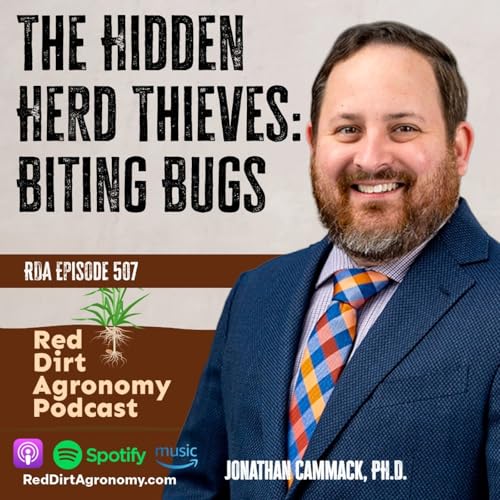
  • The Hidden Herd Thieves: Biting Bugs - RDA 507
    Feb 24 2026

    Flies, ticks, and parasites don’t just annoy cattle—they steal gain and profit. Recorded live at the Central Oklahoma Cattle Conference in Stillwater, OK, this episode features Dr. Jonathan Cammack (OSU Extension livestock entomology & parasitology) breaking down what producers should know about common pests like horn flies, how researchers test control tools, and why day-to-day management matters more than most folks think.

    The team also tackles two headline issues: New World screwworm and the invasive Asian longhorned tick. Dr. Cammack explains why screwworm is such a serious wound pest, how sterile insect technique works, and why animal movement can spread risk faster than the fly ever could. Then they pivot east—where Asian longhorned ticks have been detected in Oklahoma—and discuss why explosive tick populations and tick-borne disease threats are a growing concern across the region.

    Top 10 takeaways for producers

    1. Pests “steal” performance quietly—stress and blood-feeding divert energy away from gain.
    2. Screwworm isn’t a nuisance fly: it targets living tissue in wounds and can escalate fast.
    3. Time matters: screwworm eggs can hatch in 12–24 hours, so delayed checks can get costly.
    4. Animal movement beats fly movement—trailers move risk hundreds of miles in a day.
    5. Sterile insect technique works because females mate once; scale and logistics are the challenge during outbreaks.
    6. Asian longhorned tick can explode in numbers because it can reproduce without mating (parthenogenesis).
    7. High tick loads can cause real blood loss, and tick-vectored disease is a growing regional concern.
    8. Feedlots are a special concern due to animal density and the difficulty of visually monitoring every animal.
    9. Good management beats extremes: not “once a year,” not necessarily “daily,” but consistent eyes-on and quick response.
    10. Research behind the scenes is constant—colonies, susceptible/resistant strains, and field tests inform what works on your operation.

    Detailed timestamped rundown

    00:00–01:06 Dave Deken tees up Episode 507: flies, ticks, parasites; guest Dr. Jonathan Cammack; recorded at the Central Oklahoma Cattle Conference in Stillwater.
    01:06–02:42 “Trip around the table” intros: Brian Arnall and Josh Lofton; setting the scene at the Payne County Expo Center.
    02:42–06:56 Cammack’s role: OSU Extension livestock entomology/parasitology; what he covers across livestock species; why they keep fly colonies (houseflies, blowflies) for research and pesticide trials.
    06:56–10:51 Colony realities: genetic bottlenecks, refreshing genetics from field populations; why “susceptible” vs “resistant” strains matter for chemical testing.
    10:51–14:54 How trials work: planning population numbers; counting flies on cattle with visual estimates + photos; students doing image-based counts; “2000+” becomes the practical ceiling.
    14:54–20:01 Screwworm basics: obligate parasite of living tissue; eggs hatch fast (12–24 hours); damage can be severe; regulatory questions around response/harvest are still evolving.
    20:01–27:44 Control strategy: sterile insect technique; females mate once; sterile males overwhelm wild males; program history and why scaling facilities matters as the “front” widens northward.
    27:44–30:40 Beyond cattle: wildlife, pets, and people can be affected; reminder that wildlife movement can complicate containment; key deer example in Florida Keys (2016–2017) discussed.
    30:40–33:36 Other big concern: Asian longhorned tick found in northeast Oklahoma (summer 2024); parthenogenetic reproduction; potential for heavy infestations and disease-vector risk.
    33:36–35:27 Wrap-up: “safe from the west (for now)” tone; thanks to guest; where to find resources (reddirtagronomy.com).

    RedDirtAgronomy.com

    Show more Show less
    36 mins
  • Ask Better Questions of Your Soil - RDA 506
    Feb 17 2026
    Episode 506 dives into soil nutrition and the real-world decisions behind soil testing with Jace Whitehead of EnviroAg Laboratories, an OSU Plant & Soil Sciences grad who built a soil testing lab from his hometown roots and now supports producers across the Southern Plains. The crew breaks down what soil test “extractions” actually measure, why Mehlich-3 and Bray phosphorus numbers can disagree (especially in low pH soils), and why saturated paste is equal parts chemistry and “perfect brownie mix.” They also sort through base saturation talk, potassium response drivers, rooting depth, and why tissue test numbers can swing with weather more than soil supply.Up front, you’ll also hear a quick crop update recorded at the Oklahoma Cattle Conference: wheat and canola are starting to respond, diamondback moths are showing up in canola, and the big message for 2026 is to protect flexibility—make informed fertility calls, watch moisture conditions, and don’t spend like it’s a “maximum yield” year if the economics don’t pencil.10 TakeawaysIn 2026 economics, flexibility matters—don’t lock in every fertility decision early.Use in-rich strips and real field info to guide N rates, especially in a “cost-cutting year.”Phosphorus is the troublemaker: pH and soil chemistry can make test results look contradictory.Mehlich-3 vs Bray disagreements often come down to what chemical pools each extractant can access.If pH is low, fix that first—otherwise you can “chase P” without getting the response you expect.Saturated paste is useful for salinity/salt issues, but it’s a technique-sensitive, “art + science” test.Base saturation ratios sound appealing, but often don’t pay to chase compared to bigger constraints.Heavy clay and shallow rooting can masquerade as “cation ratio problems”—look for the real limiting factor.Potassium response may be tied to rooting zone depth/limitations more than a simple top-6-inch soil test.Tissue test numbers can swing with the environment; treat them as clues, not automatic prescriptions.Timestamped Rundown00:00:00–00:01:35 — Welcome + episode setupDave previews the topic: soil nutrition deep dive and an interview with Jace Whitehead, OSU Plant & Soil Sciences alum and soil-testing lab owner.00:01:35–00:22:44 — Crop update (recorded Feb. 13, 2026)Wheat/canola starting to respond; moisture “patchy,” with rain hopes and a reminder not to overreact early.Nitrogen timing: don’t feel forced to put “all eggs in the basket” early; use information and flexibility.Push for in-rich strips and better decision-making in a “cost-cutting year.”Pre-plant planning: soil test now for summer crops; consider partial replacement strategies on P & K if economics demand it.Canola scouting note: diamondback moth reports.Market reality check: wheat may look good but price is weak; “hot crops” might be four-legged.00:22:44–00:24:30 — Guest introductionBrian introduces Jace Whitehead and the unusual path: starting a soils lab and building sample volume through precision ag services.00:24:30–00:29:30 — Environmental testing + saturated pasteJace explains oilfield-related soil testing and salinity work; one-to-one extracts and saturated paste use cases.Brian’s saturated paste explanation: “perfect brownie mix” consistency as the endpoint.00:29:30–00:36:10 — Why phosphorus tests disagree (Mehlich vs Bray)Jace raises a producer-facing problem: Bray numbers low at low pH while Mehlich can run higher.Brian breaks down the chemistry: extractants differ in what forms they pull, and acidity complicates interpretation.Practical takeaway: address pH first; be cautious about overconfidence in a single number.00:36:10–00:40:45 — Business realities + soil trendsJace talks scale (thousands of samples/year) and why “one-off” conversations are hard to fund at low per-sample pricing.Trend discussion: rotation can drive better management attention to pH and nutrients; canola helped push rotation thinking.00:40:45–00:49:30 — Base saturation, K response, and rooting depthBase saturation & ratios: strong theory, but often weak economic payoff to chase in practice.High-magnesium soils: often a “correlation not causation” story tied to heavy clay/rooting restrictions.Big idea: we’ve over-focused on a 6-inch slice; better fertility management looks at the rooting zone and limiting layers.Tech wish list: on-the-go tools (even GPR-style concepts) to map depth/limitations.00:49:30–00:57:15 — What it means for producers + tissue testing reality“Find trusted advisors” who can handle both plant and soil chemistry questions, and keep asking questions.Tissue tests: Brian explains how nutrient concentrations can swing with weather/conditions, making blanket recs risky. RedDirtAgronomy.com
    Show more Show less
    57 mins
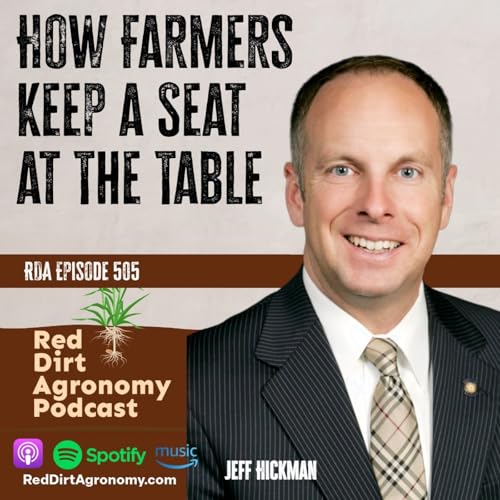
  • How Farmers Keep A Seat At The Table - RDA 505
    Feb 10 2026

    Recorded live from the Oklahoma Wheat Commission booth at the 2026 KNID AgriFest in Enid, the crew sits down with Jeff Hickman—farmer, longtime ag association leader, Oklahoma higher-education regent, and former Oklahoma House Speaker—for a grounded conversation on where agriculture is headed and why local involvement still matters.

    Jeff breaks down how ag organizations stay viable in an era of consolidation, why multiple commodity groups working together amplify agriculture’s voice, and how public policy and regulation increasingly shape day-to-day farm decisions. The discussion also hits consumer trust, social media misinformation (and how AI can muddy the waters), and why agriculture has to keep educating an audience that forgets fast.

    They close with what Jeff sees coming next—trade uncertainty, the need for a dependable farm policy, and the importance of building relationships with candidates before they’re elected. Practical, candid, and very Oklahoma.

    Ten Takeaways

    1. Ag organizations are stronger together—shared support can keep smaller groups viable and influential.
    2. Regulation is often the real battlefield, sometimes more than legislation.
    3. Fewer rural/ag lawmakers means ag has to work harder to be understood in policy rooms.
    4. Producer involvement doesn’t have to be huge—membership alone helps fund representation and benefits.
    5. Markets can disappear even after great yields, driving tough planting decisions (sorghum example).
    6. Wheat is in a strategy moment: “What’s our thing?” like corn has ethanol—new uses/value streams matter.
    7. Consumer curiosity is a double-edged sword—interest is good, misinformation is rampant.
    8. AI can accelerate fake “credible” ag narratives, raising the stakes for trusted education.
    9. Rural issues resonate when you connect the dots (health care access, metro revenue, statewide economy).
    10. Election years are relationship years—don’t wait until after someone wins to introduce agriculture.

    Detailed Timestamped Rundown

    00:00–01:44 — Episode open, setting: Oklahoma Wheat Commission booth at KNID AgriFest (Enid); introductions.
    01:45–03:35 — Jeff Hickman joins; “many hats” across OK ag organizations and higher ed.
    03:36–04:44 — Why shared management/back-office support keeps smaller ag groups viable and strengthens ag’s voice.
    04:45–06:53 — Policy reality: more dependence on public policy + regulations; increased focus on agencies/administration.
    07:03–08:52 — Jeff’s background: journalism/OU roles, media work, farm roots; “planting and harvest were my vacations.”
    09:12–12:44 — Political pendulum swings; how DC trends show up in statehouses; fewer rural/ag-connected legislators.
    12:45–15:54 — Consumer interest: good and hard; difficulty finding truth; misinformation and AI concerns; supply chain lessons.
    15:55–18:29 — Global factors hitting ag (tariffs, shipping routes, even piracy) through a real-world retail/cotton example.
    18:30–20:55 — Benefits/challenges of representing many groups; why having a strong government affairs team matters.
    21:14–23:59 — What growers are facing: crop choice risk, markets disappearing, wheat’s future “what’s our thing?”; value of membership (and CFAP example).
    24:00–27:33 — How to get more producers involved in leadership/politics; timing, family/team approach, candidate mentorship.
    28:13–32:50 — Translating rural needs for urban lawmakers (rural hospitals example); rural dollars fueling metro projects.33:26–36:31 — Next 6–9 months: trade unresolved, farm bill/farm policy stability, election-year urgency—build relationships now.
    36:32–38:11 — Wrap-up, thanks, and where to find resources.

    RedDirtAgronomy.com

    Show more Show less
    38 mins