Episodes

  • Philadelphia Quakers and the American Revolution with Jeffrey Denman
    Apr 7 2026

    Jeff Denman talks about his book Philadelphia Quakers and the American Revolution.

    How did a community rooted in pacifism navigate a moment defined by war, rebellion, and political upheaval? Philadelphia’s Quakers— committed to principles of nonviolence, religious conviction, and civic order—found themselves caught in the crosscurrents of revolution, where neutrality itself could be seen as disloyalty.

    Denman unpacks the difficult choices Quakers faced as the imperial crisis deepened into open conflict. Some sought to maintain their religious testimonies at all costs, while others were drawn, reluctantly or otherwise, into the orbit of revolutionary politics. The result was a story not of simple allegiance, but of internal division, moral struggle, and the challenge of remaining true to one’s beliefs in extraordinary times.

    Denman's examination of the experience of Philadelphia’s Quakers complicates familiar narratives of the Revolution. Their story reminds us that the era was not only shaped by soldiers and statesmen, but also by those who wrestled with conscience, community, and conviction in the face of a transforming world.

    Tell us what you think! Send us a text message!

    Show more Show less
    47 mins
  • American Ancestors on the American Revolution
    Mar 31 2026

    Genealogists David Allen Lambert and Melanie McComb of American Ancestors talk about how family history reshapes our understanding of the American Revolution. Drawing on the vast collections and scholarship of one of the nation’s oldest genealogical institutions, Lambert and McComb explore how military records, pension files, and local archives reveal stories far beyond famous names—illuminating the lives of women, immigrants, and Patriots of color whose contributions sustained the Revolutionary cause. From the remarkable longevity of Revolutionary War widows to the quiet resilience of families on the home front, the episode highlights how genealogy transforms “names and dates” into vivid human stories. Together, they make a compelling case that uncovering the past isabout rediscovering the ordinary people whose choices shaped a Revolution—and whose descendants still carry that legacy forward.

    Tell us what you think! Send us a text message!

    Show more Show less
    42 mins
  • Rage and the Republic with Jonathan Turley
    Mar 24 2026

    Most revolutions end in failure. If they succeed in toppling the bad old regime, they often create a new one that is worse. "Like Saturn," a French journalist observed in the early 1790s, "the Revolution devours its children." Why was the American Revolution different? Legal scholar and political analyst Jonathan Turley explores this question in his new book, Rage and the Republic: The Unfinished Story of the American Revolution. How did the Americans avoid the horrors other Revolutions? In this conversation we discuss the American Revolution, the history that American revolutionaries carried with them and informed their world, and the role of firebrands like Thomas Paine and Robespierre, and political theorists James Wilson and James Madison.

    Tell us what you think! Send us a text message!

    Show more Show less
    36 mins
  • The Maddest Idea: Creating a Navy with B. J. Armstrong
    Mar 17 2026

    On this episode of the Revolution 250 Podcast, host Professor Robert Allison welcomes Captain B.J. Armstrong, a 27-year officer in the United States Navy, Associate Professor of War Studies and Naval History at the U.S. Naval Academy, and Director of the Naval Academy Museum.

    BJ Armstrong's books include Small Boats and Daring Men, about irregular warfare in the Revolution. HIs regular series of blog-posts, "The Maddest Idea," explores the development of the Continental and the United States Navy.

    Their conversation explores one of the most daring and often overlooked decisions of the American Revolution: the creation of an American navy. Armstrong discusses the “maddest idea” debated by the Continental Congress in 1775, when a fledgling rebellion challenged the world’s most powerful maritime empire by taking to the sea. From small-boat raids and irregular warfare to the intellectual legacy of naval strategist Alfred Thayer Mahan, the discussion connects the Revolution’s naval origins to broader questions of maritime strategy and national power.

    Together, Allison and Armstrong examine how the Revolutionary generation imagined sea power, why maritime history is central to understanding the struggle for independence, and what the early American Navy can still teach us today.

    Tell us what you think! Send us a text message!

    Show more Show less
    40 mins
  • Nathanael Greene with Richard Howell
    Mar 10 2026

    In this episode of the Revolution 250 Podcast, host Robert J. Allison welcomes Richard Howell of the Nathanael Greene Homestead for a conversation about the life and legacy of one of the most remarkable commanders of the American Revolution, Nathanael Greene.

    Born into a Rhode Island Quaker family and raised as an ironmaster, Greene’s path to military leadership was anything but ordinary. Yet he would rise to become one of George Washington’s most trusted generals, playing a decisive role in the Southern Campaign of the Revolutionary War. Howell and Allison explore Greene’s unlikely rise from self-educated militia officer to strategic mastermind, whose campaigns in the Carolinas reshaped the course of the war.

    The conversation also examines Greene’s enduring legacy, from the preservation of his Rhode Island home to the broader challenge of remembering Revolutionary figures whose leadership unfolded far from the famous battlefields of Lexington and Concord. What made Greene such an effective commander, and why does his story still matter today?

    Join us for a lively exploration of strategy, character, and the complicated legacy of one of the Revolution’s most brilliant generals.

    Tell us what you think! Send us a text message!

    Show more Show less
    45 mins
  • Moral Capital: Foundations of British Abolitionism with Christopher L. Brown
    Mar 3 2026

    Why did an antislavery movement emerge at the time of the American Revolution, both in the American colonies and in Britain? Christopher Brown asks this question and many more in Moral Capital: Foundations of British Abolitionism. The American Revolution on both sides of the Atlantic brought together strands of thought and feeling which had been latent, as men and women grappled with questions of power and justice. Abolition was one way for Britons to restore their moral capital, and drew on many sources—economic, moral, religious. In a fascinating study Christopher Brown upends much of what we thought we knew about the antislavery movement, and allows us to see the 18th-century world with fresh eyes.

    Tell us what you think! Send us a text message!

    Show more Show less
    41 mins
  • Lafayette Returns! with Ryan Cole
    Feb 24 2026

    We talk with historian Ryan Cole about memory, gratitude, and the young republic’s most celebrated guest. Cole's new book, The Last Adieu: Lafayette's Triumphant Return, the Echoes of Revolution, and the Gratitude of the Republic , explores the extraordinary 1824–1825 return tour of Gilbert du Motier, marquis de Lafayette. Nearly fifty years after the shots at Lexington and Concord, Lafayette’s journey across all twenty-four states became a rolling national reunion, a living bridge between the Revolutionary generation and a rising America eager to define itself.

    Lafayette’s visit was more than ceremonial pageantry. It was a reaffirmation of republican ideals, a masterclass in civic memory, and perhaps the most unifying event of the early nineteenth century. From parades and banquets to emotional reunions with aging veterans, the tour rekindled revolutionary spirit at a moment when the nation stood at a crossroads.

    This conversation reminds us that anniversaries are not simply about looking backward. They are about renewing vows. Lafayette’s farewell tour shows how a grateful republic honors its past while quietly shaping its future.

    Tell us what you think! Send us a text message!

    Show more Show less
    43 mins
  • Fighting for Philadelphia with Michael C. Harris
    Feb 17 2026

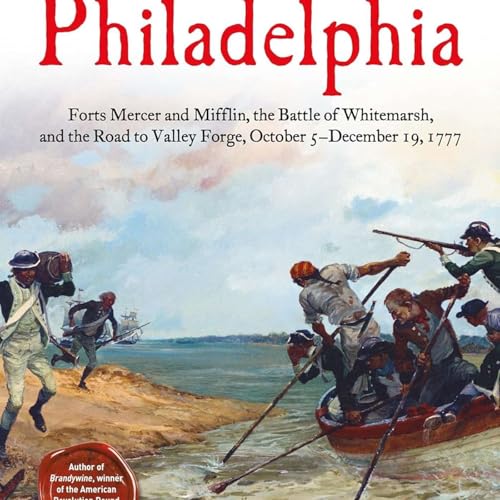
    . Why did Philadelphia matter so deeply to both the British and the Continental Army? How did strategy, logistics, and personalities shape the campaign that culminated in Brandywine, Germantown, and the winter at Valley Forge? And what did the occupation of the revolutionary capital mean for civilians caught between armies? Michael C. Harris tells this story in his new book, Fighting for Philadelphia: Forts Mercer and Mifflin, the Battle of Whitemarsh, and the Road to Valley Forge. This campaign around the new country's largest city, in the marshes, woods, and fields of Pennsylvania and New Jersey was a critical turning point testing the resilience of the American people and military and reshaping the war's momentum. .


    Tell us what you think! Send us a text message!

    Show more Show less
    42 mins