Episodes

  • Is Punch the monkey really just like us?
    Mar 26 2026

    When Punch the monkey was abandoned by his mother, zookeepers gave him a surrogate and unexpected source of comfort: a stuffed animal. Videos of Punch snuggling the stuffie went viral, and, as his stardom rose, millions of us began wondering, “Is Punch OK? Does he have a girlfriend?” Primatologist Christine Webb joins Host Flora Lichtman to talk about the ways humans relate to our closest relatives, and whether we can—and should—map human feelings onto other primates.

    Guest:

    Christine Webb is an assistant professor of environmental studies (CK) at New York University. She is the author of “The Arrogant Ape: The Myth of Human Exceptionalism and Why It Matters.”

    Transcripts for each episode are available within 1-3 days at sciencefriday.com.

    Subscribe to this podcast. Plus, to stay updated on all things science, sign up for Science Friday's newsletters.

    Show more Show less
    12 mins
  • Could bird flu still spark a pandemic?
    Mar 25 2026

    Bird flu has flown off the national news radar, with only scattered, local reports of dead birds in parks and poultry farms. Is it simply no longer a concern, or have cuts to federal science funding disrupted monitoring for this disease? Airborne pathogens expert Seema Lakdawala gives a flyover view on where bird flu stands today, and whether the government’s current monitoring efforts are enough to help prevent another pandemic.

    Guest:

    Dr. Seema Lakdawala is co-director of the Center for Transmission of Airborne Pathogens and an associate professor at Emory University in Atlanta, Georgia.

    Transcripts for each episode are available within 1-3 days at sciencefriday.com.

    Subscribe to this podcast. Plus, to stay updated on all things science, sign up for Science Friday's newsletters.

    Show more Show less
    19 mins
  • The secret powers of flowers
    Mar 24 2026

    Flowers peeking up through the soil are a welcome sight after a long cold winter—and are one of the first markers of spring. Biologist David George Haskell argues that flowers aren’t just beautiful: They’re also critical to most ecosystems and the diversity of life as we know it. Flowering plants also make up a large part of human diets (rice, maize, and wheat are all flowers). And homing in on orchids, Haskell says, can help us understand the complex relationship between flowers and pollinators.

    Guest:

    Dr. David George Haskell is a biologist and author of: “How Flowers Made Our World: The Story of Nature’s Revolutionaries”

    Transcripts for each episode are available within 1-3 days at sciencefriday.com.

    Subscribe to this podcast. Plus, to stay updated on all things science, sign up for Science Friday's newsletters.

    Show more Show less
    17 mins
  • Apple: trying to think different for 50 years
    Mar 23 2026

    The Apple Computer Company was founded on April 1, 1976, and in the 50 years since, the company has evolved from a handful of Silicon Valley misfits to a global technology and media powerhouse.

    Tech journalist David Pogue talks with Ira Flatow about the backstory of the company, and the leadership of the mercurial Steve Jobs. He offers a peek into some lesser known chapters of the company’s history, like the ill-fated Apple Paladin, a prototype Apple-produced fax machine. Pogue chronicles the company’s history in his latest book, “Apple: The First 50 Years.”

    Guest:

    David Pogue is a tech journalist, CBS Sunday Morning correspondent, and author of the book “Apple: The First 50 Years.”

    Transcripts for each episode are available within 1-3 days at sciencefriday.com.

    Subscribe to this podcast. Plus, to stay updated on all things science, sign up for Science Friday's newsletters.

    Show more Show less
    18 mins
  • ‘Project Hail Mary’ brings a new kind of alien to the big screen
    Mar 20 2026

    Science fiction nerds, rejoice: the long-awaited adaptation of “Project Hail Mary” is in theaters now. Host Flora Lichtman chats with book author Andy Weir and astrobiologist Mike Wong about the film’s aliens, and how they buck the trend of what extraterrestrials usually look like on screen.

    Guest:

    Andy Weir is the author of “Project Hail Mary” and “The Martian.”

    Dr. Mike Wong is an astrobiologist and planetary scientist at Carnegie Science in Washington, D.C.

    Transcripts for each episode are available within 1-3 days at sciencefriday.com.

    Subscribe to this podcast. Plus, to stay updated on all things science, sign up for Science Friday's newsletters.

    Show more Show less
    25 mins
  • Building a digital ant gallery, from the ground up
    Mar 19 2026

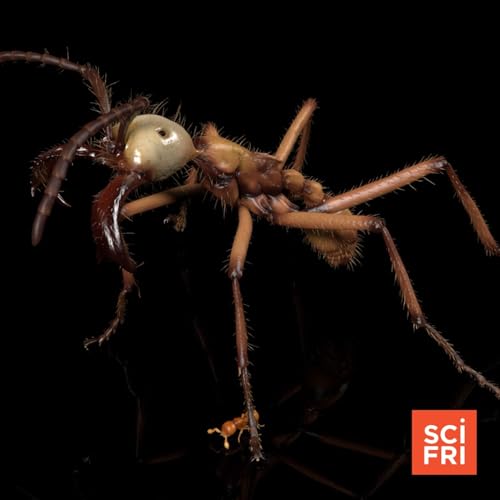
    A project called Antscan has generated high resolution images of thousands of ants, representing over 700 species. To make it happen, researchers brought preserved ants from collections around the world to a particle accelerator in Germany. There, a powerful synchrotron X-ray source combined with a vial-swapping robot allowed the researchers to build a collection of 3D ant images, inside and out. Each voxel (like a 3D pixel) has a resolution of 1.22 micrometers—enough to see the tiny hairs on ant bodies, and distinguish individual muscle fibers.

    Antscan researcher Julian Katzke joins us to describe the background of the project, and how the images could be used for science and art.

    Check out Antscan images at our website.

    Guest:

    Dr. Julian Katzke is a postdoc at the Smithsonian National Museum of Natural History. He worked on the AntScan project while a PhD student at the Okinawa Institute of Science and Technology.

    Transcripts for each episode are available within 1-3 days at sciencefriday.com.

    Subscribe to this podcast. Plus, to stay updated on all things science, sign up for Science Friday's newsletters.

    Show more Show less
    13 mins
  • The heaviness and (not) hope of climate change
    Mar 18 2026

    For decades, renowned environmental writer Elizabeth Kolbert has taken readers to remote corners of the planet to understand how all life is connected—and how our planet is changing. She’s covered everything from the collapse of insect populations to the success of one town’s effort to go carbon neutral.

    Host Flora Lichtman speaks with Kolbert about the undeniable heaviness of our current climate moment, how the splendor of the Great Barrier Reef “tilted” her worldview, and the messy business of trying to solve environmental problems.

    In March and April, the Science Friday Book Club is reading Kolbert’s latest book, “Life on a Little-Known Planet.” It’s a collection of essays she’s written over the years. Check out the Book Club to read along.

    Guest:

    Elizabeth Kolbert is a staff writer at The New Yorker and the author of several books, including “Life on a Little-Known Planet: Dispatches from a Changing World.”

    Transcripts for each episode are available within 1-3 days at sciencefriday.com.

    Subscribe to this podcast. Plus, to stay updated on all things science, sign up for Science Friday's newsletters.

    Show more Show less
    18 mins
  • Could a ‘digital twin’ help you get better health care?
    Mar 17 2026

    There’s an idea bubbling up in medicine called the “digital twin.” The concept is to take personal health data like genetics, blood test results, tissue samples, MRI scans, and family history, and create a digital model of a patient that can be used to predict how a treatment might work for them. Think personalized medicine supercharged by AI.

    For example, cancer researchers are working on models that would create radiation and chemotherapy treatment plans based on the specifics of a patient’s tumor. But these models aren’t ready for the clinic yet, and with so much patient data involved, privacy concerns abound.

    Host Flora Lichtman talks with Caroline Chung, a radiation oncologist at the forefront of digital twin research.

    Guest:

    Dr. Caroline Chung is a radiation oncologist and the co-director of the Institute for Data Science Oncology at UT MD Anderson Cancer Center.

    Transcripts for each episode are available within 1-3 days at sciencefriday.com.

    Subscribe to this podcast. Plus, to stay updated on all things science, sign up for Science Friday's newsletters.

    Show more Show less
    18 mins