SoCCC Pre-Rounds: Bite-Sized Critical Care Cardiology Topics Delivered By Experts Podcast By Dr. Balim Senman Dr. Elliott Miller Dr. Simon Parlow Dr. Anthony Carnicelli cover art

SoCCC Pre-Rounds: Bite-Sized Critical Care Cardiology Topics Delivered By Experts

SoCCC Pre-Rounds: Bite-Sized Critical Care Cardiology Topics Delivered By Experts

By: Dr. Balim Senman Dr. Elliott Miller Dr. Simon Parlow Dr. Anthony Carnicelli
Listen for free

SoCCC Pre-Rounds is your go-to for quick, high-yield insights in critical care cardiology, hosted by members of the Society of Critical Care Cardiology (SoCCC). With only 160 specialists in the U.S., mentorship is rare. This podcast bridges the gap with bite-sized episodes featuring clinical pearls, expert tips, and real-world answers on topics like cardiogenic shock, ECMO, and resuscitation. Perfect for pre-rounds, night shifts, or leveling up anytime. Listen in. Level up. Join the SoCCC community.Dr. Balim Senman, Dr. Elliott Miller, Dr. Simon Parlow, Dr. Anthony Carnicelli Hygiene & Healthy Living Physical Illness & Disease
Episodes
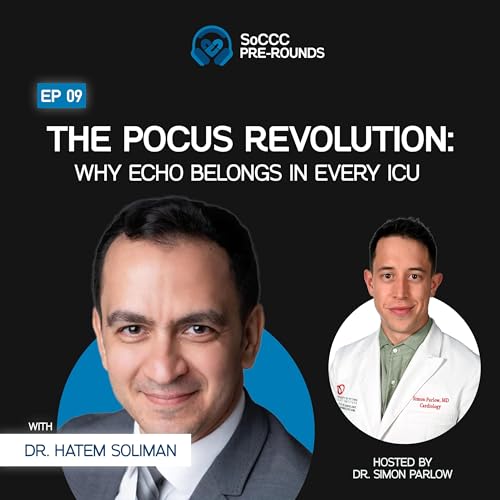
  • The POCUS Revolution: Why Echo Belongs in Every ICU with Dr. Hatem Soliman
    Apr 3 2026
    In this episode of SoCCC Pre-Rounds, Dr. Simon Parlow is joined by Dr. Hatem Soliman, a leading expert in critical care echocardiography, for a deep dive into the game-changing role of point-of-care ultrasound or POCUS in resuscitation and cardiac intensive care.Together, they unpack how resuscitative echocardiography can help identify reversible causes of cardiac arrest, like pericardial tamponade or tension pneumothorax, and even guide real-time chest compression placement to improve CPR effectiveness.Dr. Soliman highlights two must-have views: the apical five-chamber for stroke volume and the short-axis great vessels view to assess RV function and pulmonary pressures.If you're looking to sharpen your bedside skills and bring more precision to your resuscitation toolkit, this episode is packed with insights you won’t want to miss.Key TakeawaysMove beyond the IVC: Hepatic, portal, and renal vein Doppler give a clearer picture of systemic venous congestion than IVC alone.Cardiac output needs context: Doppler VTI can mislead unless combined with views like apical five-chamber and timing indices like isovolumetric contraction time.Every echo parameter has a pitfall: Never interpret one measure in isolation; always integrate findings with clinical judgment.His go-to views in shock? Apical 5 chamber (LVOT VTI) and parasternal short axis of great vessels (PA flow) to assess perfusion and RV afterload.In This Episode[00:00] Introduction to the podcast[02:24] Role of echo in cardiac arrest[03:43] Training and cautions with echo in CPR[06:19] Key skills for new trainees in critical care echo[07:33] Physiological assessment in critical care echo[09:21] Multi-organ ultrasound and venous congestion[11:45] Systemic venous congestion in post-ICU patients[12:18] Comprehensive cardiac output assessment[15:50] Pitfalls and dangers of critical care POCUS[17:18] Favorite echo views in cardiac ICUNotable Quotes[06:33] "Critical care echo is actually complex... you need to further proceed from this basic level to intermediate and then advanced levels in which you will be able to assess physiological changes in the heart." — Dr. Hatem Soliman[09:22] "The practice of multi-organ ultrasound and looking beyond the chest cavity for congestion is a very important advancement in point-of-care ultrasound." —Dr. Hatem Soliman[17:24] "If I have two views to look at in a very short time... the apical five chamber view to get the LVO TVTI because that immediately gives you a clue about stroke volume and cardiac output." — Dr. Hatem SolimanDr. Hatem SolimanDr. Hatem Soliman is a cardiac intensivist at Harefield Hospital and senior lecturer at King’s College London. He serves on the executive board of the European Association of Cardiovascular Imaging and the editorial board of JACC: Cardiovascular Imaging. A global educator and author of key POCUS textbooks, Dr. Suleiman is renowned for advancing the use of bedside echocardiography in critical care to improve hemodynamic assessment and patient outcomes.Resources and LinksBecome a member of the Community: https://www.soccc.org/subscribeDr. Hatem Solimanhttps://www.escardio.org/https://www.linkedin.com/in/hatemsoliman/Dr. Simon Parlowhttps://www.ottawaheart.ca/profile/parlow-simonMentioned Doyen A. et al. Portal Doppler Ultrasound in Congestion Assessment (André Denault’s work)JACC Imaging, Journal of Cardiovascular UltrasoundEuropean & American Resuscitation GuidelinesSupported By:This episode is made possible by unrestricted support from Zoll LifeVest — thanks for keeping high-impact education free for our community.DisclaimerThis podcast is not medical advice, just candid, practical discussions about what your hosts do every day in the CICU. Always consult your supervising team and current guidelines before applying any interventions.
    Show more Show less
    19 mins
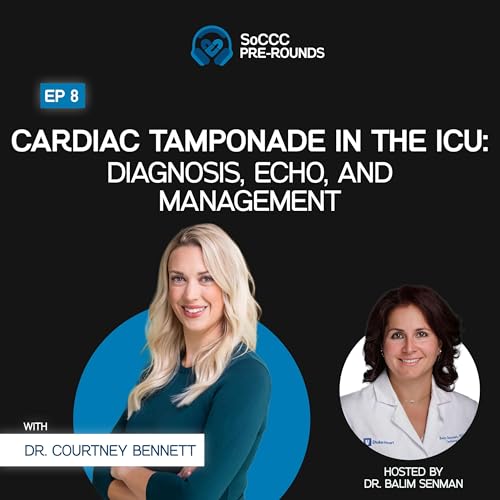
  • Cardiac Tamponade in the ICU: Diagnosis, Echo, and Management with Dr. Courtney Bennett
    Mar 6 2026
    In this episode of SoCCC Pre-Rounds, Dr. Balim Senman sits down with Dr. Courtney Bennett, a critical care cardiologist and echocardiographer at Mayo Clinic Rochester, to unpack the bedside recognition and management of cardiac tamponade. The conversation emphasizes tamponade as a clinical diagnosis, highlighting key physical exam clues such as tachycardia, hypotension, elevated JVP, pulsus paradoxus, and electrical alternans. Dr. Bennett explains the physiology of ventricular interdependence and why the rate of pericardial fluid accumulation matters more than volume alone.The episode also explores how point-of-care echocardiography supports but does not replace clinical judgment, distinguishing early findings like inflow variation from late signs such as chamber collapse. Management strategies are discussed in real-world terms, including when to urgently drain an effusion, how to stabilize patients with fluids and vasopressors while awaiting intervention, and common pitfalls like inappropriate diuresis. This episode delivers practical, high-yield guidance for clinicians managing undifferentiated shock in the cardiac ICU.Key TakeawaysTamponade is a clinical diagnosis: Pericardial effusion alone does not equal tamponade without hemodynamic compromiseTachycardia often comes first: Hypotension and shock may follow as compensation failsSmall, rapidly accumulating effusions can be fatal, while large chronic effusions may be well toleratedEcho supports, not replaces clinical judgment: Chamber collapse suggests late disease; inflow variation may signal early tamponadeDrain emergently when unstable: Approach and urgency depend on patient trajectory, not imaging aloneIn This Episode[00:00] Introduction[01:11] Definition of cardiac tamponade[01:50] Physical exam findings in tamponade[03:25] Pulsus paradoxus: definition and mechanism[04:57] Etiologies of pericardial effusion[05:43] Volume vs. hemodynamic instability[06:40] Clinical vs. echo diagnosis of tamponade[08:09] Echocardiographic findings in tamponade[10:02] Management: tamponade vs. stable effusion[12:10] Stabilizing the pre-tamponade patient[13:23] Fluid vs. diuretics in tamponadeNotable Quotes[01:28] "This is a diagnosis when a patient has pericardial effusion. So excess fluid around the heart that's causing them to have hypotension, low blood pressure, and part of that actually could be what we would describe as Beck's triad." — Dr. Courtney Bennett[12:38] "So first and foremost, I would start with IV fluid resuscitation bolus. I don't think there's a well-defined amount that we should use. 500 a liter of fluid. You have to use your clinical assessment because many of our patients may also be peripherally volume overloaded as well. But typically in this scenario, fluid is really the upfront management."— Dr. Courtney Bennett[13:48] "Sometimes I work with learners who think that because there's an excess of fluid around the heart, we should be giving diuretics. That's not the case because diuretics will decrease the preload and actually worsen the hypotension."— Dr. Courtney BennettResources and LinksBecome a member of the Community: https://www.soccc.org/subscribeDr. Courtney Bennetthttps://alumniassociation.mayo.edu/colleague-notes/courtney-bennett-d-o/Dr. Balim Senmanhttps://www.linkedin.com/in/balim-senman-7561436b/https://x.com/BalimSenmanMDhttps://www.soccc.org/Supported By:This episode is made possible by unrestricted support from Zoll LifeVest — thanks for keeping high-impact education free for our community.DisclaimerThis podcast is not medical advice, just candid, practical discussions about what your hosts do every day in the CICU. Always consult your supervising team and current guidelines before applying any interventions.
    Show more Show less
    15 mins
  • The Basics of the Pulmonary Artery Catheter with Dr. Aniket Rali
    Feb 6 2026
    Did you know that pulmonary artery catheters are crucial for patients with unclear shock etiology? In this episode of SoCCC Pre-Rounds, Dr. Elliot Miller sits down with Dr. Aniket Rali, a dual-trained critical care and heart failure cardiologist at Vanderbilt, for a deep dive into the art and science of pulmonary artery catheterization, also known as the Swan-Ganz catheter.Dr. Rali demystifies the PAC by walking us through the fundamentals of when to use it, who should not get one, and how to interpret and troubleshoot the data it provides. Whether you're a resident inserting your first swan or a fellow refining your hemodynamic assessments, this episode will elevate your bedside practice.From contraindications and waveform recognition to zeroing, troubleshooting, and avoiding wedge-related complications, Dr. Rali shares high-impact pearls grounded in real-world CICU experience.Key TakeawaysUse PACs when shock etiology is unclear; they're diagnostic, not therapeuticAvoid PACs in patients with endocarditis, thrombus, or proximal PEKnow your waveforms; it's your only guide during bedside placementAlways level and zero the transducer for accurate pressuresJustify PAC use daily and remove once it’s no longer neededTroubleshoot waveform loss by checking positioning, clots, or tubingAvoid repeated wedging; use diastolic-to-wedge trends when possibleUse chest X-ray to confirm safe placement and prevent complicationsIn This Episode[00:00] Introduction[01:16] Pulmonary artery catheter basics[02:04] Indications for PA catheter use[06:57] Special considerations: left bundle and pacemaker leads[08:12] Bedside placement preparation and checklist[11:33] Presenting PA catheter data on rounds[12:03] Ensuring data accuracy and daily safety checks[15:17] Sequence for presenting hemodynamic data[16:23] Cardiac output measurement methods[18:31] Choosing between Fick and thermodilution[20:04] Limitations in shunt physiology[20:58] Troubleshooting PA catheter issuesNotable Quotes[02:17] "At the end of the day, a diagnostic tool is not going to treat your patient. But if it provides you with additional information that helps you reach the right diagnosis, then it becomes a valuable tool." — Dr. Aniket Rali[09:07] "I firmly believe that the more you sweat in peace, less you bleed in war. And that holds true of any procedure." — Dr. Aniket Rali[10:07] "You really should not be putting in a bedside swan unless you have mastered the waveforms, because the waveforms are your only guidance as to which cardiac chamber you are in." —Dr. Aniket Rali[12:31] "I encourage trainees, next time they have a patient with a SWAN Ganz catheter in, to just have them move their arm or move the catheter up by a foot and down by a foot and see how the pressure readings change." — Dr. Aniket Rali[27:28] "Long live the swan." — Dr. Aniket RaliDr. Aniket RaliDr. Aniket Rali is a heart failure and critical care cardiologist at Vanderbilt University. She’s known for her expertise in hemodynamics, real-world application of advanced monitoring, and thoughtful mentorship of trainees learning the art of bedside right heart catheterization.Resources and LinksBecome a member of the Community: https://www.soccc.org/subscribeDr. Aniket Ralihttps://medicine.vumc.org/department-directory/Aniket-Ralihttps://www.linkedin.com/in/aniket-rali-md-facc-fccp-69ab15228Dr. Elliot Millerhttps://x.com/ElliottMillerMDhttps://www.soccc.org/Supported By:This episode is made possible by unrestricted support from Zoll LifeVest — thanks for keeping high-impact education free for our community.DisclaimerThis podcast is not medical advice, just candid, practical discussions about what your hosts do every day in the CICU. Always consult your supervising team and current guidelines before applying any interventions.
    Show more Show less
    28 mins
No reviews yet