Speaking of Mol Bio Podcast By Thermo Fisher Scientific cover art

Speaking of Mol Bio

Speaking of Mol Bio

By: Thermo Fisher Scientific
Listen for free

Speaking of Mol Bio, a podcast series from Thermo Fisher Scientific, discusses trending applications in science and the molecular biology aspects of those applications. Our host delves in to deep discussion with CEOs, R&D scientists, researchers, and key opinion leaders across the globe. Speaking of Mol Bio helps scientific curious people - from all scientific and non-scientific backgrounds - understand how modern molecular biology applications can help push the boundaries in medicine, science, drug discovery, and in the cure and treatment of diseases. Music from NOWHERE by ikson™ (https://www.iksonmusic.com)2025 Thermo Fisher Scientific Biological Sciences Natural History Nature & Ecology Science
Episodes
  • DNA-encoded library use in living cells for drug discovery
    Apr 22 2026

    In this episode of Speaking of Mol Bio, host Steve Lewis speaks with Dr. Leif Larsen, Director of Biology at Vipergen, about the power of DNA-encoded libraries (DELs) in modern drug discovery. DEL technology enables researchers to screen extremely large chemical libraries by attaching a unique DNA barcode to each compound, allowing millions, or even hundreds of millions, of compounds to be analyzed simultaneously through sequencing.

    Larsen explains how Vipergen’s platform flips traditional screening methods by storing massive compound libraries in a single tube and identifying binding interactions through DNA sequencing. He also describes their proprietary Binder Trap Enrichment (BTE) method, which links DNA barcodes when compounds successfully bind their protein targets. One of the company’s most innovative advances is performing DEL screening inside living Xenopus oocytes. By expressing target proteins in these large cells and microinjecting DNA-encoded libraries, researchers can evaluate binding events in a physiologically relevant environment.

    The discussion also explores how this technology accelerates early drug discovery timelines and enables screening of difficult targets such as transcription factors and membrane proteins. Larsen closes by highlighting emerging areas such as PROTAC-based targeted protein degradation and how DEL screening can help identify molecules suitable for these next-generation therapeutic strategies.

    Subscribe to get future episodes as they drop and if you like what you’re hearing we hope you’ll share a review or recommend the series to a colleague. 

    Visit the Invitrogen School of Molecular Biology to access helpful molecular biology resources and educational content, and please share this resource with anyone you know working in molecular biology.

    For Research Use Only. Not for use in diagnostic procedures.

    Show more Show less
    30 mins
  • Choosing the right PCR method for your experiment
    Apr 8 2026

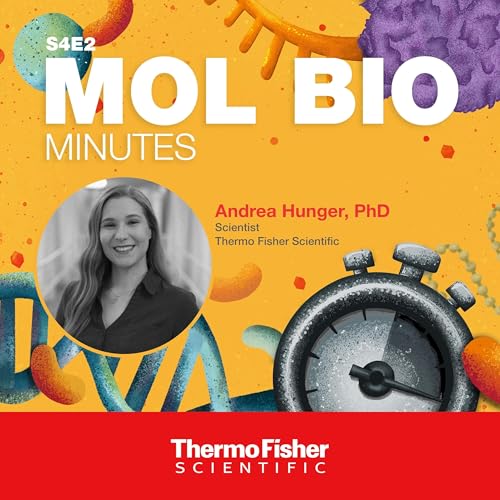
    In this Mol Bio Minutes mini-episode of Speaking of Mol Bio, Dr. Andrea Hunger walks listeners through the practical differences between three core PCR approaches: endpoint PCR, quantitative PCR (qPCR), and digital PCR. Drawing on her experience in both academic research and industry, she explains how each technique provides different types of information and why choosing the right one depends on the biological question being asked.

    Endpoint PCR is the simplest method and is ideal for basic presence-or-absence questions such as confirming cloning success or genotyping samples. While fast and accessible, it does not provide quantitative information. For experiments requiring measurement of gene expression levels or comparisons between samples, qPCR offers a powerful solution by monitoring amplification in real time and using Ct values and standard curves to estimate starting concentrations.

    Hunger then discusses digital PCR, a newer technology that partitions samples into many micro-reactions to enable highly precise, absolute quantification of nucleic acids. Because it counts positive and negative partitions directly, digital PCR is especially valuable for detecting rare mutations, low-abundance targets, and applications like liquid biopsy analysis. Ultimately, she emphasizes that these PCR approaches are complementary tools, and the best experimental strategy is to choose the method that provides the level of information required for the next step in a research workflow.

    Helpful resource links mentioned in this episode:

    • Access educational eBook covering all three types of PCR and their use in gene expression analysis.
    • Watch a video on when to choose digital vs. real-time PCR.
    • Use the PCR primer design tool from Thermo Fisher.
    • Access Harvard’s PrimerBank, a public resource of PCR primers.

    Subscribe to get future episodes as they drop and if you like what you’re hearing we hope you’ll share a review or recommend the series to a colleague. 

    Visit the Invitrogen School of Molecular Biology to access helpful molecular biology resources and educational content, and please share this resource with anyone you know working in molecular biology.

    For Research Use Only. Not for use in diagnostic procedures.

    Show more Show less
    13 mins
  • From bench to bushland ─ developing a koala chlamydia vaccine
    Mar 25 2026

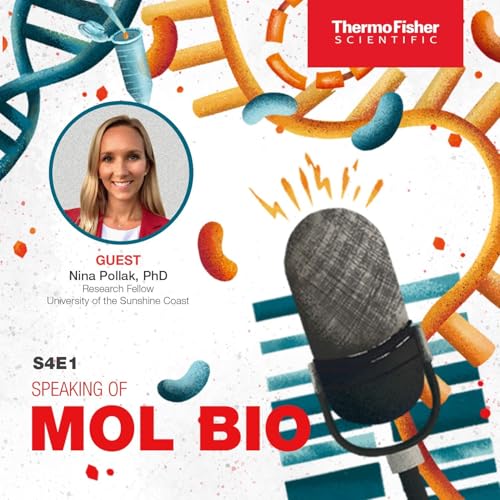
    In this Season 4 premiere of Speaking of Mol Bio, host Steve Lewis speaks with Dr. Nina Pollak from the University of the Sunshine Coast about the development of a single-dose vaccine aimed at protecting endangered koalas from Chlamydia pecorum. The disease is a major threat to koala populations across eastern Australia, contributing to infertility, blindness, and increased mortality. Pollak’s work focuses on optimizing the production and quality control of vaccine antigens while supporting regulatory approval and field trials that ultimately led to a conditional minor-use permit from Australia’s veterinary regulatory authority.

    The vaccine relies on recombinant versions of the major outer membrane protein (MOMP) from three dominant chlamydial genotypes. Using standard molecular biology techniques, including gene cloning in E. coli, His-tag purification, SDS-PAGE verification, western blotting, and mass spectrometry, Pollak’s team produces and verifies these vaccine antigens before combining them with adjuvants to stimulate protective immune responses.

    Beyond the science, the episode explores the challenges of conservation-focused vaccinology: field vaccination of wild animals, limited commercial incentives, and the importance of methods for monitoring disease prevalence. Pollak also reflects on the collaborative nature of the decade-long project and offers advice to young scientists pursuing difficult but meaningful research challenges.

    Subscribe to get future episodes as they drop and if you like what you’re hearing we hope you’ll share a review or recommend the series to a colleague. 

    Visit the Invitrogen School of Molecular Biology to access helpful molecular biology resources and educational content, and please share this resource with anyone you know working in molecular biology.

    For Research Use Only. Not for use in diagnostic procedures.

    Show more Show less
    36 mins
No reviews yet