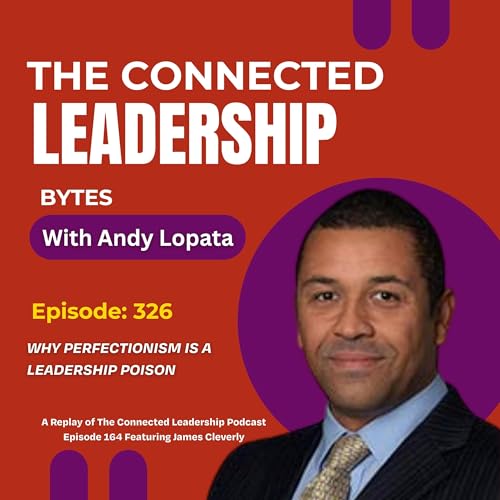
The Connected Leadership Podcast Podcast By Evergreen Podcasts cover art

The Connected Leadership Podcast

The Connected Leadership Podcast

By: Evergreen Podcasts
Listen for free

Speaker and author on professional relationships, Andy Lopata, explores great connections with experts and high achievers worldwide.Andy Lopata, H & A Lopata ltd 2020 Career Success Economics Leadership Management & Leadership
Episodes
  • Why Perfectionism is a Leadership Problem with James Cleverly
    Mar 30 2026
    Is admitting a mistake a sign of weakness or a leadership superpower? In this episode of Connected Leadership Bytes, Andy Lopata reaches into the archive to share a fascinating conversation with James Cleverly MP. Cleverly explores the "artificiality" of politics—a world where a simple "I’ll check those figures and get back to you" can be framed as a lack of credibility, and any change of course is branded a " U-turn." Drawing from his background in the military and business, he contrasts these rigid expectations with other industries where making mistakes is seen as a vital part of the evolutionary process. James discusses the anatomy of a political car crash, to reveal how "clever people in closed rooms" accidentally create echo chambers. Discover why leaders often fail to press the "stop button" even when they see a disaster coming, and learn how to balance the need for speed with the vital necessity of a "periodic sanity check." What you will learn in this episode 1. The Pivot vs. The Scandal: Why is a "course correction" celebrated in startups but punished in leadership—and how is this mindset stifling your team’s growth? 2. The "Clever People" Trap: How small, high-performing teams accidentally "plug themselves into the matrix" and ignore the elephant in the room. 3. The Anatomy of a Car Crash: Discover the five or six specific points in every decision where a simple intervention could have prevented total failure. 4. The Aeronautical Safety Lesson: Why adding too many "safety valves" to your leadership process might actually make your organisation too heavy to fly. 5. The Art of "Rolling the Pitch": Why you should never present a solution until you have achieved a collective agreement on the parameters of the problem. Actionable Insights 1. Schedule a "Sanity Check": To avoid echo chambers, ensure that your decision-making process includes an explicit phase where the team must "unplug from the matrix" and seek a blunt, external perspective. Ask: "Am I the only one who thinks this is bonkers?" 2. Reward the "Stop Button": Build a culture where team members feel empowered to pause a process if a fact or figure "doesn't feel right." In high-stakes environments, the confidence to intervene is more valuable than the speed of implementation. 3. Frame Mistakes with the 80/10/10 Rule: When correcting a policy or project, frame it logically: "80% is working brilliantly, 10% is adequate, and 10% needs adjustment." This shifts the narrative from a "failure" to a pragmatic optimisation. Connect with Andy Lopata: Website | Instagram | LinkedIn | X/Twitter | YouTube Connect with James Cleverly: Website |LinkedIn | The Financial Times Guide to Mentoring Episode 164 Featuring James Cleverly
    Show more Show less
    21 mins
  • The Secret to High-Performing Teams: Psychological Safety with Rebecca Morgan
    Mar 23 2026
    What is the single most important factor that separates the highest-performing teams from the rest? When Google launched "Project Aristotle" to answer this exact question, they assumed the answer would be a mix of education, experience, and demographics. They were wrong. The number one element of a successful team, according to Google's massive study, is psychological safety. In this episode from the archive, Andy Lopata is joined by Silicon Valley leadership expert Rebecca Morgan to unpack this critical concept. They explore what psychological safety actually means, why the best leaders actively admit their mistakes, and how to create an environment where teams are comfortable taking risks and pushing back. If you want to build a culture of innovation, reduce turnover, and stop your team from blindly driving off a cliff because they were too afraid to speak up, this is a must-listen. Key Takeaways From This Episode 1. What is the formal definition of psychological safety, and why was it identified as the #1 factor in Google's highest-performing teams? 2. How does a leader admitting their own mistakes actually increase a team's performance and innovation? 3. What is the "authenticity continuum," and how do you find the balance between being too filtered and dangerously unfiltered at work? 4. How can you "disagree agreeably" with a boss or a team that is heading in the wrong direction? 5. What is a "pre-mortem," and how can teams use it to plan for failure before a project even launches? Actionable Insights 1. Model Vulnerability to Give Permission: If you want your team to take risks and admit errors, you have to go first. As a leader, openly sharing your own mistakes gives your team psychological permission to do the same. This shifts the culture from hiding failures to learning from them. 2. Use "Reservation Phrases" in Meetings: If you're an introvert (or just need a moment to think), use a simple phrase to reserve your spot in a fast-paced discussion without having to shout over extroverts. Say, "Hold on just a second, I have an idea. Give me five seconds to articulate it." This secures your airtime while you formulate your thought. 3. Upgrade Your "How Are You?" Stop using "how are you doing?" as a throwaway greeting. To build genuine psychological safety, ask deeper, semantic differential questions like, "How are you really doing?" or "Is there anything I can do to lighten your load?" This shows genuine care and opens the door for real support. SELECTED LINKS FROM THE EPISODE Connect with Andy Lopata: Website | Instagram | LinkedIn | X/Twitter | YouTube Connect with Rebecca Morgan: Website |LinkedIn | The Financial Times Guide to Mentoring Episode 163 Featuring Rebecca Morga
    Show more Show less
    23 mins
  • The Power of Simple Messaging with Ben Brabyn
    Mar 16 2026
    Welcome back to The Connected Leadership Bytes. In today’s archive episode, Andy is joined by Ben Brabyn, a former Captain in the Royal Marines, former CEO of the renowned London tech company Level39, and a pioneer who helped build one of the world's first crowdfunding platforms. Drawing from his unique career journey—spanning military service, investment banking at JP Morgan, and tech entrepreneurship—Ben shares invaluable insights into how network structures actually work. Andy and Ben explore the surprising similarities between military and corporate networks, how to navigate deep uncertainty through contingency planning, and why radical simplicity is the secret to getting your network to advocate for you. Ben also introduces the concept of the "Conveyors of Confidence"—the unsung heroes who serve as the cultural glue in any successful organisation. Key Takeaways from This Episode: 1. Listening is the Ultimate Unifying Skill: Whether you are leading Royal Marines, navigating an investment bank, or building a tech startup, the most critical networking skill is the ability to listen. Using your network to gather information, analyse it, and extract wisdom—not just data—is what drives success across all sectors. 2. Veterans Bring a "Comfort with Uncertainty": The military isn't just about shouting orders; it's a highly collaborative environment that trains leaders to be comfortable with ambiguity. Veterans bring a learned habit of "contingency planning"—constantly analysing the "what ifs" and fallback positions—which is an invaluable asset for civilian companies facing rapid change. 3. Identify Your "Conveyors of Confidence": Every organisation has people who act as the cultural backbone (similar to Non-Commissioned Officers in the military). These individuals might not bring in the big sales, but they are the "collective memory" of the company. They listen to everyone—from top executives to the cleaning staff—and build the horizontal and vertical trust that holds teams together. 4. Complex Messages Do Not Travel: If your 30-second elevator pitch is packed with intense, complex information, third parties will never pass it on. The best listeners are often the best simplifiers. To truly leverage your network, you must create a simple message that anyone can understand and enthusiastically share. SELECTED LINKS FROM THE EPISODE Connect with Andy Lopata: Website | Instagram | LinkedIn | X/Twitter | YouTube Connect with Ben Brabyn: Website |LinkedIn | The Financial Times Guide to Mentoring Episode 162 Featuring Ben Brabyn
    Show more Show less
    24 mins
No reviews yet