• Does the Label Given to My MS Disease Course Matter?
    Mar 19 2026

    How much do the labels used to describe multiple sclerosis actually reflect the lived experience of people affected by the disease?

    In this first episode of the new ECTRIMS–MS Journal collaboration series, host Dr. Anneke van der Walt, Controversies Editor at the Multiple Sclerosis Journal, speaks with Jon Strum, MS caregiver and host of the RealTalk MS podcast, and Kathryn Smith, patient advocate and volunteer with the National MS Society, and person living with MS.

    Together they explore a deceptively simple question: does the label given to an MS disease course actually matter?

    Jon argues that disease labels shape perception, communication and expectations for people living with MS and their families. Kathryn explains why those same labels increasingly fail to capture the day-to-day reality of living with the disease.

    They discuss:

    • Why traditional MS disease course labels can feel disconnected from lived experience
    • The emotional and practical impact of terms such as relapsing-remitting and secondary progressive
    • The concept of PIRA (progression independent of relapse activity) and what it reveals about MS progression
    • Why functional outcomes and patient experience should play a greater role in how MS is described
    • The importance of patient voice in research, clinical conversations and scientific publishing

    Although they begin from opposing viewpoints, Jon and Kathryn ultimately arrive at a shared conclusion: the MS community may need a new language — one that better reflects biology, individual experience and the realities of living with the disease.

    Note: This episode is part of the MS Journal Controversies in MS series, specifically its new Controversies: Patient Voice section – a dedicated space highlighting the lived experiences of people affected by MS. Please see the following articles for more information:

    • "Yes" – The label does matter
    • "No" – The label does not matter
    • Commentary
    Show more Show less
    24 mins
  • Rehabilitation in MS and the Case for Early Intervention
    Feb 25 2026

    Rehabilitation is more than exercise – it is a personalised process of learning and adaptation that empowers people living with MS to maximise independence, participation and quality of life.

    In this episode – recorded at ECTRIMS 2025 in Barcelona during the joint ECTRIMS–RIMS meeting – host Brett Drummond speaks with Prof. Roshan das Nair from SINTEF and Dr. Blanca de Dios Pérez from University of Nottingham about the evolving role of rehabilitation in MS care.

    They explore:

    · Why rehabilitation should be integrated from diagnosis

    · The rise of vocational rehabilitation and supporting people to remain in work

    · Mental health as a core component of MS care

    · Digital technologies for cognitive screening and personalised triage

    · The importance of implementation — turning research into real-world care

    · Moving toward a "community of care" model beyond the clinic

    As MS care advances, rehabilitation remains essential for translating medical progress into meaningful everyday outcomes.

    Show more Show less
    22 mins
  • Fenebrutinib in PPMS: Insights from ACTRIMS Forum 2026
    Feb 7 2026

    Clinical trial results unveiled today at ACTRIMS Forum 2026 suggest that fenebrutinib may be a novel and effective treatment option for people living with primary progressive multiple sclerosis. In this exclusive episode providing the first expert discussion of the complete dataset, FENtrepid trial leads Prof. Amit Bar-Or (University of Pennsylvania) and Dr. Stephen Hauser (University of California San Francisco) break down what the fenebrutinib results really show. Together, they explore:

    • Why BTK inhibition is uniquely positioned to address progressive MS biology
    • How fenebrutinib compared to ocrelizumab in the Phase 3 FENtrepid PPMS trial
    • What the data suggest for patients with non-relapsing, chronic disease

    Listen for a deep dive into the science and the clinical implications.

    Editorial Note:
    At 21:49, the discussion refers to Müller cells. The correct term is Kupffer cells.

    Show more Show less
    34 mins
  • Harnessing the Gut Microbiome in MS: From Insight to Intervention
    Jan 13 2026

    What role does the gut microbiome play in multiple sclerosis — and how close are we to translating microbiome research into meaningful clinical interventions?

    In this episode of the ECTRIMS Podcast, host Brett Drummond is joined by Mahesh Desai (Luxembourg Institute of Health) and Ashutosh Mangalam (University of Iowa), two internationally recognised leaders in microbiome and MS research, to explore how gut microbes influence disease susceptibility, progression, and immune regulation in MS.

    The discussion moves beyond simple "good vs bad bacteria" narratives, highlighting why microbial function, community structure, and host–microbiome dialogue are far more informative than individual taxa alone. The speakers examine evidence from animal models and human studies, including twin studies, microbial networks, and immune markers such as IgA coating, to understand whether microbiome changes are drivers or consequences of disease.

    They also explore the potential of the gut microbiome as a predictive biomarker, the challenges of causality, and why diet and personalised approaches may be key to restoring immune balance in MS.

    Show more Show less
    33 mins
  • How well are we measuring cognition in MS?
    Dec 8 2025

    Cognitive change is one of the most common—and most misunderstood—symptoms of multiple sclerosis. In this episode, host Brett Drummond speaks with Dr. Vicki Levitt (Columbia University) and Dr. Tom Fuchs (MS Center Amsterdam) about the state of cognition research, why measurement still lags behind clinical need, and how new tools may change the field forever.

    Show more Show less
    30 mins
  • MS Nursing: Listening, Leadership, and the Role of AI in Patient Care
    Nov 13 2025

    At every stage of the MS journey, nurses are the steady link between patients, families, and the healthcare team.

    In this episode, host Brett Drummond speaks with Amy Perrin Ross, MS Specialist Nurse and Program Coordinator at Loyola University Chicago (USA), and Miguel Ángel Cortés-Vicente, Multiple Sclerosis Consultant Nurse at CEMCAT – Centre d'Esclerosi Múltiple de Catalunya (Spain), about the evolving role of MS nurses — from care coordination and patient engagement to leadership in research and innovation.

    They share insights from the 2025 ECTRIMS Congress Nurse Sessions, exploring how nurses are advancing health literacy, supporting shared decision-making, and integrating AI to improve patient care.

    Show more Show less
    25 mins
  • Why We Need to Talk More About Mental Health in MS
    Oct 29 2025

    While much of MS care focuses on physical symptoms, mental health challenges—like depression, anxiety, loneliness, and stigma—often go under-recognised.

    In this episode, host Brett Drummond speaks with Dr. Rebecca MaGuire, psychologist and MS researcher at Maynooth University, who also lives with MS herself. Together they discuss why mental health must become a core part of MS care, what the latest research reveals, and how clinicians and communities can better support emotional wellbeing throughout the MS journey.

    Show more Show less
    21 mins
  • Patient Community Day 2025
    Oct 15 2025

    Patient Community Day 2025 set a new attendance record, highlighting the growing desire among people living with MS to connect with experts leading the charge in understanding the disease and advancing effective treatments.

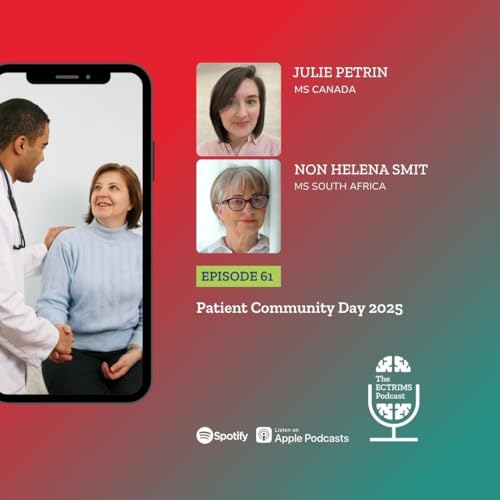
    After the event wrapped up in Barcelona, host Brett Drummond caught up with Julie Petrin, Director of Impact and Evaluation at MS Canada and a person living with MS, and Non Helena Smit, CEO of MS South Africa, to reflect on key takeaways and share what they're looking forward to at next year's event in Toronto.

    Show more Show less
    22 mins