• Why the Same Surgery, Same Doctor, Same Insurance Can Costs 3x More – Dr. Allison (Alli) Oakes, Trilliant Health
    Apr 20 2026

    The same surgery. The same doctor. The same hospital. Same insurer, but a different insurance plan and a price that's three times higher. That's not a hypothetical. It's the daily reality of healthcare in 2026, and it's what Dr. Allison (Alli) Oakes, VP and Chief Research Officer at Trilliant Health, has spent her career trying to fix.

    Alli sat down with Nathan C Bowser live at Vive 2026 to talk through what health plan price transparency data reveals about the American healthcare system.

    Trilliant sits at an unusual vantage point: not a provider, payer, or employer, but an independent research engine that aggregates claims data, price transparency data, and provider directories to give stakeholders a picture of their full market — including where patients are leaking out and where money is leaving the system without explanation.

    Her hot take closes the episode: be as bold about de-adopting technology that isn't performing as you are about adopting the new thing.

    Key Moments:

    • [00:03:12] What Trilliant Health Does: How claims data, price transparency data, and provider directories combine to show what no single stakeholder can see alone.
    • [00:04:19] The Price Variation Problem: Same procedure, same market, three to ten times the cost depending on your payer — and why it's solvable.
    • [00:08:25] Garbage In, Garbage Out — Multiplied: Why generative AI makes clean data more critical, and how Trilliant built a five-to-seven-year head start.
    • [00:11:38] The Value Equation: Healthcare is 18% of US GDP with worse outcomes than comparable countries. Patients can't shop their way out of this problem.
    • [00:16:49] The Hot Take: Rapid experimentation only works if you're equally bold about cutting what the data says isn't working.

    Watch the full episode on YouTube, subscribe to The Tech Glow Up, and join the newsletter on Substack → https://substack.com/@mxnathanc

    About Allison Oakes, Ph.D.
    Dr. Allison (Alli) Oakes is a health services researcher dedicated to translating complex data into actionable insights. With a background spanning academia, government, health systems, and payers, she brings a comprehensive perspective to the complexities of the U.S. healthcare system.

    As Chief Research Officer at Trilliant Health, Alli leverages extensive internal datasets to inform strategic decision

    A "glow up" signifies a positive transformation, reflecting the journey of becoming a better, more successful version of oneself.

    At The Tech Glow Up, we humanize the startup and innovation landscape by focusing on the essential aspects of the entrepreneurial journey. Groundbreaking ideas are often ahead of their time, making resilience and perseverance vital for founders and product leaders.

    In our podcast, we engage with innovators to discuss their transformative ideas, the challenges they face, and how they create value for future success.

    If you're a founder or product leader seeking your own glow up, or a seasoned entrepreneur with stories to share, we invite you to join our guest list via this link.

    Show more Show less
    20 mins
  • Free the Pharmacist. Ask the Doctor. Two Vive Conversations On Doing AI Right In Healthcare - Virginia Halsey, Dr. Jay Anders
    Apr 16 2026

    Everyone says AI in healthcare needs a "human in the loop." Fewer people can tell you what that actually means. This live Vive 2026 episode of The Tech Glow Up features two health IT veterans who are done waiting for theory to catch up with practice.

    Virginia Halsey, SVP of Product and Strategy at First Data Bank, has 35 years in health IT and a clear view of where medication workflows are failing. Pharmacists spend 30 to 40% of their day verifying prescription orders, while the clinical judgment they trained for goes unused. FDB is building tools to fix medication reconciliation and free pharmacists to round and participate in real patient care.

    Her hot take: even big tech companies love the AI buzzwords but aren't ready for healthcare-specific protocols like MCP when you get into the details.

    Dr. Jay Anders, CMO at Medicomp Systems, practiced internal medicine for 20 years and has spent 21 years since as the bridge between clinicians and tech. Clinicians haven't been asked what they need from AI, and when ambient listening tools produce text that nobody verifies, "human in the loop" is just a phrase. Medicomp converts ambient AI output into structured clinical data and gives clinicians a fast way to validate what the system produced.

    Key Moments:

    • [00:04:04] The Medication Workflow Problem: Why pharmacists spend 30–40% of their day on verification — and what FDB is building to change that.
    • [00:07:23] Med Rec on Admission: The fragmented data problem that makes medication reconciliation risky when patients can't speak for themselves.
    • [00:10:03] The AI Readiness Gap: Many organizations love AI buzzwords but aren't ready for the protocols that make it real in clinical settings.
    • [00:20:45] "They Haven't Been Asked": Why clinician trust in AI is in turmoil — and why the fix starts with asking doctors what they need.
    • [00:21:32] Beyond the Text: Medicomp converts ambient AI transcripts into structured data, then gives clinicians a fast way to verify the output.

    Watch the full episode on YouTube, subscribe to The Tech Glow Up, and join the newsletter on Substack → https://substack.com/@mxnathanc

    About Jay Anders:

    Dr. Jay Anders serves as the Chief Medical Officer of Medicomp Systems, where he plays a pivotal role in product development and acts as a liaison to the healthcare community. He hosts the award-winning HealthcareNOW Radio podcast, “Tell Me Where IT Hurts,” discussing critical issues such as physician burnout, EHR usability, healthcare interoperability, and the impact of technology on healthcare with industry experts.

    About Virginia Halsey:

    Virginia Halsey serves as senior vice president of strategy and product management where she manages the team responsible for the development and success of all FDB solutions spanning a variety of healthcare markets across the US and Canada.

    A "glow up" signifies a positive transformation, reflecting the journey of becoming a better, more successful version of oneself.

    At The Tech Glow Up, we humanize the startup and innovation landscape by focusing on the essential aspects of the entrepreneurial journey. Groundbreaking ideas are often ahead of their time, making resilience and perseverance vital for founders and product leaders.

    In our podcast, we engage with innovators to discuss their transformative ideas, the challenges they face, and how they create value for future success.

    If you're a founder or product leader seeking your own glow up, or a seasoned entrepreneur with stories to share, we invite you to join our guest list via this link.

    Show more Show less
    29 mins
  • What Self-Driving Cars Taught This CEO About Safe AI in Healthcare | Nitesh Shroff at VIVE
    Apr 13 2026

    The revenue cycle is one of healthcare's most expensive blind spots. Health systems pour everything into clinical excellence and then leave money on the table through billing leakage, under-coded claims, denied authorizations, and documentation gaps that erode reimbursement for genuinely complex care. Nitesh Shroff, co-founder and CEO of Arintra, has spent five years building the AI infrastructure to close that gap.

    Nitesh came to healthcare from an unexpected place. He was an early AI engineer at Zoox, the autonomous vehicle company now owned by Amazon, where the work was perception models, real-time object detection, and safety-first architecture.

    The throughline to Arintra is direct: just as a self-driving car cannot afford to misread a pedestrian, an AI coding system cannot afford to hallucinate a medical code. Every code Arintra generates is fully explainable, tied back to the source documentation, and auditable. Clients have started using that audit trail as evidence in denial appeal letters to payers — a use case Nitesh didn't design for but has now built into the workflow.

    • [00:03:18] What Arintra Does: How a network of clinical and financial AI agents reads physician notes and converts them into accurate medical codes — the backbone of every insurance claim.
    • [00:05:56] Why Hallucination is Not an Option: The case for explainable AI in revenue cycle, and how redundancy in the system exceeds human coding accuracy.
    • [00:09:06] From Autonomous Vehicles to Healthcare AI: The perception model work at Zoox and why safety-first thinking translates directly to medical coding.
    • [00:11:00] The Denial Letter No One Expected: How hospitals are using Arintra's code explainability as evidence in insurance denial appeals.
    • [00:13:58] How Fast Arintra Scales: A new location turns on in five minutes. A new specialty is built from scratch in three to four weeks.

    Health systems provide exceptional care. The billing infrastructure around that care should match. That's what Arintra is building.

    Watch the full episode on YouTube, subscribe to The Tech Glow Up, and join the newsletter on Substack → https://substack.com/@mxnathanc

    About Nitesh Shroff

    Nitesh Shroff is the CEO and co-founder of Arintra, an autonomous coding platform that combines GenAI with deep clinical expertise to help health systems get paid accurately and efficiently for the care they deliver.

    Nitesh holds a Ph.D. in Machine Learning from the University of Maryland and is an inventor with 30+ patents and publications. Throughout his career, Nitesh has applied AI and cutting-edge technologies to solve high-impact problems where precision and reliability are essential.

    As an early engineer at Zoox and Light, he developed foundational technologies critical to the performance and safety of autonomous vehicles.

    A "glow up" signifies a positive transformation, reflecting the journey of becoming a better, more successful version of oneself.

    At The Tech Glow Up, we humanize the startup and innovation landscape by focusing on the essential aspects of the entrepreneurial journey. Groundbreaking ideas are often ahead of their time, making resilience and perseverance vital for founders and product leaders.

    In our podcast, we engage with innovators to discuss their transformative ideas, the challenges they face, and how they create value for future success.

    If you're a founder or product leader seeking your own glow up, or a seasoned entrepreneur with stories to share, we invite you to join our guest list via this link.

    Show more Show less
    19 mins
  • AI That Really Gets You, Building Emotional Intelligence Into Mental Health Care - Attune Media Labs
    Apr 11 2026

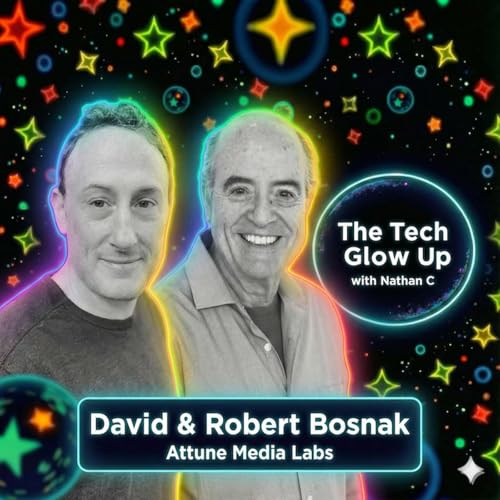
    Most AI reads your words. Attune Media Labs built one that reads your body, your mannerisms, your culture. David and Robert Bosnak, the father-son co-founders and HLTH Foundation Techquity Impact Award recipients, spent decades waiting for the technology to catch up with their idea.

    When GPT-3 arrived in 2020, they launched MIM, an artificial emotional intelligence companion that processes the tone, pitch, cadence, facial expressions, and body language that make up 93% of human communication.

    Robert has been a psychotherapist and psychoanalyst for 55 years and first developed emotion recognition at the MIT Media Lab in the 1990s, when computers were too slow to run it in real time. David studied electrical engineering, spent a decade in LA writing and acting, then returned to engineering.

    Together they set out to close the mental health supply-demand gap by putting emotionally intelligent AI in the hands of people who need it most, starting with the unhoused community in Los Angeles and scaling now to frontline healthcare workers in Cameroon, where the doctor-to-citizen ratio reaches 50,000 to one.

    Episode Key Moment Highlights:

    • [00:03:13] The MIT Media Lab origin: how 55 years of psychotherapy and a 1990s research project became the foundation for artificial emotional intelligence.
    • [00:05:37] Beyond sentiment analysis: how MIM reads nonverbal biomarkers and detects the dissonance between what you say and how your body actually feels.
    • [00:12:01] The public benefit corporation decision: why Attune was built around user wellbeing from day one, not advertising or engagement.
    • [00:15:30] The Cameroon pilot: 1,000 frontline health workers, a 50,000 to one doctor ratio, and what it means to build MIM for a culture you know nothing about yet.
    • [00:22:47] The guardrails: 18 and over only, usage caps, and why people report feeling compelled to reconnect with real people after using MIM.

    Their vision is not a digital therapist. MIM learns who you are, adjusts to your culture, and is designed to be pro-social, making real human connection more possible, not less necessary.

    Watch the full conversation on YouTube and like and subscribe so you never miss an episode of The Tech Glow Up.

    📩 GO DEEPER
    Join the Tech Glow Up newsletter on Substack → https://substack.com/@mxnathanc

    A "glow up" signifies a positive transformation, reflecting the journey of becoming a better, more successful version of oneself.

    At The Tech Glow Up, we humanize the startup and innovation landscape by focusing on the essential aspects of the entrepreneurial journey. Groundbreaking ideas are often ahead of their time, making resilience and perseverance vital for founders and product leaders.

    In our podcast, we engage with innovators to discuss their transformative ideas, the challenges they face, and how they create value for future success.

    If you're a founder or product leader seeking your own glow up, or a seasoned entrepreneur with stories to share, we invite you to join our guest list via this link.

    Show more Show less
    29 mins
  • Carta Healthcare Grew 50% in a Quarter By Applying Values & AI To The Right Problems – Brent Dover
    Apr 9 2026

    Most CEOs at VIVE were talking about what AI could do. Brent Dover, CEO of Carta Healthcare, came back to the Tech Glow Up with receipts. Since we last spoke in October, Carta grew revenue 50% in a single quarter, retained every customer, and is now in conversations with major health systems about platforming their entire abstraction operations at scale.

    The work is specific and the impact is real. Hospitals spend $15 billion a year paying nurses to log into patient records, scan through dozens of entries, and manually abstract the data that goes into clinical registries.

    That data drives 30 years of quality benchmarking across the country. It is how hospitals know whether their knee replacements, their stents, and their stroke care are actually measuring up. Carta's AI tools cut that process from two hours to 40 minutes per form, surface findings a human abstractor might have missed, and do it while keeping the nurse's hands on the keyboard the entire time.

    Episode Key Moment Highlights:

    • [00:02:38] The $15 billion problem: why hospitals spend a fortune on clinical data abstraction and what is actually at stake in the quality data it produces.
    • [00:05:52] What effective AI looks like in practice: from two hours to 40 minutes per form, better answers, and less cognitive burden on the people doing the work.
    • [00:08:51] The cake mix design principle: why Carta deliberately slows the AI down just enough to keep humans cognitively engaged and in the driver's seat.
    • [00:11:57] The update: 50% revenue growth since October, zero customer churn, and a path to doubling or tripling the business again within a year.
    • [00:15:05] The Glow Up for 2026: closing the loop so abstracted data feeds back into hospital data science initiatives within an hour of the case, while the patient is still in the building.

    Brent calls the standard approach to business backwards thinking. Most companies prioritize the company first and treat customers and employees as means to that end. Carta is building the other way around, and the growth numbers are making the case.

    Watch the full conversation on YouTube and like and subscribe so you never miss an episode of The Tech Glow Up.

    📩 GO DEEPER
    Join the Tech Glow Up newsletter on Substack → https://substack.com/@mxnathanc

    A "glow up" signifies a positive transformation, reflecting the journey of becoming a better, more successful version of oneself.

    At The Tech Glow Up, we humanize the startup and innovation landscape by focusing on the essential aspects of the entrepreneurial journey. Groundbreaking ideas are often ahead of their time, making resilience and perseverance vital for founders and product leaders.

    In our podcast, we engage with innovators to discuss their transformative ideas, the challenges they face, and how they create value for future success.

    If you're a founder or product leader seeking your own glow up, or a seasoned entrepreneur with stories to share, we invite you to join our guest list via this link.

    Show more Show less
    21 mins
  • This Patent-Holding ER Doctor Uses AI For Workforce & Patient Empowerment – Dr. Pavitra Krishnamani
    Apr 6 2026

    What if the biggest barrier to healthcare AI wasn't the technology, but it was the workforce not yet equipped to use it? Dr. Pavitra Krishnamani is the newly appointed Director of AI and Digital Health Education at MD Anderson Cancer Center and an emergency physician who's been at the intersection of clinical care and digital health innovation for nearly a decade. Her answer to that question is the job she was literally just handed.

    Pavitra's path here started in a fellowship at Jefferson, where she was the clinical voice embedded in a team of designers and developers. That team built a VR code blue simulator that was later patented. In one year.

    That origin story shaped everything: her belief that getting the right people at the table early, clinicians, developers, designers, (all of them) is what separates innovation that gets translated into real healthcare settings from the ideas that never make it out of the lab.

    Episode Key Moment Highlights:

    • [00:04:06] The AI and Digital Health Journal Club: how MD Anderson gets clinicians, technologists, and business leaders in the same room to dissect what's actually working — and what isn't.
    • [00:05:21] Inside the hackathon: why MD Anderson opened it to residents, fellows, and trainees — because innovation comes from collaboration first, not seniority.
    • [00:09:27] The VR patent story: how one fellowship produced a patented VR code blue simulator and a cardiac rehab virtual reality research program.
    • [00:16:07] Where healthcare AI is actually delivering ROI today: predictive analytics, clinical decision support, and freeing up human capital to do what AI can't.
    • [00:22:04] "Innovate with purpose": Pavitra's call for translational innovation — starting with a problem and a person, not a product.

    Pavitra coined a phrase in this conversation I haven't been able to shake: translational innovation. Asking from day one how your solution will actually be adopted, not just whether it works in a lab.

    Her work at MD Anderson is building the culture and curriculum to make that the norm.

    Watch the full conversation on YouTube and like and subscribe so you never miss an episode of The Tech Glow Up.

    Join the Tech Glow Up newsletter on Substack → https://substack.com/@mxnathanc

    A "glow up" signifies a positive transformation, reflecting the journey of becoming a better, more successful version of oneself.

    At The Tech Glow Up, we humanize the startup and innovation landscape by focusing on the essential aspects of the entrepreneurial journey. Groundbreaking ideas are often ahead of their time, making resilience and perseverance vital for founders and product leaders.

    In our podcast, we engage with innovators to discuss their transformative ideas, the challenges they face, and how they create value for future success.

    If you're a founder or product leader seeking your own glow up, or a seasoned entrepreneur with stories to share, we invite you to join our guest list via this link.

    Show more Show less
    25 mins
  • This Tech Helps Community Health Workers Get Paid, Solves Ops & Care Gaps - Colby Takeda, Pear Suite
    Apr 4 2026

    The reality of health equity starts not in a clinic but in the community, addressing fundamental needs like housing, food, and transportation that doctors and nurses can't solve. These critical factors, known as Social Determinants of Health (SDOH), are the true barriers to living healthier and happier lives.

    But who is on the ground, doing the vital work of connecting people with these resources and building the necessary trust? Community Health Workers (CHWs)—trusted community members with invaluable lived experience—have been the hidden backbone of this effort, often operating with just paper and spreadsheets.

    Founder Colby Takeda of Pear Suite is on The Tech Glow Up to talk about the technology he built to incorporate these local experts into the official healthcare system and, most critically, finally get them paid. This episode is a deep dive into how Pear Suite, a 2026 HLTH Foundation Techquity Award winner, is driving value-based care in local communities.

    Pear Suite’s philosophy is elegantly simple: healthcare should be done in the community, and those with the most relevant experience must be empowered to lead. Takeda explains that their solution not only uplifts the CHWs’ work by providing a practice management software to organize their efforts but also allows them to handle the compliance, billing, and claims that are essential to unlocking reimbursement opportunities and value-based care contracts.

    Episode Highlights

    • Social Determinants of Health Focus: The platform helps local workers address critical factors like housing, transportation, and food security that doctors and nurses are unable to directly assist with.
    • Value-Based Care Success: A partnership with Health Net in California saw over 800 CHWs onboarded in 12 months, leading to reduced ER admissions and increased vaccinations and cancer screenings for over a million members.
    • Enhancing the Workforce with AI: Pear Suite is actively working to integrate AI not to replace the essential human element of CHWs but to enhance their capacity, reduce mistakes, and save them time.
    • The Power of Lived Experience: Takeda built the company on the principle that the lived experience CHWs bring to the table "can't be bought or taught," making them the most qualified navigators for hard-hit communities.

    Takeda's compelling approach is a masterclass in building a successful and equitable business model: act as the intermediary that translates the on-the-ground successes of nonprofits into the language of health plans (metrics and cost savings), ensuring the community's work is both valued and financially compensated.

    By starting from the community and building trust, Pear Suite is proving that investing in this workforce is an investment in the health outcomes and long-term sustainability of the entire system.

    Watch the full video on YouTube, and please like and subscribe to The Tech Glow Up!


    A "glow up" signifies a positive transformation, reflecting the journey of becoming a better, more successful version of oneself.

    At The Tech Glow Up, we humanize the startup and innovation landscape by focusing on the essential aspects of the entrepreneurial journey. Groundbreaking ideas are often ahead of their time, making resilience and perseverance vital for founders and product leaders.

    In our podcast, we engage with innovators to discuss their transformative ideas, the challenges they face, and how they create value for future success.

    If you're a founder or product leader seeking your own glow up, or a seasoned entrepreneur with stories to share, we invite you to join our guest list via this link.

    Show more Show less
    27 mins
  • Fixing Healthcare Pains in Patient Identity, Predictive Journeys & Price Transparency Live From Vive - Joe Hickey, Patty Hayward, Lathe Bigler
    Apr 2 2026

    Healthcare has a data problem, but not the kind most people assume. The information exists. It's scattered across dozens of systems that don't talk to each other, and every provider encounter requires reconstructing your story from scratch. In this live Vive 2026 episode, I sit down with three leaders each working on a different layer of that gap.

    Joe Hickey, VP of HIE and Provider Solutions at Verato, makes the case that stable patient identity is the foundation everything else is built on. Healthcare poured billions into EMRs, CRMs, and data lakes over the past decade and got fragmentation in return.

    Patty Hayward, GM of Healthcare and Life Sciences at Talkdesk, returns to the show with a view of where AI earns its keep (scheduling, reminders, billing) while keeping clinical decisions with humans.

    Lathe Bigler, SVP of Business Strategy at Buzz Health, closes with the case for price transparency as a patient right. Buzz Health embeds affordability intelligence as an API layer so providers and patients see the same price at the moment it counts.

    Key Moments:

    • [00:04:26] Identity as Infrastructure: How a decade of data investment created fragmentation, and how Verato unifies patient identity across the enterprise.
    • [00:16:00] The AI Signal Worth Noticing: Physicians who planned to retire in two years now have three to five more, because ambient listening transformed their daily workload.
    • [00:20:59] Where AI Belongs Right Now: Patty draws the line between what AI handles in patient communications and where human judgment stays essential.
    • [00:25:00] The Change Management Blind Spot: Bring physicians into contact center projects early or they become the biggest blocker — Patty's most consistent advice.
    • [00:34:10] The Prescription Abandonment Numbers: 75% of providers say cost barriers prevent patients from picking up prescriptions. Buzz Health puts the solution inside the prescribing workflow.

    Three conversations, one clear thread — the gap between what patients need and what they get comes down to information that exists but isn't connected, surfaced, or trusted.

    Watch the full episode on YouTube and subscribe so you never miss The Tech Glow Up.

    Join the Tech Glow Up newsletter on Substack → https://substack.com/@mxnathanc


    A "glow up" signifies a positive transformation, reflecting the journey of becoming a better, more successful version of oneself.

    At The Tech Glow Up, we humanize the startup and innovation landscape by focusing on the essential aspects of the entrepreneurial journey. Groundbreaking ideas are often ahead of their time, making resilience and perseverance vital for founders and product leaders.

    In our podcast, we engage with innovators to discuss their transformative ideas, the challenges they face, and how they create value for future success.

    If you're a founder or product leader seeking your own glow up, or a seasoned entrepreneur with stories to share, we invite you to join our guest list via this link.

    Show more Show less
    38 mins