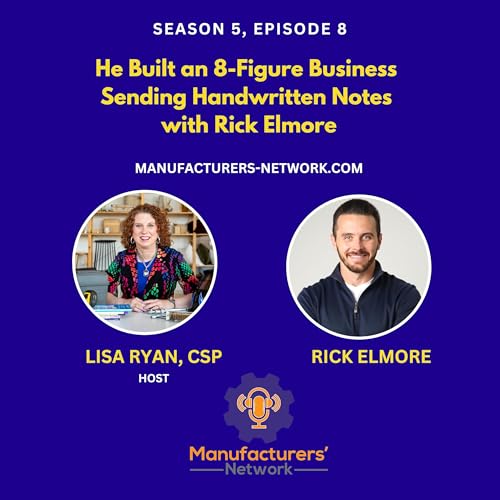
The Manufacturers Network Podcast By Lisa Ryan cover art

The Manufacturers Network

The Manufacturers Network

By: Lisa Ryan
Listen for free

The Manufacturers’ Network is where manufacturing leaders, plant managers, and industry innovators come to talk straight about what’s working and what’s not, on the shop floor and beyond. Each week, host Lisa Ryan sits down with people who live and breathe this business: operations executives, HR directors, engineers, and founders who are building stronger teams and smarter systems in the face of nonstop change. Listeners gain real-world insights on: • Employee retention and workforce engagement • Automation, AI, and the future of skilled trades • Supply chain and operations leadership • Safety, sustainability, and company culture that lasts If you’re tired of generic “leadership talk” and want practical conversations from people who get it, this podcast is for you. New episodes drop every Monday and are short enough for your commute, sharp enough to shape your week. Subscribe and be part of the conversation that’s connecting manufacturers across industries, one story at a time.Copyright 2026 Lisa Ryan Economics Management Management & Leadership Personal Development Personal Success
Episodes
  • He Built an 8-Figure Business Sending Handwritten Notes with Rick Elmore
    Mar 30 2026
    Lisa Ryan welcomes Rick Elmore, founder and CEO of Simply Noted, a 100% bootstrapped, handwritten mail automation company powered by patented robotics and AI-driven personalization. A former NFL athlete turned 9-patent tech founder, Rick scaled Simply Noted to $10 million-plus in revenue by combining manufacturing, automation, and disciplined sales systems, all without a single dollar of outside investment.From the NFL to the Factory FloorRick's path to building a robotics company is anything but conventional. Drafted to the Green Bay Packers in 2011, he played for six teams in three years before facing what he describes as an identity crisis at 25. He took the transferable skills of an elite athlete: grit, discipline, competitiveness, and the willingness to embrace a process, and applied them first to corporate sales, where he became a consistent top 1% performer, and then to entrepreneurship.The spark came during his MBA program when a marketing professor closed a three-hour lecture with a simple observation: handwritten notes get opened 99% of the time and the mailbox is empty. Rick tested the idea with a pen plotter, 500 targeted prospects, and sold $300,000 in six weeks on a $50,000 quota. The entrepreneurial seizure, as he calls it, had arrived.Building What Didn't ExistWhat followed was eight years of over-engineering everything. Because no off-the-shelf solution existed, Rick had to build it from scratch: robots, software, algorithms, and all. Key milestones include:Going through 14 engineering firms over more than a year, using each proposal to sharpen the next, before committing to a single partnerSpending three years building the technology in chunks, funded entirely by customer revenue, with Thursday-night engineering sessions running from 2 PM to 10 PMDeveloping intelligent handwriting algorithms that understand context — an "E" at the start of a word is drawn differently than an "E" in the middle or at the endBuilding 220 custom handwriting robots in a 10,000 square foot facility, holding real pens, replaced twice a day by human attendantsEarning 9 patents along the way — and openly sharing why he now thinks they may not have been worth itPersonalization at Scale: What Simply Noted Actually DoesSimply Noted has made handwritten mail as automatable and trackable as email. Clients can start simple: a spreadsheet with first name, last name, and address. or go deep with full CRM integration, LLM-powered personalized messaging, QR code tracking, delivery notifications, and trigger-based workflows. Examples include:A lead moving to "closed" in Salesforce automatically triggers a personalized handwritten thank-you noteA complaint in a ticketing system pulls the complaint data, drafts a custom apology via an LLM, and sends a pen-written note to keep bad reviews offlineE-commerce brands sending anniversary notes on the date of a customer's first purchase — completely automatedQR codes on notes that, when scanned, automatically alert a sales rep via text message to follow up in real timeWhy the Mailbox Is the Last Uncluttered ChannelAds are ignored. Inboxes are buried. Social feeds are sponsored noise. But the physical mailbox is nearly empty, and something that looks genuinely handwritten stops people cold. Rick shares how a single handwritten note from a window contractor led Lisa's family to refer over $100,000 in business. That story, he says, is exactly why relationship-based businesses: real estate, home services, financial services, nonprofits, e-commerce see the strongest results.The Athlete Mindset Applied to EntrepreneurshipRick draws a direct line between fifteen years of athletic training and his ability to build slowly, stay disciplined, and not quit when things got hard. He pushes back against the social media myth of overnight success, pointing out that most "overnight" stories hide decades of accumulated domain expertise. Compounding success over time, he argues, is as fundamental in business as it is in sport.Actionable Takeaways for ListenersStart with a crawl-walk-run approach. Request a sample kit, test a simple send, then integrate; don't try to fully automate on day one.Relationship building works best consistently over time. A one-time campaign won't move the needle. The businesses getting the most value from Simply Noted are using it month after month, year after year.The mailbox is your competitive advantage. If everyone you compete with is fighting for inbox and ad space, stepping into a nearly empty channel is an asymmetric opportunity.Personalization doesn't require complexity. Even a simple mail merge with first names on a templated message outperforms nearly any digital equivalent in open rates and memorability.Patents are lawsuit coupons. Protect your business by being so difficult to copy that competitors exhaust themselves trying — not by relying on legal protection alone.Connect with Rick Elmore: LinkedIn: Rick Elmore simplynoted.com to request a free ...
    Show more Show less
    31 mins
  • Beyond the Hype: Making AI Work in Manufacturing with Sebastian Chedal
    Feb 16 2026

    In this insightful and practical episode, Lisa Ryan welcomes Sebastian Chedal, founder of Fountain City and co-founder of TestFox.ai. Sebastian helps executives implement AI strategies that actually work, focusing on one critical question: How do you join the 20% of AI initiatives that succeed instead of the 80% that fail? With 60% of his work in manufacturing and industrial sectors, Sebastian brings a grounded, practical perspective where implementation matters more than hype.

    A Journey Through Digital Transformation

    Sebastian's journey began in 1998 when he started Fountain City in the Netherlands. Over more than two decades, his work has evolved through network security, website and app development, creative projects, and ultimately into digital transformation with a focus on AI implementation—predominantly in manufacturing.

    As a self-described generalist at heart with diverse interests, Sebastian has founded five businesses total (two non-profits that didn't make it), giving him an entrepreneurial track record that includes both successes and failures. This real-world experience informs his practical, results-oriented approach to AI implementation. Fountain City has been the anchor and core of his professional life, adapting and evolving as technology has transformed over the past 26 years.

    The Catalytic Moment: Why AI Is Different Now

    Sebastian draws a powerful parallel between today's AI landscape and the mid-1990s internet era, when people would ask, "What's a website? I don't need a website. Why would I need a website?" People didn't understand the benefits, how it worked, or how much effort it would take to implement.

    Like many technological innovations, AI has finally reached a threshold catalytic point where it becomes truly useful, effective, and mainstream. The real breakthrough with large language models (LLMs)—what most people refer to when discussing AI today—is the ability to create qualitative automations, not just deterministic ones.

    The Fundamental Difference

    Deterministic automation (traditional): If this number is above this number, do this thing—straightforward logic gates we've had for decades.

    Qualitative automation (AI-powered): Integration of nuanced, context-dependent decisions into automation processes, opening entirely new categories of automation.

    This capability works at multiple levels:

    1. Workflow automation: Eliminating time-consuming, mundane work like data transformation and entry that used to require hours or intern labor
    2. Strategic support: Brainstorming, strategic planning, code planning, and design patterns
    3. Knowledge work: Tasks requiring judgment, context, and understanding rather than simple calculations

    The last year in particular has brought proposals and curiosity from people wanting to understand what it actually takes to put these systems in place—but the hype also leads to overestimation of capabilities and underestimation of implementation effort.

    Becoming AI-Ready: The Foundation for Success

    Sebastian outlines several critical dimensions of AI readiness that organizations must address:

    1. Management and Strategic Vision

    The wrong approach: "We need to make sure 30% of our processes are run by AI by the end of the year."

    This mandate isn't inspiring and doesn't give teams something meaningful to rally behind, even if it's the directive from stakeholders or management.

    The right approach: Transform mandates into meaningful vision:

    Show more Show less
    29 mins
  • Manufacturing Without Borders: Technology, Culture, and the Future of the Industry with Tony Gunn
    Feb 9 2026

    In this energetic and information-packed episode, Lisa Ryan welcomes Tony Gunn, who leads global operations at his new venture TGM Global Services after a successful five-year run with MTD CNC. Tony has spent two decades on shop floors and in boardrooms around the world, traveling approximately 300 days a year to over 60 countries, giving him an unparalleled front-row seat to the technologies, trends, and people shaping modern manufacturing.

    Tony shares his remarkable journey from mopping floors on weekends for minimum wage and learning to use basic presses, to mastering CNC machining through the mentorship of industry veterans who taught him line-by-line programming. His story exemplifies the power of workplace mentorship and the importance of taking skilled workers under your wing—lessons that continue to guide his mission today.

    The Smartest Person in the Room

    Tony lives by a powerful principle: "If you're the smartest person in the room, you're in the wrong room." He thrives on being the "dumbest person in the room," learning from experts across the manufacturing spectrum—from garage shops with three or four machines to CEOs of the world's largest manufacturing companies. This humility and hunger for knowledge informs everything he does in media and content creation.

    His approach to sharing stories and technology stems from remembering his own starting point—when he was just learning to turn raw material into something of value. He's passionate about explaining concepts at a level that empowers everyone, avoiding the industry jargon and acronyms that can leave people behind. He never forgets the experts who gave their time to an amateur, and now pays that forward by putting others under his wing.

    The Technology Challenge: Keeping Up When It's Your Job

    Tony candidly admits that even though it's his full-time job to know as much about the manufacturing industry as possible and share it with as many people as he can, he still can't keep up with how fast everything is moving. He can only imagine how difficult it must be for shop owners and operators whose day-to-day activities involve actually running their businesses.

    From a global perspective, Tony sees shops still running machines that are 15, 20, 30, even 40 years old—machines that run good parts but can't complete a part on one machine, requiring five machines and much longer cycle times compared to modern technology. He draws a powerful contrast from his visit to the American Precision Museum in Vermont: 200 years ago, they were making micron parts, but it took two weeks. Today, it takes two minutes.

    The Labor Shortage and Automation Imperative

    The conversation centers on what manufacturers are most hungry to understand and solve right now. Tony identifies the labor shortage as a critical issue that companies are trying to address through multiple strategies:

    Inspiring the next generation through STEM - While crucial, this is years in the making and can't be the only solution

    Adapting technology in the midterm - Companies must figure out which technologies are most affordable and provide the best ROI to minimize labor shortages while competing globally

    Various forms of automation - From traditional robots and cobots to pallet systems and bar feeds, companies are finding ways to have one machinist run 10 machines instead of one, with processes running 24/7

    Digital transformation - Tools like Datanomics and Fulcrum that take traditionally tribal knowledge and display it on screens, giving operators and management real-time visibility into what's actually happening on the shop floor—eliminating the need for all-day meetings filled with 80% truths and 20% fabrication

    Tony emphasizes that knowing actual uptime, real capabilities, bottlenecks, and opportunities for improvement allows companies to create better...

    Show more Show less
    34 mins
No reviews yet