The SurgeonMasters Podcast Podcast By Jeffrey M. Smith MD cover art

The SurgeonMasters Podcast

The SurgeonMasters Podcast

By: Jeffrey M. Smith MD
Listen for free

The SurgeonMasters Podcast is for surgeons who wish to create a highly successful and sustainable practice that is lifestyle-friendly with less stress and frustration. Each episode focuses on learning, understanding and implementing effective habits that will allow you to create a thriving practice while still having time to travel, connect with your family, take care of your health, and pursue outside interests. Your host is Jeffrey M. Smith, MD a practicing Orthopaedic Trauma Surgeon (Orthopaedic Traumatologist) who also assists other Surgeons to develop the critical skills needed to create a highly successful lifestyle-friendly practice which is physically, mentally and emotionally sustainable.© 2026 The SurgeonMasters Podcast Career Success Economics Hygiene & Healthy Living Personal Development Personal Success Physical Illness & Disease
Episodes
  • Injury Prevention! Life improvement strategies for the surgeon who wants more … in 10 minutes – Episode 138
    Mar 25 2026

    Send us Fan Mail

    Pump the brakes on your week and take 10 minutes to make your life as a surgeon just a little better…

    Jeff welcomes to the podcast, exercise physiology LiverTransplant Program member, Gil Spitz.

    In many ways, physicians are like athletes. We're high performers always striving to be the best version of ourselves - often to our physical detriment.

    Many physicians do things that are generally healthy, but they may not be doing exercises that properly train them for the rigors of a career in medicine. Instead of moving as fast as possible at all times, we should focus on precise movements that create specific outcomes. We need to train for what we do on a daily basis.

    Just like you would see on a sports team, there are a variety of different positions that physicians play. For example, a open surgery requires a different set of training than laparoscopic surgery. Training for different situations is essential to prevent injuries..

    What steps does Gil suggest we do to prevent injuries?

    • Step 1 - Perform an honest physical check. How does your body feel? What hurts?
    • Step 2 - Work with an exercise physiologist or another qualified professional to create a personalized plan that helps you sustain your career longer.
    • Step 3 - Follow your plan with scheduled check-ins to evaluate what is working well and what you can improve.


    Most importantly, PRACTICE personal injury prevention!


    BIO:

    Originally a classical musician, Gil Spitz shifted his focus to ergonomics and preventative exercise to help musicians with repetitive motion injuries. He furthered his expertise with an MS in Exercise Physiology, researching optimized training for first responders.

    In 2019, he joined the Medical ICU team at Baylor/St. Luke’s Medical Center, developing and enacting exercise plans for medically compromised patients. Since 2021, he has been with the LiverTransplant Program, implementing a hospital-wide method for assessing transplant patients physical suitability, providing post-transplant follow-up, and developing a virtual pre-habilitation program to improve outcomes.

    During this time he has worked with the surgical staff helping them prevent musculoskeletal and repetitive motion injuries. Gil has worked with providers both on a 1-on-1 basis, addressing specific needs and issues as well as presenting the topic of OR ergonomics, inter- & intra-op preventative exercises to incoming resident cohorts during an annual bootcamp at Baylor College of Medicine.


    Social Media:

    LinkedIn - https://www.linkedin.com/in/gil-spitz-088346138/

    SurgeonMasters is a physician peer community dedicated to improving the personal and professional well-being of physicians.

    Join your colleagues online at SurgeonMasters.com for events, resources, and more.

    PRACTICE Your Best!

    Show more Show less
    10 mins
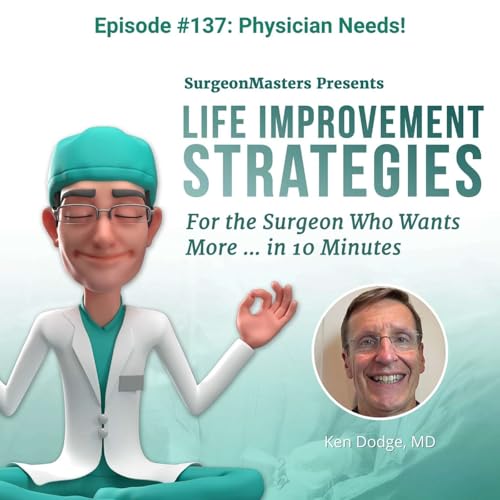
  • Physician Needs! Life improvement strategies for the surgeon who wants more … in 10 minutes – Episode 137
    Mar 11 2026

    Send a text

    Pump the brakes on your week and take 10 minutes to make your life as a surgeon just a little better…

    Jeff welcomes physician coach and family physician, Ken Dodge, MD, to the podcast.

    As physicians, we often struggle to identify our needs. In fact, we often don't know the value. It's easy for us to get disconnected from our feelings and lack self-awareness.

    If we understood our needs, it would make life much easier. We could set boundaries, be intentional, and have honest conversations. It's ironic because we spend all day telling patients what they need, yet we often don't know what we need ourselves.

    If we're aware of our needs at any moment, we can have less self-judgment. Emotions often signal what is happening in our world and give us clues. If you become angry, it may indicate you need respect, fairness, or protection. When you understand your needs, the emotions you experience make more sense. By honoring your needs, you send a message to yourself that you matter.

    What steps does Ken recommend we take to more effectively express our needs?

    • Step 1 - Be intentional in knowing your needs by practicing self-reflection and observation.
    • Step 2 - Ask yourself what you need right now that you wish someone would notice without you having to say anything.
    • Step 3 - Practice vulnerability by sharing your needs with someone you trust, such as a spouse or close friend.


    Most importantly, PRACTICE honoring and expressing your needs!


    BIO

    Dr. Ken Dodge is a retired family physician who devoted 42 years to patient care after earning his MD from Wright State University and completing residency in Dayton, Ohio. With an undergraduate background in psychology from The Ohio State University, he developed a lifelong interest in relationships, emotional health, and personal growth.

    Now retired from clinical practice as of June 2025, Ken coaches physicians, offering a compassionate, reflective space grounded in deep listening and respect for emotional and spiritual influences. He is passionate about helping physicians navigate challenges, reconnect with their inner wisdom, and cultivate greater balance and serenity.

    Ken is married, a father of three, and a grandfather of five. He enjoys hiking, biking, traveling, and reading.

    SurgeonMasters is a physician peer community dedicated to improving the personal and professional well-being of physicians.

    Join your colleagues online at SurgeonMasters.com for events, resources, and more.

    PRACTICE Your Best!

    Show more Show less
    10 mins
  • Narrative Medicine! Life improvement strategies for the surgeon who wants more … in 10 minutes – Episode 136
    Feb 18 2026

    Send us Fan Mail

    Pump the brakes on your week and take 10 minutes to make your life as a surgeon just a little better…

    Jeff welcomes Richard A. Schaefer, MD, MPH, an orthopaedic surgeon at Johns Hopkins University, to the podcast.

    Richard is a big fan of the concept of narrative medicine. It’s an intentional, reflective practice of medicine in which you take what you’re experiencing and put it into narrative form.

    We use evidence-based medicine every day in practice. But narrative medicine is different. It’s about the importance of stories. Our own stories, as well as those of our colleagues and patients.

    Narrative medicine can help us be better listeners to our patients and colleagues. It can also help increase our empathy and prevent burnout.

    So what steps does Richard suggest we take to integrate a practice of narrative medicine?

    • Step 1 – Explore the Humanities in Medical Literature
      Many clinicians are unaware that academic journals often include sections dedicated to the humanities, the arts, and narrative medicine. Reading these pieces is an easy way to begin integrating reflective and humanistic perspectives into clinical practice.
    • Step 2 – Learn and Remember What Matters to Your Patients
      Make a deliberate effort to understand personal details meaningful to your patients, such as family members, hobbies, milestones, or concerns. Document and revisit these details at future visits. Small acknowledgments can significantly strengthen trust and rapport.
    • Step 3 – Incorporate Narrative into Patient Communication
      Use storytelling and attentive listening in clinical conversations. Invite patients to share their experiences, and frame explanations in ways that connect medical information to their personal stories.


    Most importantly, PRACTICE narrative medicine!


    BIO

    Richard A. Schaefer, MD, MPH is an orthopaedic surgeon at Johns Hopkins University in Baltimore, MD. He grew up in Buffalo, NY, after which he went to West Point followed by medical school at Tulane. He did his orthopaedic residency at the former Fitzsimons Army Medical Center in Colorado, and orthopaedic oncology fellowship at Mayo Clinic. Prior to joining Johns Hopkins, Dr. Schaefer served for over 30 years in the U.S. Army, retiring at the rank of colonel. He had a number of stateside and overseas assignments at military medical facilities, including two tours in Afghanistan. He received several military decorations and awards for his service, including the Bronze Star Medal and Combat Action Badge.

    In addition to his clinical practice at Johns Hopkins, Dr. Schaefer is a medical student advisor, providing longitudinal school and career advising to a cohort of students from their first day and throughout the 4 years until they graduate. He has a variety of outside interests including travel, art, and sports, and is a lifelong die-hard fan of the Buffalo Bills.


    Social Media:

    Closler

    LinkedIn - https://www.linkedin.com/company/closler/

    Instagram - https://www.instagram.com/closler

    Facebook - https://www.facebook.com/CLOSLER/

    YouTube - https://www.youtube.com/channel/UCL2CyImH8fICsHrf9YGxEwg

    X - https://twitter.com/CLO

    SurgeonMasters is a physician peer community dedicated to improving the personal and professional well-being of physicians.

    Join your colleagues online at SurgeonMasters.com for events, resources, and more.

    PRACTICE Your Best!

    Show more Show less
    10 mins
No reviews yet