Travelers In The Night Podcast By Albert D. Grauer cover art

Travelers In The Night

Travelers In The Night

By: Albert D. Grauer
Listen for free

A real "Science Snack" for anyone who is interested in the extraterrestrial.
Dr. Al Grauer is a member of the Catalina Sky Survey which has led the world in near Earth asteroid discoveries for 17 of the past 19 years.
The music is "Eternity" by John Lyell.
Astronomy Asteroids Space NASA Comets Earth Impact AliensAlbert D. Grauer
Astronomy Astronomy & Space Science Science
Episodes
  • 381E-417-Red Dwarf Planets
    Mar 24 2026
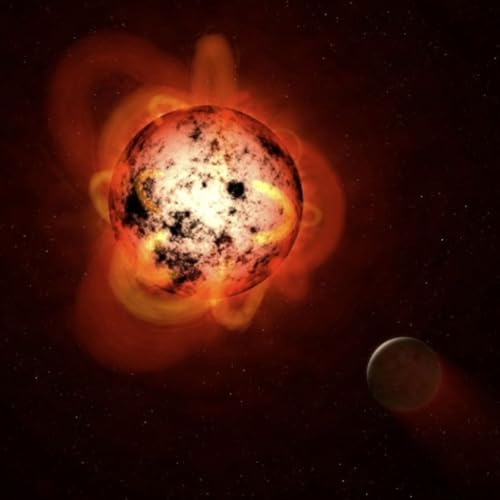
    Astronomers continue to be delighted when they discover an Earth sized planet. Scientists were thus very disappointed when the red dwarf star hosting the nearest such planet, Proxima b some 4.2 light years away, turns out to have the nasty habit of emitting bursts of radiation which are likely to sterilize and/or remove the atmospheres of it's family of planets. Recently, hope of finding a nearby Earth was rekindled when scientists at the European Southern observatory in Chile discovered a small planet circling what appears to be a quiet well behaved red dwarf star 11 light years from us. Astronomers are not yet sure that this newly discovered Earth sized planet lies within it's stars habitable zone where liquid water could exist on it's surface. Jumping the gun, ET enthusiasts have beamed a friendly message in the direction of another nearby red dwarf planet system. Their target the super Earth planet, GJ 273b is located some 12.4 light years away near the bright star Sirius in the constellation of Canis Major. At this distance a civilization on GJ 273b could have already received a picture of humanity by deciphering 'I love Lucy' and other TV signals it has been picking up for 50 years or so. The next generation of very large telescopes will allow astronomers to search for the presence of oxygen and other molecules which indicate the presence of life in the atmospheres of nearby worlds. In the mean time we have more reasons to be thankful for what we have here on planet Earth. For Travelers in the Night this is Dr. Al Grauer. Go to travelersinthenight.org program 417 for more information.
    Show more Show less
    2 mins
  • 891-2026-AA
    Mar 20 2026
    My Catalina Sky Survey teammate Tracie Beuden was observing with our Schmidt telescope on Mt. Bigelow, Arizona in the constellation of Persus when she found the first asteroid of 2026. Asteroid hunters are trying to like Tracie's discovery with our number on it far enough in advance so humans could give it a tiny nudge and make it miss Earth.
    Show more Show less
    2 mins
  • 380E-416-Odd Ball
    Mar 17 2026
    The orbits of the planets are closely aligned with the extension of the Sun's equator into space and are contained within the flattened disk of material which forms the plane solar system. Most asteroids have orbits with inclinations or tilts to the solar system's plane which are less than 20 degrees. Thus, when my Catalina Sky Survey teammate Rose Matheny discovered a small space rock which soars into the lonely space high above and below our solar system's plane, it got our attention. As with all of our asteroid discoveries, Rose had no idea of what kind of object she had discovered with our Schmidt Telescope on Mt. Bigelow, Arizona until it had been tracked by observers around the world. The Minor Planet Center used the data from 14 different telescopes to calculate an orbit, estimate a size, and give the new object the name, 2017 TF4. Rose's odd ball near Earth Apollo asteroid discovery , 2017 TF4, has an orbit which is tilted by 60 degrees to the plane of our solar system. It's inclination or tilt is greater than 99.5% of the other 8,000 known Earth approaching Apollo asteroids. 2017 TF4, Rose's 260 foot diameter discovery orbits the Sun at about the same distance as the Earth once every 414 days. Perhaps as asteroid hunters discover additional small objects with orbits similar to Rose's discovery we will be able to trace them back to when they were created by a catastrophic collision long ago.
    Show more Show less
    2 mins
No reviews yet