

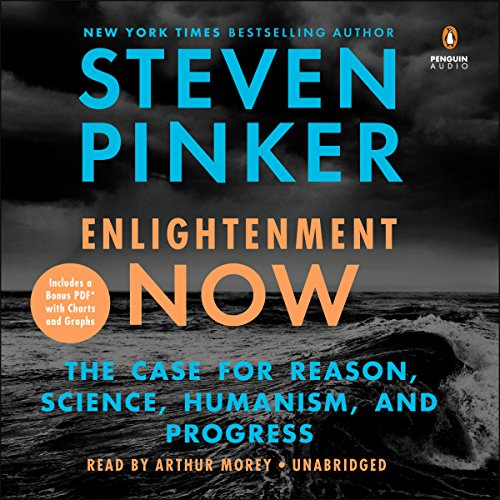
Enlightenment Now
The Case for Reason, Science, Humanism, and Progress
Failed to add items
Sorry, we are unable to add the item because your shopping cart is already at capacity.
Add to Cart failed.
Please try again later
Add to Wish List failed.
Please try again later
Remove from wishlist failed.
Please try again later
Adding to library failed
Please try again
Follow podcast failed
Please try again
Unfollow podcast failed
Please try again
Get 30 days of Standard free
Auto-renews at $8.99/mo after 30-day trial. Cancel anytime

Enlightenment Now
Narrated by:
Arthur Morey
Buy for $24.75
-
Narrated by:
-
Arthur Morey
-
By:
-
Steven Pinker
A NEW YORK TIMES NOTABLE BOOK OF 2018
ONE OF THE ECONOMIST'S BOOKS OF THE YEAR
If you think the world is coming to an end, think again: people are living longer, healthier, freer, and happier lives, and while our problems are formidable, the solutions lie in the Enlightenment ideal of using reason and science. By the author of the new book, Rationality.
Is the world really falling apart? Is the ideal of progress obsolete? In this elegant assessment of the human condition in the third millennium, cognitive scientist and public intellectual Steven Pinker urges us to step back from the gory headlines and prophecies of doom, which play to our psychological biases. Instead, follow the data: In seventy-five jaw-dropping graphs, Pinker shows that life, health, prosperity, safety, peace, knowledge, and happiness are on the rise, not just in the West, but worldwide. This progress is not the result of some cosmic force. It is a gift of the Enlightenment: the conviction that reason and science can enhance human flourishing.
Far from being a naïve hope, the Enlightenment, we now know, has worked. But more than ever, it needs a vigorous defense. The Enlightenment project swims against currents of human nature--tribalism, authoritarianism, demonization, magical thinking--which demagogues are all too willing to exploit. Many commentators, committed to political, religious, or romantic ideologies, fight a rearguard action against it. The result is a corrosive fatalism and a willingness to wreck the precious institutions of liberal democracy and global cooperation.
With intellectual depth and literary flair, Enlightenment Now makes the case for reason, science, and humanism: the ideals we need to confront our problems and continue our progress.
Listeners also enjoyed...


adbl_web_anon_alc_button_suppression_c
Featured Article: The Best Philosophy Audiobooks for Getting Lost in Thought
Featured Article: The Best Philosophy Audiobooks for Getting Lost in Thought
Philosophy asks and analyzes the questions that have pressed on humankind for centuries: What does it mean to be human? Why are we here? From ancient to contemporary times, these questions have been answered with varying, and sometimes contradictory, schools of thought. Our picks span centuries and subjects, and draw parallels across time to embolden listeners to dive deep into questions about the fundamental nature of our reality.

People who viewed this also viewed...


Steven Pinker is, without doubt, one of the most important and knowledgeable intellectuals in the world today. With Enlightenment Now, he proves this point again. Few write as well as Pinker. And even fewer can pack so much information and statistics into a book and still maintain such beautiful prose. Even if you only remember a small part of all the knowledge you will acquire if you read this book, you will have learned a lot.
The book has two parts. The first and longest part (around 20 chapters) describes the progress that has occurred in a number of different areas of life (see below). The second part of the book is a defense of the ideas of the enlightenment - the ideas that are responsible for much of the progress that has been observed. Below is a non-exhaustive list of topics reviewed by Pinker in this book
Life duration - Life expectancy, at any age, is longer today than it has ever been i.e. old people today also have a longer life expectancy than old people in the past
Economics - We are much much richer and every day another 130.000 people in the world exits extreme poverty
Access to food - All parts of the world have access to more food, in the west, the poor are often obese
Equality - There is more equality between the genders and between different ethnic groups and people (especially youth) value equality more than ever before
The environment - Climate change IS a potential concern however we are making progress and in most other respects the environment is getting better: more trees, cleaner air etc. As we are entering the digital age we are also using fewer resources (paper, plastics etc).
Wars - Whereas wars used to be the norm, there are no wars between major powers today and even with the terrible civil war in Syria, casualties are nowhere near that in previous wars
Accidents - People are less likely to die from car crashes, lightning strikes, falls etc. We seem to value life more today and we have taken steps to look out for and prevent all kinds of accidents
Violence - Murders, rapes, and violence are less common. It is very unlikely that you will die in a terror-attack.
Political systems - Contrary to what you might think if you watch the news, democracy is on the rise and has been for a long time. The anti-enlightenment populism (ex Trump) is a concern however, it is an old-people movement and will likely dissipate
Quality of life - More people today find their life exciting and meaningful than before. We have more spare-time and we don’t have to work until we die
Happiness - People are happier today and happiness comes with progress in the other variables described here.
Existential threats - The hole in the ozone is gone, forests are growing, no nukes have been launched (despite what doomsayers of yesterday would have you believe).
To sum up the first part of the book: Things have gotten better. Much better. Still, don’t think that Pinker believes that all problems are gone. He reiterates the point that the laundry does not wash itself - and global challenges don’t solve themselves. Despite the progress we have seen there are ample challenges left. There are still wars, famines, genocides, and environmental issues. Pinker acknowledges this, however, he emphasizes that the world has seen progress, not regress. And it is important to acknowledge that things have gotten better - not to pad ourselves on the shoulder - but rather so that we can analyze what it is that has worked so that we can keep doing that.
Is it the enlightenment ideas that have caused the undeniable progress in the world? This is the question addressed in the second part of the book. Since progress occurred in the world before the enlightened philosophers took the stage I would say only partly. Then again there were people acting in the spirit of the enlightenment even before Hume, Voltaire and the rest. And it feels safe to say that progress is not achieved through irrationality, populism, and closed-mindedness. To me as a scientist, this seems like a relatively trivial point, but I get reminded that it isn’t a view shared by the rest of the world every time I turn on the TV or radio.
The objections to this book are predictable (see other reviews). People are accusing Pinker of being a politically motivated naive optimist. If you think so then I can only advice you to read the book (and finish it), and then make up your own mind. Unlike most of those who criticise him, Pinker provides data to back his claims. I can only assume that it is Pinker’s critics, not Pinker himself, who are politically motivated “progressophobics” who, upon hearing a couple of anecdotes or reading about the war in Syria, throws all data out the window and claim that things are getting worse and that anyone who says otherwise is a naive optimist, right-wing fundamentalist or climate change denier.
This book is another masterpiece from one of the best non-fiction writers, and on my rating scale it no doubt deserves the top rating. However, I still think that Better Angels, with its more narrow focus, is probably a better book. To some extent, this book is a follow up to Better Angels, even though this book has a broader scope. Since Better Angels was published many people seem to think that things have turned around and that the world is now regressing. If you read this book you will learn that this is not the case. The progress until 2011 when Better Angels were published has continued and is expected to continue into the future as well.
So, to sum up, read this book if you want an antidote to all the doomsayers that dominate the media. Read this book if you want to revive the optimist in you. Evidently, we can make the world a better place - as we have done in the past.
We live in the best of all times
Something went wrong. Please try again in a few minutes.
Pinker is best positioned among world-renowned intellectuals to update against all current challenges and repudiations the great tradition of european englightenment, which is not , as some would have it, a euro-centric quirk, but the only sound, time-proven and universal basis for an open liberal society.
Many self-help/positive thinking books advise people to "count their blessings" every day, but this book should be the ultimate blessing-provider : remind every day that you live in a time where the risks of suffering or dying a violent death are lower than they have ever been, thanks, ultimately, to science and reason. And it should make deservedly proud all those who have contributed, through the patient incremental collective efforts of science and engineering, to this secular achievement.
A must read for our age
Something went wrong. Please try again in a few minutes.
Light up your life
Something went wrong. Please try again in a few minutes.
Can’t get over the elections
Something went wrong. Please try again in a few minutes.
Great 1st two third, poor current religion insight
Something went wrong. Please try again in a few minutes.