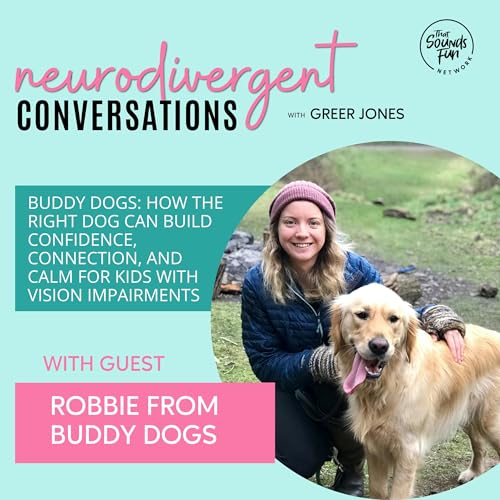
• Buddy Dogs: How the Right Dog Can Build Confidence, Connection, and Calm for Kids With Vision Impairments
    Apr 9 2026
    What if the first positive thing connected to your child’s diagnosis was… a dog in a little jacket that makes people smile? In this episode, Greer talks with Robbie Campbell from Buddy Dogs, a service within Guide Dogs UK that places specially matched dogs with children who have vision impairments—often alongside other complex needs. Robbie explains why Buddy Dogs exists: guide dogs are trained for mobility and require a level of independence that simply isn’t realistic for most children. But the companionship, confidence, and connection that dogs bring? That can be life-changing for kids and families. Robbie shares what he sees again and again: dogs becoming an “icebreaker” in public, helping kids feel more confident talking to others, and even opening doors for children to speak about their vision impairment in a new way—sometimes for the very first time. For some families, the Buddy Dog becomes a shift in the emotional story: instead of isolation and heavy equipment drawing stares, there’s a warm, inviting focus that brings people closer. You’ll also hear how Buddy Dogs are different from guide dogs: Buddy Dogs aren’t trained for mobility tasks. They’re placed for companionship and day-to-day confidence-building—and they’re typically dogs who didn’t continue down the guide dog route, but are still beautifully suited for family life. Matching is taken seriously, including what a particular dog needs and what each family’s lifestyle can support, with training and ongoing check-ins to make sure the partnership stays strong. The conversation also touches on neurodivergent families: many kids in the programme are also autistic, ADHD, or otherwise neurodivergent. Robbie describes how dogs often become natural regulators—helping with transitions, reducing anxiety, and bringing grounding presence (without being “task trained” like some assistance dogs). One story stands out: a child who arrived at a session as a whirlwind of anxiety and energy, then settled and connected once the dog entered the room—and after being matched, showed a remarkable shift in focus, communication, and calm. Greer also shares her own experience: how giving her son simple dog-care “jobs” after school (feeding, playing, petting) has helped soften the tricky transition from school to home—because sometimes that repetitive, comforting connection is exactly what a nervous system needs. This episode is a reminder that so much of disability and neurodivergence is invisible—and we never fully know what someone is carrying. Robbie’s takeaway is simple and powerful: be open, be curious, and be willing to support people as they are. GUEST LINKS: GET THE LINKS⁠⁠⁠The Unfinished Idea WebsiteJoin the Unfinished Community Follow me on socials: ⁠⁠⁠INSTAGRAM⁠⁠⁠⁠⁠⁠⁠⁠⁠⁠ FACEBOOK⁠⁠⁠ Learn more about your ad choices. Visit megaphone.fm/adchoices
    Show more Show less
    26 mins
  • You Might Also Like: Everyone Gets a Juice Box, from Understood.org
    Apr 2 2026
    You Might Also Like.... Check out Everyone Gets a Juice Box here Some kids don’t fall apart at school or out in public. They hold it together all day… and then unravel the second they walk through the front door—because home is the safest place their nervous system knows. In this episode, Dr. Arielle Schwartz (psychologist, author, and mom) shares the story of how she “followed the clues” to understand what was really going on for her son—starting long before the word dyslexia ever entered the picture. She takes us back to early signs like sensory processing challenges, a highly sensitive nervous system, and delayed language development—plus the frustration of having a bright mind with big feelings and not enough ways to get it all out. As school demands increased, the gaps became more visible—especially around reading. Arielle describes the heartbreaking moment when her son didn’t just avoid books… he hid from them—and how the shame of feeling “different” can show up shockingly early. One turning point came from an unexpected place: a film about dyslexia that helped her finally name what she was seeing and pursue a full evaluation. From there, she opens up about what the diagnosis clarified (and what it didn’t), how hard it can be to find the right interventionist (not just the most qualified on paper), and why felt safety is everything for kids who freeze, shut down, or hide when learning feels threatening. She also shares how advocacy with schools can be both exhausting and necessary—and how one committed teacher chose to learn, grow, and become part of the solution. And then comes the hope-filled part: the “game changers” that helped her son begin to see himself differently—community, mentorship, movement, and being surrounded by people who reflected back what was possible. You’ll hear why programs like Project Eye to Eye mattered so much, why some kids need parents out of the homework battle to protect the relationship, and how a few key supports can slowly unwind years of shame. This conversation is tender, honest, and deeply reassuring—especially if you’re in that phase of parenting where you’re thinking, Is it my instinct… or am I overreacting? Arielle’s story is a reminder: your noticing matters. And with the right support, your child’s future can look so much brighter than it feels right now. Learn more about your ad choices. Visit megaphone.fm/adchoices
    Show more Show less
    46 mins
  • Stop Doing It All Alone: ADHD Parenting Support That Brings Your Child Into the Strategies Too
    Mar 26 2026
    If you’re parenting a child with ADHD (or you’re late-diagnosed yourself), it can feel like you’re constantly trying to “figure it out” — schedules, school, food, sleep, behaviour, emotions… all of it. In this episode, Greer talks with Dr. Jennifer Dall about approaching ADHD through a whole-person lens: not as a “fix,” but as support for real life. They unpack why the basics (sleep, movement, food, connection) matter so much — and how to build strategies with your child so it doesn’t all sit on your shoulders. What we cover Why “whole body” support matters for ADHD day-to-day The question that can change everything: “What do I need right now?” How sleep, food, water, movement, and connection can shape emotional regulation Letting go of perfection (and the guilt) — and choosing supports that fit your life How to start including your child in problem-solving so they build self-advocacy over time Helping kids understand ADHD in an age-appropriate way (and giving them time to process) A gentle takeaway You’re not failing. This is a learning process — for you and your child — and small shifts can make a big difference. GUEST LINKS: Follow Dr. Jennifer on Insta Check out her website GET THE LINKS The Unfinished Idea website⁠⁠⁠⁠⁠⁠ ⁠Join the Unfinished Community Follow me on socials: ⁠⁠⁠INSTAGRAM⁠⁠⁠⁠⁠⁠⁠⁠⁠ ⁠FACEBOOK⁠⁠⁠ Learn more about your ad choices. Visit megaphone.fm/adchoices
    Show more Show less
    29 mins
  • Addiction Isn’t Always a Disease: Neurodivergence and Addictive Behaviours and How to Understand What’s Really Going On
    Mar 19 2026
    What if some “addictive behavior” is actually a nervous system trying to cope in the only way it knows how? In this episode, Greer sits down with Ben Branson (The Hidden 20%) to talk about the overlap between neurodivergence and addiction, especially for people who were diagnosed late and spent years chasing dopamine, trying to regulate, and not knowing why life felt so hard. They also talk about the bigger picture: long NHS waitlists, siloed assessments, and the painfully common experience of finally getting a diagnosis… and then being handed a letter with zero meaningful support attached. This conversation is honest, sometimes fiery, and deeply human. It’s about what needs to change, but it’s also about something quieter: how understanding your brain can bring relief, context, and self-compassion. In this episode, we talk about How ADHD and autism traits can link with dopamine-seeking and repetitive coping loops Why Ben questions the “disease model” and focuses on behavior, support, and unmet needs The reality of diagnosis without aftercare and why that “so what?” moment hurts Why current pathways feel siloed and why whole-person support matters Moving from awareness to acceptance to action in education, healthcare, and policy What The Hidden 20% is building and why their goal is to eventually not need to exist Gentle reminder: if this topic touches something tender for you, take it slow. You’re allowed to pause and come back. GUEST LINKS: Follow Ben on Insta Check out the Hidden 20% GET THE LINKS ⁠⁠⁠The Unfinished Idea Website Join the Unfinished Community Follow me on socials: ⁠⁠⁠INSTAGRAM⁠⁠⁠⁠⁠⁠⁠⁠⁠ ⁠FACEBOOK⁠⁠⁠ Learn more about your ad choices. Visit megaphone.fm/adchoices
    Show more Show less
    35 mins
  • Stop Trying to Bubble Bath Your Way Out of Burnout: Parental Burnout Warning Signs and What Support Actually Looks Like
    Mar 12 2026
    If you’re a neurodivergent parent or you’re parenting a neurodivergent child, burnout can creep in quietly… until it suddenly doesn’t feel quiet at all. In this episode, Greer talks with Liz (The Untypical OT) about what burnout actually is, why it’s so common in neurodivergent families, and why it’s often not your child causing it. They name the real load: the constant planning, the constant navigating, the constant advocating, and the systems that make everything harder than it needs to be. They also talk about something that matters a lot: burnout isn’t something you can “self-care” your way out of. It’s nuanced. It’s personal. And the earlier you can recognize your warning signs, the more gently you can support yourself. In this conversation, we cover What burnout is (and why it’s not a personal failure) Why burnout in neurodivergent families is so often about systems, not your child The importance of learning your personal burnout warning signs Why “just do self-care” can feel infuriating when you’re drowning Tiny, realistic moments that help you come back to yourself (even 2–3 minutes) Being more present when your brain is always ten steps ahead Gentle reminder: you’re not failing. You’re carrying a lot, and it makes sense that your body gets tired of holding it. GUEST LINKS: Follow Liz on Insta Check out her podcast GET THE LINKS The ⁠⁠⁠Unfinished Idea website⁠⁠⁠⁠⁠⁠ Join the Unfinished Community! Follow me on socials: ⁠⁠⁠INSTAGRAM⁠⁠⁠⁠⁠⁠⁠⁠⁠ ⁠FACEBOOK⁠⁠⁠ Learn more about your ad choices. Visit megaphone.fm/adchoices
    Show more Show less
    35 mins
  • Stop Assuming Silence Means “No”. AAC Support: How to Help Non-Speaking Kids Communicate
    Mar 5 2026
    If you have ever heard “they can’t communicate” and felt your stomach drop, this episode is for you. Because communication is not a performance. It’s a connection. It’s a regulation. It’s being understood. And when we only count spoken words, we miss the ways autistic kids communicate all day long. In this conversation, we reframe what communication actually is, talk about AAC in plain language, and share how to support non-speaking, minimally speaking, and situationally speaking people with more respect, more curiosity, and way less assumption. Today on Neurodivergent Conversations, I’m joined by Becky, a Speech and Language Therapist and Clinical AAC Specialist with Smartbox Assistive Technology, and we are going there in the best way. This episode is packed with the exact kind of clarity parents and educators need, including: The difference between speech, language, and communication, and why those labels matter in assessments, school meetings, and everyday life What AAC really means, plus what counts as AAC beyond a high-tech device Why “non-speaking” does not mean “no thoughts,” “no understanding,” or “no personality” How to spot communication in regulation, behaviour, body language, eye gaze, and connection Why “presume competence” is not just a phrase, it’s a starting point that changes how adults respond a simple way to begin at home, even if you feel stuck: noticing patterns and building a “communication dictionary” so your child feels understood If you are searching for support with autistic communication, AAC strategies, minimally speaking autism, or neurodiversity-affirming speech therapy approaches, this episode will give you language, hope, and next steps you can actually use. GUEST LINKS: Smartbox Assistive Technology GET THE LINKS The Unfinished Idea Website Follow me on socials: ⁠⁠⁠INSTAGRAM⁠⁠⁠⁠⁠⁠⁠⁠⁠ ⁠FACEBOOK⁠⁠⁠ Learn more about your ad choices. Visit megaphone.fm/adchoices
    Show more Show less
    29 mins
  • Late-Diagnosed ADHD in Women Over 60: Grace, Systems, and the Mother Daughter Shift with Lisa Randall
    Feb 27 2026
    What if you are not “too much,” “too chatty,” “too sensitive,” or “just rude” What if your brain has been working overtime for decades, and a diagnosis is not a label, but permission to finally offer yourself grace? In this episode, we talk about what it feels like to be diagnosed with ADHD later in life, the quiet shame so many women carry, and the surprisingly practical supports that can change your day-to-day. Today on Neurodivergent Conversations, I’m sitting down with Lisa, who was encouraged toward her own late ADHD diagnosis through her daughter Michelle’s journey, and who now leads Lexie’s Voice, a nonprofit supporting families touched by autism and developmental disabilities. We chat about: what “loving yourself” can look like in the form of pursuing diagnosis and support the moment medication made her handwriting slow down and finally match her thoughts how masking can look like people pleasing, and why it can actually be about soothing your own nervous system the social “whiplash” of being deeply present, then forgetting details later, and the systems that help the mother daughter shift when your adult child starts protecting their limits (and what it can teach you about asking for what you need) why “you’ve met one autistic person, you’ve met one,” and what that means for how we show up with compassion You will leave with language for what you have been experiencing, and a few gentle ideas you can try this week if your brain is always five steps ahead of your body. GET THE LINKS ⁠⁠⁠Check out the refreshed website⁠⁠⁠⁠⁠⁠ ⁠Learn about the ⁠⁠⁠Exhausted to Empowered Collective⁠⁠⁠ Follow me on socials: ⁠⁠⁠INSTAGRAM⁠⁠⁠⁠⁠⁠⁠⁠⁠ ⁠FACEBOOK⁠⁠⁠ SPONSOR LINKS: Check out ADHD Central! Learn more about your ad choices. Visit megaphone.fm/adchoices
    Show more Show less
    36 mins
  • We Almost Didn’t Make It: Neurodivergent Marriage, Honest + Hopeful
    Feb 19 2026
    Marriage can feel hard for so many reasons… and when you’re in a neurodivergent household, it can feel like there are extra layers you can’t always name. In this solo episode, Greer shares a very honest snapshot of her marriage: she has ADHD, her husband is autistic, and they’re raising an autistic/ADHD child (with another little one whose “brain type” they’re still learning). She talks about the real stress points, the growth they’ve fought for, and the small “language tools” that have made communication feel safer and more doable. Greer also opens up about a turning point from about five years ago—when she was close to leaving—and what helped them start repairing: individual counselling, marriage counselling, and learning how their brains work. Why marriage can feel especially heavy in an ADHD/autism relationship How miscommunication often comes from what wasn’t said (or how something landed) The difference between being near each other… and actually feeling connected Practical phrases that reduce conflict (like “10 minutes to dream” and “10-minute tap out”) Why scheduling hard conversations can help neurodivergent nervous systems feel safer How “survival seasons” can look like couch time—and why that can be okay (for a while) A gentle reminder: you’re on the same team, and you’re not alone If you’re in a season where it feels like you’re roommates, not partners—there’s no shame in that. You’re carrying a lot. This episode is your reminder that help is allowed, connection can be rebuilt, and sometimes the first step is simply finding words that work for your brains. If this episode lands for you, share it with a friend who’s trying to love well in a neurodivergent home—and needs to feel a little less alone.GET THE LINKS⁠⁠⁠Check out the refreshed website⁠⁠⁠⁠⁠⁠⁠ Learn about the ⁠⁠⁠Exhausted to Empowered Collective⁠⁠⁠Follow me on socials: ⁠⁠⁠INSTAGRAM⁠⁠⁠⁠⁠⁠⁠⁠⁠⁠ FACEBOOK⁠⁠⁠ Learn more about your ad choices. Visit megaphone.fm/adchoices
    Show more Show less
    30 mins