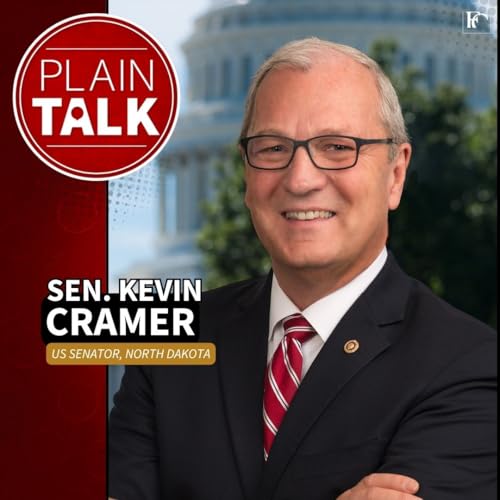
Plain Talk Podcast By Forum Communications Co. cover art

Plain Talk

Plain Talk

By: Forum Communications Co.
Listen for free

Plain Talk is a podcast hosted by Rob Port and Chad Oban focusing on political news and current events in North Dakota. Port is a columnist for the Forum News Service published in papers including the Fargo Forum, Grand Forks Herald, Jamestown Sun, and the Dickinson Press. Oban is a long-time political consultant.©2026 Forum Communications Co. Political Science Politics & Government Social Sciences
Episodes
  • 697: 'I think my resignation, that woke up a lot of people'
    Apr 22 2026

    When Oliver County Commissioner Dave Berger -- a veteran of more than 50 years of local public service -- stepped down amid what he describes as an abusive and slanderous backlash over a data center proposed by Applied Digital, it illustrated the dark side of two debates.

    One is the debate over data centers. There are good arguments to be made on both sides of the debate, but some elements involved in it have become incapable of acknowledging that it's possible to disagree in good faith.

    The other is the debate over public service itself, and how difficult its become in an era where social media has made it possible for an angry and overwrought minority to hound those in public service.

    "The slander, the judgment of my character, my integrity. They just call it into question like I never existed before," Berger told us on this episode of Plain Talk, say he's been accused of taking bribes on the data center issue. "Then the calls with the swearing at me, you know, the f-word, the a-word. "If you want to have a conversation, I'll just lay [the phone] on the counter, they can cuss at the counter."

    "I've got nothing to hide," Berger added, noting that there have been open records requests filed for his communications and financial information.

    The ironic thing is that Berger says he hasn't actually made up his mind on whether Applied Digital should build a data center in Oliver County. "I have never told anyone but my wife how I feel about it because I'm not sure how I feel," Berger said. "And Dave with Applied Digital, when he first called...I just told him, I'm not sold on it. What you got to sell it to is the public. And that's that's how I got to base my opinions, right? You've got to listen to both sides."

    Berger is no longer in office -- he's said that he plans on spending more time with his family in retirement -- but he did have some advice for people who see stories like his and are afraid of serving in office: "Keep going forward," he said.

    Also on this episode, guest co-host Rep. Zac Ista and I talk about whether U.S. House candidate Trygve Hammer is trying to peel some populist voters away from incumbent U.S. Rep. Julie Fedorchak as well as the controversy of the U.S. Supreme Court's so-called "shadow docket."

    If you want to participate in Plain Talk, just give us a call or text at 701-587-3141. It's super easy — leave your message, tell us your name and where you're from, and we might feature it on an upcoming episode. To subscribe to Plain Talk, search for the show wherever you get your podcasts or use one of the links below.

    Apple Podcasts | Spotify | YouTube | Pocket Casts | Episode Archive

    Show more Show less
    1 hr and 6 mins
  • 696: 'Hopefully we can regain the public trust in what we do'
    Apr 17 2026

    If you get into a scrape involving local government in North Dakota -- say a garbage truck side swipes your car, or you get hurt on park district property -- the organization you'd likely seek relief through is the North Dakota Insurance Reserve Fund. This is an entity created by local governments, and funded by local tax dollars, which acts essentially like an insurance company.

    But the organization has come under fire, with critics saying NDIRF can be ruthless when it comes to claims filed by the public, even as the organization passes along millions in conferments to its members.

    On this episode of Plain Talk, NDIRF CEO Keith Pic said the organization serves North Dakota by keeping costs down for local governments. "I think the important part here is that the coverages that we provide are unique to North Dakota," he said. "We can be responsive to North Dakota. We don't have the entire United States impacting the rates that would be charged for the risk that our political subdivisions have."

    I recently wrote an article critical of NDIRF over the organization's handling of the Northwood school bus crash, where dozens of students were injured. That happened back in 2023, but the litigation around it is still lingering, with some families and legal representatives blaming NDIRF for bogging the process down.

    "The easy thing for NDIRF in that situation would have been to just pay the $300,000 and just be done with it," Pic said, referring to the underinsured motorist coverage for the school district that is at issue. "But I think there would have been some major inequities that would happen or would have happened from that global settlement if we had participated in it. And here you had kids that were still treating well into 2025. Well, we don't know the extent of those injuries in 2024 when that global mediation happened."

    Pic also argued that the millions in conferments the organization has made back to local governments have nothing to do with claims decisions. "There's no thought as to how is this going to affect our financials. Our claims adjusters are very much examining, what is the legal liability? What's a legal standard as to what can make up this claim and is it an allowable claim to be paid?" he said. "Ultimately, the claims decisions are made afterwards after the year's over. We have an actuarial analysis that's completed to make sure that our our liabilities are set. So I think it's a misconception that there's this incentive uh to make that happen."

    Pic says he's an "open book" for critics. "I'm certainly hopeful that I can help resolve some of the issues that have come up. Every day is a day of improvement, little by little, and hopefully we can regain the public trust in what we do."

    Also on this episode, we talk about political troll Brandon Prichard directing inquiries about his organizations campaign finance disclosures to Saul Goodman, and the reality of North Dakota's three political parties.

    If you want to participate in Plain Talk, just give us a call or text at 701-587-3141. It's super easy — leave your message, tell us your name and where you're from, and we might feature it on an upcoming episode. To subscribe to Plain Talk, search for the show wherever you get your podcasts or use one of the links below.

    Apple Podcasts | Spotify | YouTube | Pocket Casts | Episode Archive

    Show more Show less
    1 hr and 6 mins
  • 695: 'This is not a place where you can burn a lot of bridges'
    Apr 15 2026

    Sen. Kevin Cramer and I have had a running dispute over President Donald Trump and his approach to politics. Cramer says media critics like me are too focused on Trump's antics. I say people like Cramer are too muted in their own criticism.

    "I'm a United States senator from North Dakota who has a really good personal relationship with the president of the United States," Cramer said in defense of his stance on this episode of Plain Talk, "and there is a long list of advantages for the people of North Dakota because of that relationship."

    "This is not a place where you can burn a lot of bridges," he added.

    Cramer also accused the news media of not being focused enough on the accomplishments of the Trump era, including tax reform.

    "My complaint is not just that they aren't covering the tax cuts enough. It's that certain media outlets are so fascinated by the rants and raves of people about the evils of Donald Trump and Republicans, but they don't write about the accomplishments with the samem," he said. "In fact, they almost don't publish any of it."

    He also talked about the war President Donald Trump has launched against Iran, and whether it needs congressional approval.

    "In the case of the War Powers Act, there's a pretty strong argument -- it's never been tested, mind you, but pretty strong argument -- that the War Powers Act as a piece of legislation as a power that Congress has passed in law is not even constitutional," he said. "But having said that, as it stands, the War Powers Act is what requires the president to, when he does enact a kinetic conflict like we're in with Iran right now, he has 60 days in which to either get out of it or inform Congress or he can extension."

    Cramer says he believes Trump should want congressional approval.

    Also on this episode, Cramer talks about his efforts to improve U.S. relations with Canada, and co-host Chad Oban and I discuss the out of state money funding Together for School Meals, the ballot measure campaign to have the state cover the cost of school meals for parents.

    If you want to participate in Plain Talk, just give us a call or text at 701-587-3141. It's super easy — leave your message, tell us your name and where you're from, and we might feature it on an upcoming episode.

    Show more Show less
    1 hr and 3 mins
No reviews yet