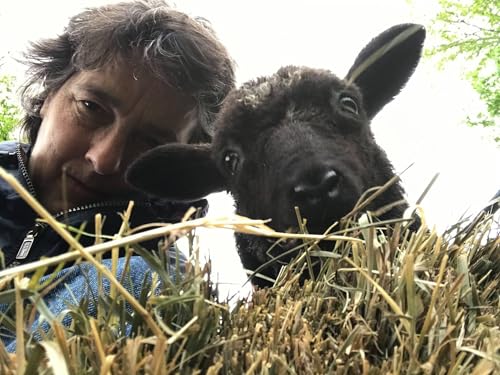
Story Time at Clatter Ridge Farm Podcast By Bobbie Emery cover art

Story Time at Clatter Ridge Farm

Story Time at Clatter Ridge Farm

By: Bobbie Emery
Listen for free

I'm a farmer, thinker, and writer. I can't seem to help myself. It's what I do, who I am, and what I love.

clatterridgefarm.substack.comBobbie Emery
Biological Sciences Science Social Sciences
Episodes
  • For The Love of Spring
    Mar 26 2026

    The most wonderful sound in the whole wide world is, without a doubt, the evening song of the Wood Thrush. The mesmerizing flute-like notes carry and echo across the ridge and weave their way in and out of the forest’s edge. The sound is soulful, somewhat haunting and deeply magical. When I hear it, I know I’m home and that no matter what else is going on beyond my forested retreat- at this moment in time, everything is going to be okay.

    I love the little potbellied Wood Thrush deeply - but I have to admit that the sound that brings me the purest joy, bar none, is the chorus of the Spring Peeper. In early spring, the tiny frogs gather along the swampy edges of ponds and wetlands and compete for the love of their lives – or at least, for a chance to procreate. The louder and faster a male Spring Peeper chirps, the more likely it is that a female will choose him to be her mate. Though each frog is less than an inch in length, their springtime chorus can reach 90 decibels and be heard one to two miles away.

    I know the chorus they produce is just a heartfelt love song not intended for the likes of me, but in its melody, I can feel the certainty that spring has arrived and that winter has been left in its muddy wake. It is pure hope, belted out with amphibian acapella joy.


    This is a public episode. If you would like to discuss this with other subscribers or get access to bonus episodes, visit clatterridgefarm.substack.com
    Show more Show less
    2 mins
  • More Lambs - Fewer Kings
    Mar 19 2026

    In an attempt to protect their monopoly on the wool industry, England tried hard to discourage one from ever taking hold in its American colonies. To that end, the exporting of sheep to America was expressly forbidden, but by 1655, a few smuggled sheep had multiplied to 10,000. Oops! I’m not sure what I find more amusing; that colonial sheep smuggling was actually a thing or that breeding sheep became such a subversive (and successful) act of independence.

    Clearly unable to completely stop America’s burgeoning sheep industry, British Parliament in 1699, attempted to at least contain it by enacting “The Woolens Act”. The law prohibited the export of any woolen items from the American colonies (and Ireland) and the import of textiles from any country other than Britain. Though the law had a devastating effect on Ireland and effectively crushed its economy - it was not well enforced in the American colonies.

    That benign neglect ended when King George III ascended the throne and made wool trading in the Colonies an offense punishable by cutting off the offender’s right hand. That renewed and elevated threat, along with various other taxes and tariffs, set the stage for the rebellion that soon led to the Revolutionary War.

    Many colonists boycotted British goods and proudly wore homespun clothes as a sign of their patriotism. And while their male counterparts formed the “Sons of Liberty” and rioted drunkenly in the streets, the women of colonial America held spinning bees. They came together peacefully not only to produce yarn and textiles but as a show of their own solidarity and patriotic fever.

    Join us Sunday, March 29th, 2026, from 10-4 at Hill Stead Museum as we shear our sheep and demonstrate how their wool can be turned “from sheep to shawl”

    There will be rebellious lambs, sheep shearing, lots of spinning, weaving and solidarity. Public displays of drunkenness, rioting and looting, however, will be strongly discouraged.

    See you there!


    This is a public episode. If you would like to discuss this with other subscribers or get access to bonus episodes, visit clatterridgefarm.substack.com
    Show more Show less
    2 mins
  • A Chance to Explain
    Mar 12 2026

    When I was in my twenties a scuba diving accident landed me in the hospital for ten days. I was living in California, and though I didn’t have any family nearby I had a lot of friends. They all rallied around and visited me often and while most of them made a concerted effort to cheer me up, what I remember best was my friend Jules. She was taking an art class at a local community college and would stop by in between work and school. I’d wake up and see her sitting in the chair sketching. I’d say “hey” and she’d look up and smile and say “hey” and then she’d go back to sketching and I’d go back to sleep. When I’d wake up again, there’d be a sketch of my feet, or of the view out the window, propped up for me on my nightstand. There was something extraordinarily comforting knowing that she was there, and that I didn’t have to do anything. She wasn’t trying to entertain or distract me. She was just quietly keeping me company on my journey.

    I like to think that’s what I have to offer with my writing and with the photos that I take. I can’t fix anything. I can’t change the trajectory of the planet’s health - or that of my friends, but I can quietly keep them company on their journey and perhaps leave them something I’ve written, or a photograph, on their nightstand. I write, in part to bear witness to a changing way of life- to a changing planet and ecosystem. To a way of living and being and also as a chance to explain myself.

    A couple of years ago I went to a memorial service for someone who I didn’t know very well but whom I appreciated for all the work she’d done in the community. I went to show my appreciation and pay my respects. At the service her husband was understandably inconsolable and unable to speak. The only other people who spoke were her boss and her hairdresser. Her boss shared with us that she was really good at filling out forms and her hairdresser talked about what a friendly client she was. I thought “God help me, this is going to be me.” I spend so much time alone and in my own head I’m afraid all anyone will be able to say about me is that I was pleasant and really good at filling out forms.

    And in fact, that would be a stretch. I’m not good at filling out forms at all. Most forms don’t leave enough space for the answers, so I often feel the need to write in the margins. And as far as being pleasant – it kind of depends on the day.

    Writing is the best way I have of expressing myself, so, after that memorial service I started writing and I haven’t stopped. I love Robin, the woman who cuts my hair, but if there is ever a service in my honor, please ask her to read something I’ve written.

    Humor has a curious way of making the darkness lighter. This is a collection of essays - sharing that humor, bearing witness to a changing climate and a changing way of life. It is a way of explaining myself so that at my memorial service no one else has to. I am a writer, a thinker and a farmer. It’s who I am, what I do and what I love.


    This is a public episode. If you would like to discuss this with other subscribers or get access to bonus episodes, visit clatterridgefarm.substack.com
    Show more Show less
    3 mins
No reviews yet