• For The Love of Spring
    Mar 26 2026

    The most wonderful sound in the whole wide world is, without a doubt, the evening song of the Wood Thrush. The mesmerizing flute-like notes carry and echo across the ridge and weave their way in and out of the forest’s edge. The sound is soulful, somewhat haunting and deeply magical. When I hear it, I know I’m home and that no matter what else is going on beyond my forested retreat- at this moment in time, everything is going to be okay.

    I love the little potbellied Wood Thrush deeply - but I have to admit that the sound that brings me the purest joy, bar none, is the chorus of the Spring Peeper. In early spring, the tiny frogs gather along the swampy edges of ponds and wetlands and compete for the love of their lives – or at least, for a chance to procreate. The louder and faster a male Spring Peeper chirps, the more likely it is that a female will choose him to be her mate. Though each frog is less than an inch in length, their springtime chorus can reach 90 decibels and be heard one to two miles away.

    I know the chorus they produce is just a heartfelt love song not intended for the likes of me, but in its melody, I can feel the certainty that spring has arrived and that winter has been left in its muddy wake. It is pure hope, belted out with amphibian acapella joy.


    This is a public episode. If you would like to discuss this with other subscribers or get access to bonus episodes, visit clatterridgefarm.substack.com
    Show more Show less
    2 mins
  • More Lambs - Fewer Kings
    Mar 19 2026

    In an attempt to protect their monopoly on the wool industry, England tried hard to discourage one from ever taking hold in its American colonies. To that end, the exporting of sheep to America was expressly forbidden, but by 1655, a few smuggled sheep had multiplied to 10,000. Oops! I’m not sure what I find more amusing; that colonial sheep smuggling was actually a thing or that breeding sheep became such a subversive (and successful) act of independence.

    Clearly unable to completely stop America’s burgeoning sheep industry, British Parliament in 1699, attempted to at least contain it by enacting “The Woolens Act”. The law prohibited the export of any woolen items from the American colonies (and Ireland) and the import of textiles from any country other than Britain. Though the law had a devastating effect on Ireland and effectively crushed its economy - it was not well enforced in the American colonies.

    That benign neglect ended when King George III ascended the throne and made wool trading in the Colonies an offense punishable by cutting off the offender’s right hand. That renewed and elevated threat, along with various other taxes and tariffs, set the stage for the rebellion that soon led to the Revolutionary War.

    Many colonists boycotted British goods and proudly wore homespun clothes as a sign of their patriotism. And while their male counterparts formed the “Sons of Liberty” and rioted drunkenly in the streets, the women of colonial America held spinning bees. They came together peacefully not only to produce yarn and textiles but as a show of their own solidarity and patriotic fever.

    Join us Sunday, March 29th, 2026, from 10-4 at Hill Stead Museum as we shear our sheep and demonstrate how their wool can be turned “from sheep to shawl”

    There will be rebellious lambs, sheep shearing, lots of spinning, weaving and solidarity. Public displays of drunkenness, rioting and looting, however, will be strongly discouraged.

    See you there!


    This is a public episode. If you would like to discuss this with other subscribers or get access to bonus episodes, visit clatterridgefarm.substack.com
    Show more Show less
    2 mins
  • A Chance to Explain
    Mar 12 2026

    When I was in my twenties a scuba diving accident landed me in the hospital for ten days. I was living in California, and though I didn’t have any family nearby I had a lot of friends. They all rallied around and visited me often and while most of them made a concerted effort to cheer me up, what I remember best was my friend Jules. She was taking an art class at a local community college and would stop by in between work and school. I’d wake up and see her sitting in the chair sketching. I’d say “hey” and she’d look up and smile and say “hey” and then she’d go back to sketching and I’d go back to sleep. When I’d wake up again, there’d be a sketch of my feet, or of the view out the window, propped up for me on my nightstand. There was something extraordinarily comforting knowing that she was there, and that I didn’t have to do anything. She wasn’t trying to entertain or distract me. She was just quietly keeping me company on my journey.

    I like to think that’s what I have to offer with my writing and with the photos that I take. I can’t fix anything. I can’t change the trajectory of the planet’s health - or that of my friends, but I can quietly keep them company on their journey and perhaps leave them something I’ve written, or a photograph, on their nightstand. I write, in part to bear witness to a changing way of life- to a changing planet and ecosystem. To a way of living and being and also as a chance to explain myself.

    A couple of years ago I went to a memorial service for someone who I didn’t know very well but whom I appreciated for all the work she’d done in the community. I went to show my appreciation and pay my respects. At the service her husband was understandably inconsolable and unable to speak. The only other people who spoke were her boss and her hairdresser. Her boss shared with us that she was really good at filling out forms and her hairdresser talked about what a friendly client she was. I thought “God help me, this is going to be me.” I spend so much time alone and in my own head I’m afraid all anyone will be able to say about me is that I was pleasant and really good at filling out forms.

    And in fact, that would be a stretch. I’m not good at filling out forms at all. Most forms don’t leave enough space for the answers, so I often feel the need to write in the margins. And as far as being pleasant – it kind of depends on the day.

    Writing is the best way I have of expressing myself, so, after that memorial service I started writing and I haven’t stopped. I love Robin, the woman who cuts my hair, but if there is ever a service in my honor, please ask her to read something I’ve written.

    Humor has a curious way of making the darkness lighter. This is a collection of essays - sharing that humor, bearing witness to a changing climate and a changing way of life. It is a way of explaining myself so that at my memorial service no one else has to. I am a writer, a thinker and a farmer. It’s who I am, what I do and what I love.


    This is a public episode. If you would like to discuss this with other subscribers or get access to bonus episodes, visit clatterridgefarm.substack.com
    Show more Show less
    3 mins
  • A Symphony of Sap
    Mar 5 2026

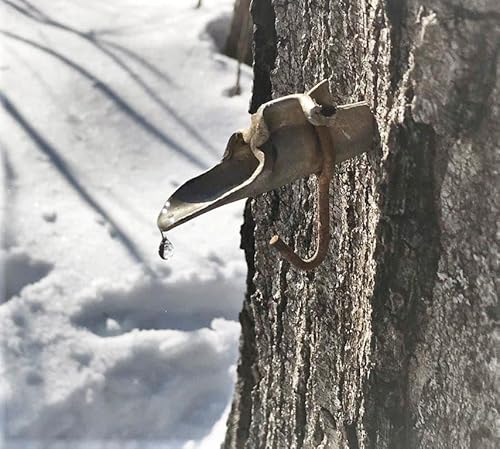
    When we open up the sugar house in the morning, there’s often just the sound of the frozen ground crunching beneath our feet, the singing of a few early morning birds, and perhaps an intermittent drip of sap dropping into an empty sap bucket.

    As the day progresses, though, the trees warm up and the sap really begins to flow. The warmer it gets the faster it flows, and by mid-day the trees surrounding our sugar house are a symphony of drops dripping and splashing as the taps flow in earnest.


    This is a public episode. If you would like to discuss this with other subscribers or get access to bonus episodes, visit clatterridgefarm.substack.com
    Show more Show less
    1 min
  • The Morally Superior Maple
    Feb 26 2026

    We tapped our sugar maples this week, and that to me is the beginning of spring. The sap will run as long as the temperatures are below freezing at night and well above freezing during the day. The “sugaring” season usually lasts about 6 weeks, or until the trees start to bud.

    Maple Syrup was a dietary staple for the Native Americans that lived in New England. When little else was available in early spring, they relied heavily on maple syrup for sustenance. It takes at least 40 gallons of sap boiled down to make 1 gallon of syrup, and without the use of kettles they collected the sap in hollowed out logs and boiled it down by dropping hot rocks into it. (Okay, I quit).

    Later, the colonists used copper kettles over an open flame which made the process infinitely easier. (It’s all relative right?) They boiled the sap beyond the syrup stage and turned it into sugar, which without refrigeration was much easier to preserve. An average family would make 200 pounds of maple sugar and an exceptionally industrious family could make 1,000 pounds. Any excess was an easy commodity to trade or sell. (For comparison’s sake, if Anne and I converted the syrup we make each year into sugar, it would probably be about 50 pounds, slackers that we are).

    In 1789 Benjamin Rush and a group of Philadelphia Quakers started a campaign to end slavery by convincing people to use maple sugar as a sweetener instead of cane sugar, which was grown in the West Indies with slave labor. Rush described maple sugar as the “morally superior” choice. His mission was to “lessen or destroy the consumption of West Indian Sugar, and thus indirectly destroy slavery.”

    Thomas Jefferson picked up the cause and attempted to start a “sugar orchard” at Monticello. Using the labor of enslaved people, he planted maple trees which he had purchased while touring New England. Jefferson’s interest in breaking the cane sugar trade was “to help relieve the misery of the West Indian slave trade” and to break Great Britain’s grip on the United States. Sugar was the number one import of that era, and it all came by way of England.

    After the civil war, beet sugar became popular, the price of cane sugar dropped, and the demand for maple sugar collapsed. Maple syrup, instead of maple sugar, soon became the maple product of choice.

    After multiple failed attempts, Jefferson was finally able to get some of his sugar maples to grow, but the trees never produced any “sweet water.” There is something about the freeze thaw cycle and temperature differential of our northern climate that creates the sugar, and the flow of sap. During the summer months the tree collects sunshine and turns it into a simple sugar which it stores over the winter as starch. In the spring the starch turns back into sugar. When the tree becomes pressurized, through a process which is not entirely understood, the sap begins to flow from high pressure to low, and the tap hole gives the sap an easy way out. Technically, it’s all a byproduct of photosynthesis, but really - that’s just a fancy name for something that is nothing short of pure magic.


    This is a public episode. If you would like to discuss this with other subscribers or get access to bonus episodes, visit clatterridgefarm.substack.com
    Show more Show less
    3 mins
  • Patience!
    Feb 20 2026

    Luckily for me, the joy of spring is wrapped up in its anticipation. If I woke up one morning to a garden in full bloom, I’d be thrilled and in awe, but I’d acclimate, and the novelty would quickly fade.

    Spring for me is like a wonderfully drawn out, well-crafted love story. And like any great courtship, there is allure and longing - and impatience bordering on despair.

    The daytime temperatures this week were warm enough for collecting sap in short sleeved shirts. It felt so decadent and then came the demoralizing winds of a “bomb cyclone” to drive us all back inside.

    The sap flows and stops, a mirror of nighttime temperatures. True spring is never far off, and it will arrive eventually. The daffodils are pushing their way out of the barely thawed ground - only to be dumped on by a heavy blanket of wet snow. The daffs are still there under the snow waiting patiently - they know this drill all too well.

    Time is on our side. Like the leaves of the skunk cabbage emerging from still frosted streams, we just have to wait for the sun to do its magic. Patience, though, is perhaps a tonic best served warm.


    This is a public episode. If you would like to discuss this with other subscribers or get access to bonus episodes, visit clatterridgefarm.substack.com
    Show more Show less
    1 min
  • Sowing Seeds
    Feb 12 2026

    As Christianity spread half a world away, a new way of life was also taking hold here in New England. About two thousand years ago, the cultivation of corn – though curiously slow to catch on, was transforming how the woodland tribes lived and related to their environment – and to each other.

    For several thousand years, the tribes that called New England home had lived as hunter gatherers. Survival was challenging, but their world was relatively peaceful. Traveling in small bands of 5-30 members, they went where, and when, the food was most plentiful. I’m sure that all the things I have tried to learn, they would have known intuitively, as they passed through the woods and fields, I now call home.

    They’d have known at a glance where the deer and bear could be found, where the nuts and berries could be gathered, when the fish would be spawning and what birds would be migrating through and when. They followed the seasons and harvested what the landscape provided for them. They were friendly, family-centric and peaceful members of the Eastern Woodland Algonquian speaking tribes.

    Corn started its journey to New England, 9,000 years ago, as the exotic mutant grass known as maize. First encouraged, engineered and grown by the ancient Mayans in South America, it eventually made its way north via trade routes to the southern and midwestern tribes of North America. From there, it took several thousand years more to make its way east to New England.

    The native Hopewell traders of Ohio were frequent visitors to northern New England and had a well-established trade route with the Eastern Woodland tribes. Though the Algonquians were quick to adopt the ceramic pottery the Hopewell traders were known for, the concept of cultivating the soil and growing the small multicolored maize took several hundred years to really catch on. It pleases me to know that the original inhabitants of New England were as stubbornly set in their ways as some of us “Yankee” farmers are still accused of being today. Perhaps it was, and is, our unpredictable weather that makes us so resistant to change.

    When the growing and harvesting of corn finally did catch on, it became a staple food, and its cultivation completely changed how the hunter gatherers lived and related to their surroundings. They became more sedentary and their populations and encampments grew exponentially. They quite literally became rooted in place and quickly discovered the gifts and burdens of agriculture.

    Having cleared large swaths of woodland, planted the corn and diligently tended to it all summer, the tribes became territorial as they had now made a significant investment in their land. They learned the hard way that though corn was easy to grow and store, it was difficult to defend. There were jealousies, hostilities, and outright wars with formerly friendly neighbors. Villages became fortified and stockades were built for protection. Gone was the fluidity and cross pollination of culture, knowledge, and ideas.

    Just as the seeds of Christianity united and divided nations abroad, the seeds of agriculture united and divided the former friends living among the woodlands, and newly cleared fields of New England.


    This is a public episode. If you would like to discuss this with other subscribers or get access to bonus episodes, visit clatterridgefarm.substack.com
    Show more Show less
    3 mins
  • Keep On Keeping On
    Feb 6 2026

    Not a day goes by that I don’t wonder why I keep farming.

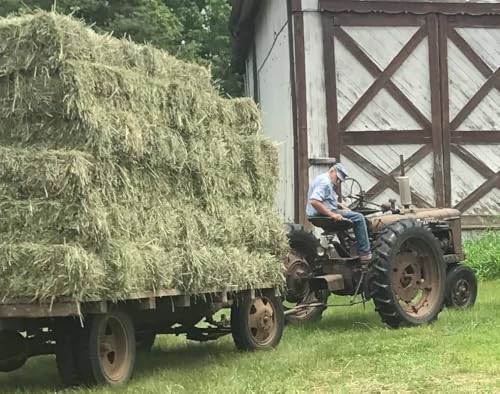
    A couple years ago, we bought hay from a farmer whose family has been farming the same land for a hundred and fifty years or so. He said jokingly “I have come to the realization that I’m not a farmer anymore, technically, I’m now a pet food manufacturer. You are the only one buying my hay for livestock - everyone else is either feeding pet goats or rescue ponies.”

    I knew he was making light of it, and I laughed, but even so it tapped into a sadness that just won’t quit. I can’t quite shake the feeling that I am bearing witness to the end of small family farms in Connecticut. Real farms. I can’t imagine that he takes much pride anymore in being a fifth-generation pet food manufacturer. Since then, whenever Anne and I stop by, we bring him pork chops or some bacon – something to let him know that we, at least, are still producing food, so he’s still a farmer after all.

    Last year one of our sows had a piglet stuck while giving birth, which I tried in vain to get “unstuck”. When we called our farm vet for help, we discovered that not only do they no longer take care of pigs, there are, in fact, no longer any vets anywhere in Connecticut that will care for a pig. So, despite spending five hours with the sow, trying to help her - I lost them both.

    I was so despondent that night, that in my mind at least, I quit farming. By morning though I knew I couldn’t quit, and I know it’s all just a vicious cycle. If I quit there’s one less farm to support a farm vet, the hay farmer, our wonderful abattoir, the sheep shearer, the spinning mill, the weaver, and perhaps most importantly of all, it’s one less opportunity for kids to see animals raised outdoors, on pasture and not just in a petting zoo.

    When I was growing up in Farmington, there was a cow barn on Main Street. My mom used to bribe us that if we went to church (and behaved) she’d take us to see the cows afterwards. There’s an astroturf soccer field where the clover used to grow. I often wonder what the honeybees think of us humans when they fly over the acres of synthetic plastic grass and past all the overly manicured lawns in Farmington in search of clover – or anything that we haven’t sprayed or mowed.

    When we purchased our first pig 15 years ago, we decided on Tamworth pigs, a heritage breed that do well on pasture and are relatively easy on the land. At the time, we had a choice of three farms in Connecticut from which to purchase that particular breed, and there were a dozen other farms raising other breeds. When I went to buy a piglet to replace the sow we lost last year, I couldn’t find any farms selling any piglets of any breed except for one farm which had 150 sows all indoors confined to farrowing crates. It’s no wonder there are no pig vets here anymore – there are no pig farms to support them.

    So, for now we’ll just keep on keeping on, and doing the very best we can. We’ll keep on raising our animals outside on pasture and know that, if nothing else, because of that, there will be plenty of clover for the bees, bacon for the hay farmer, fiber for the spinnery, yarn for the weavers, and there will still be plenty of kids, in their Sunday best, walking down the farm road to visit our sheep after church.


    This is a public episode. If you would like to discuss this with other subscribers or get access to bonus episodes, visit clatterridgefarm.substack.com
    Show more Show less
    3 mins