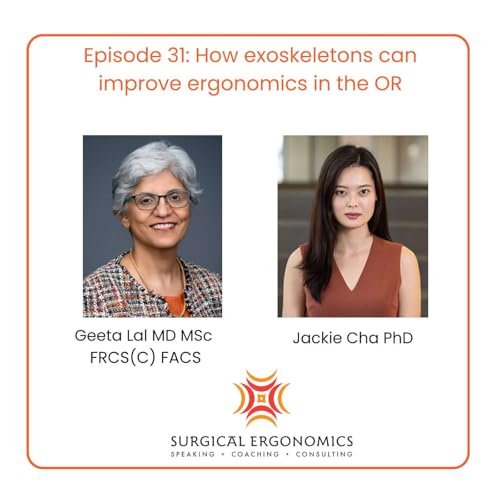
Surgical Ergonomics Podcast By Geeta Lal MD cover art

Surgical Ergonomics

Surgical Ergonomics

By: Geeta Lal MD
Listen for free

This podcast will discuss everything relating to surgical and procedural ergonomics i.e. the people, ideas and technology that will help enhance your physical wellness and career longevity.

© 2026 Surgical Ergonomics
Hygiene & Healthy Living Physical Illness & Disease
Episodes
  • How exoskeletons can improve ergonomics in the OR with Dr. Jackie Cha
    Apr 6 2026

    Dr. Jackie Cha is the Patricia Flatley Brennan Assistant Professor in the Department of Industrial and Systems Engineering at the University of Wisconsin – Madison. Her research focuses on measuring physical human-robot interactions, particularly in healthcare environments, to improve worker performance, safety, and system efficiency. Her team investigates applications of robotics – both surgical robotic systems and wearables – in clinical environments and the changes of physical and cognitive interactions between human teams and robots. Prior to joining UW-Madison, she served as an assistant professor at Clemson University. Her research has been funded by several sponsors such as the National Science Foundation (NSF) (including the NSF CAREER award), National Institutes of Health (NIH), and the Agency of Healthcare Research and Quality (AHRQ).

    In this episode Dr. Cha:

    - Explains what exoskeletons are and the difference between active and passive exoskeletions

    - Shares how exoskeletons have been used to reduce strain in industrial sectors (as PPE)

    - Describes why adapting exoskeletons to the OR is especially challenging i.e. due to the large physical and cognitive load intrinsic to OR work

    - Shares the work she and others have done evaluating exoskeletons for the OR both in the simulation environment and in actual OR rooms

    - Discusses the pros and cons of currently available exoskeletons in terms of adapting them to surgical work


    The Society of Surgical Ergonomics webinar on exoskeletons can be found here:https://www.societyofsurgicalergonomics.org/copy-of-video-library

    The recent study with qualitative and objective data with use of a neck/back exoskeleton can be found here: https://pubmed.ncbi.nlm.nih.gov/40201977/

    Dr. Jackie Cha can be reached via Linked In: https://www.linkedin.com/in/jackiecha/


    Follow us on LinkedIn, X, Instagram and Facebook and please reach out to us if you have any suggestions regarding episode ideas and guests or if you'd like to be a guest on the show

    Show more Show less
    35 mins
  • Ergonomics for otolaryngologists and incorporating ergonomics into daily work with Rhinologist, Skull base surgeon and Physical therapist Dr. Raewyn Campbell
    Mar 23 2026

    This episode of the podcast is sponsored by Q-optics. You can learn about them, the special rates they are offering for podcast listerners and schedule a demo via : https://q-optics.com/pages/surgicalergonomics-drlal

    Disclosure:

    Q-optics is a paid sponsor and the affiliate link above supports the podcast at no cost to you. It also provides you with a discount and a giveaway to listeners of the podcast, so we hope that it is a win-win!

    Dr. Raewyn Campbell is an Associate Progessor and a rhinologist and skull base surgeon in Sydney, Australia. She is also a former physical therapist with a post-graduate diploma in exercise and sport science. She completed 3 international fellowships in Rhinology and Skull Base surgery in Auckland, NewZealand and Philadelphia and Columbus, USA. She holds leadership positions in multiple societies and is the the ENT research lead for the Royal Prince Alfred Hospital Institute of Academic Surgery and the ENT Associate Member Representative for the Australian Society of Clinical Immunology and Allergy (ASCIA). She is currently pursuing a PhD in ergonomics at The University of Sydney.

    In this episode, Dr. Campbell:

    - Discusses her journey from working as a physical therapist to then pursuing a career as an surgical subspecialist and now pursuing her PhD in Ergonomics

    - Describes the research she has done looking at MSK injuries among otolaryngologists, with high rates of injuries among rhinologists and skull base surgeons, which impact not only their work but also their lives outside the OR

    - Shares the common risk factors for MSK injury for her subspecialty including glove size, standing, case load, amount of exercise, time spent in clinic, female sex and BMI of the surgeon. Many of these are modifiable and are common to other specialties as well

    - Emphasizes strategies to incorporate ergonomics into OR practice such as keeping the patient as close to oneself as possible and tilting the bed as necessary, alternating foot use for the foot pedal, using anti-fatigue mats, wearing sport shoes, paying attention to the direction of the tubing, having the scrub assistant opposite to the surgeon and including microbreaks (for both physical and cognitive ergonomics)

    - Shares her strategies for incorporating ergonomics principles into clinic work

    - Discusses the importance of incorporating physical activity (stretching ans strengthening) inside and outside the OR

    - Describes new technologies on the horizon for surgeons working on the microscope, such as exoscopes and robotic surgery

    Follow us on LinkedIn, X, Instagram and Facebook and please reach out to us if you have any suggestions regarding episode ideas and guests or if you'd like to be a guest on the show

    Show more Show less
    44 mins
  • Developing a new ergonomic retractor with Trauma and Critical Care Surgeon Dr. Ramon Cestero
    Mar 9 2026

    This episode of the podcast is sponsored by PearsonRavitz Insurance. You can learn about them and schedule a consultation on my website at: https://pearsonravitz.com/surgicalergonomics/

    Disclosure:

    PearsonRavitz is a paid sponsor and the affiliate link above supports the podcast at no cost to you.

    Episode details:

    Dr. Ramon Cestero is a Professor of Surgery at UT Health San Antonio and a nationally recognized trauma and critical care surgeon. A former Navy surgeon with extensive experience in combat and austere environments, he has dedicated his career to advancing surgical care through innovation and education.

    Dr. Cestero is the Chief Medical Officer and Co-Founder of Advanced Surgical Retractor Systems, Inc. and the inventor of the TITAN CSR® retractor, a next-generation surgical exposure system designed to address the longstanding limitations of traditional retractors. The TITAN CSR® retractor has been the subject of a Department of Defense–funded military study and a published case review series, and it has earned national recognition, including the American Association for the Surgery of Trauma’s Best New Instrument award two years in a row. His work reflects a commitment to improving surgical ergonomics, optimizing operating room performance, and advancing technologies that enhance both surgeon effectiveness and patient outcomes.

    In this episode, Dr. Cestero:

    - Shares information about the commonly used surgical retractor systems and discusses their limitations

    - Describes how his work in combat environments inspired him to develop a new retractor system

    - Discusses the details about the TITAN CSR retractor, including how it can be integrated into existing workflows and equipment surgeons and OR personnel are already familiar with

    - Details his innovation journey, where he initially partnered with the Office of Technology at his institution to manufacture a prototype and test it, and eventually formed his own company

    - Explains how the new retractor improves team ergonomics and efficiency

    - Emphasizes that the retractor also has the option of built in lighting


    You can reach Dr. Cestero here

    Details for the TITAN CSR retractor here


    Follow us on LinkedIn, X, Instagram and Facebook and please reach out to us if you have any suggestions regarding episode ideas and guests or if you'd like to be a guest on the show

    Show more Show less
    38 mins
No reviews yet