• How exoskeletons can improve ergonomics in the OR with Dr. Jackie Cha
    Apr 6 2026

    Dr. Jackie Cha is the Patricia Flatley Brennan Assistant Professor in the Department of Industrial and Systems Engineering at the University of Wisconsin – Madison. Her research focuses on measuring physical human-robot interactions, particularly in healthcare environments, to improve worker performance, safety, and system efficiency. Her team investigates applications of robotics – both surgical robotic systems and wearables – in clinical environments and the changes of physical and cognitive interactions between human teams and robots. Prior to joining UW-Madison, she served as an assistant professor at Clemson University. Her research has been funded by several sponsors such as the National Science Foundation (NSF) (including the NSF CAREER award), National Institutes of Health (NIH), and the Agency of Healthcare Research and Quality (AHRQ).

    In this episode Dr. Cha:

    - Explains what exoskeletons are and the difference between active and passive exoskeletions

    - Shares how exoskeletons have been used to reduce strain in industrial sectors (as PPE)

    - Describes why adapting exoskeletons to the OR is especially challenging i.e. due to the large physical and cognitive load intrinsic to OR work

    - Shares the work she and others have done evaluating exoskeletons for the OR both in the simulation environment and in actual OR rooms

    - Discusses the pros and cons of currently available exoskeletons in terms of adapting them to surgical work


    The Society of Surgical Ergonomics webinar on exoskeletons can be found here:https://www.societyofsurgicalergonomics.org/copy-of-video-library

    The recent study with qualitative and objective data with use of a neck/back exoskeleton can be found here: https://pubmed.ncbi.nlm.nih.gov/40201977/

    Dr. Jackie Cha can be reached via Linked In: https://www.linkedin.com/in/jackiecha/


    Follow us on LinkedIn, X, Instagram and Facebook and please reach out to us if you have any suggestions regarding episode ideas and guests or if you'd like to be a guest on the show

    Show more Show less
    35 mins
  • Ergonomics for otolaryngologists and incorporating ergonomics into daily work with Rhinologist, Skull base surgeon and Physical therapist Dr. Raewyn Campbell
    Mar 23 2026

    This episode of the podcast is sponsored by Q-optics. You can learn about them, the special rates they are offering for podcast listerners and schedule a demo via : https://q-optics.com/pages/surgicalergonomics-drlal

    Disclosure:

    Q-optics is a paid sponsor and the affiliate link above supports the podcast at no cost to you. It also provides you with a discount and a giveaway to listeners of the podcast, so we hope that it is a win-win!

    Dr. Raewyn Campbell is an Associate Progessor and a rhinologist and skull base surgeon in Sydney, Australia. She is also a former physical therapist with a post-graduate diploma in exercise and sport science. She completed 3 international fellowships in Rhinology and Skull Base surgery in Auckland, NewZealand and Philadelphia and Columbus, USA. She holds leadership positions in multiple societies and is the the ENT research lead for the Royal Prince Alfred Hospital Institute of Academic Surgery and the ENT Associate Member Representative for the Australian Society of Clinical Immunology and Allergy (ASCIA). She is currently pursuing a PhD in ergonomics at The University of Sydney.

    In this episode, Dr. Campbell:

    - Discusses her journey from working as a physical therapist to then pursuing a career as an surgical subspecialist and now pursuing her PhD in Ergonomics

    - Describes the research she has done looking at MSK injuries among otolaryngologists, with high rates of injuries among rhinologists and skull base surgeons, which impact not only their work but also their lives outside the OR

    - Shares the common risk factors for MSK injury for her subspecialty including glove size, standing, case load, amount of exercise, time spent in clinic, female sex and BMI of the surgeon. Many of these are modifiable and are common to other specialties as well

    - Emphasizes strategies to incorporate ergonomics into OR practice such as keeping the patient as close to oneself as possible and tilting the bed as necessary, alternating foot use for the foot pedal, using anti-fatigue mats, wearing sport shoes, paying attention to the direction of the tubing, having the scrub assistant opposite to the surgeon and including microbreaks (for both physical and cognitive ergonomics)

    - Shares her strategies for incorporating ergonomics principles into clinic work

    - Discusses the importance of incorporating physical activity (stretching ans strengthening) inside and outside the OR

    - Describes new technologies on the horizon for surgeons working on the microscope, such as exoscopes and robotic surgery

    Follow us on LinkedIn, X, Instagram and Facebook and please reach out to us if you have any suggestions regarding episode ideas and guests or if you'd like to be a guest on the show

    Show more Show less
    44 mins
  • Developing a new ergonomic retractor with Trauma and Critical Care Surgeon Dr. Ramon Cestero
    Mar 9 2026

    This episode of the podcast is sponsored by PearsonRavitz Insurance. You can learn about them and schedule a consultation on my website at: https://pearsonravitz.com/surgicalergonomics/

    Disclosure:

    PearsonRavitz is a paid sponsor and the affiliate link above supports the podcast at no cost to you.

    Episode details:

    Dr. Ramon Cestero is a Professor of Surgery at UT Health San Antonio and a nationally recognized trauma and critical care surgeon. A former Navy surgeon with extensive experience in combat and austere environments, he has dedicated his career to advancing surgical care through innovation and education.

    Dr. Cestero is the Chief Medical Officer and Co-Founder of Advanced Surgical Retractor Systems, Inc. and the inventor of the TITAN CSR® retractor, a next-generation surgical exposure system designed to address the longstanding limitations of traditional retractors. The TITAN CSR® retractor has been the subject of a Department of Defense–funded military study and a published case review series, and it has earned national recognition, including the American Association for the Surgery of Trauma’s Best New Instrument award two years in a row. His work reflects a commitment to improving surgical ergonomics, optimizing operating room performance, and advancing technologies that enhance both surgeon effectiveness and patient outcomes.

    In this episode, Dr. Cestero:

    - Shares information about the commonly used surgical retractor systems and discusses their limitations

    - Describes how his work in combat environments inspired him to develop a new retractor system

    - Discusses the details about the TITAN CSR retractor, including how it can be integrated into existing workflows and equipment surgeons and OR personnel are already familiar with

    - Details his innovation journey, where he initially partnered with the Office of Technology at his institution to manufacture a prototype and test it, and eventually formed his own company

    - Explains how the new retractor improves team ergonomics and efficiency

    - Emphasizes that the retractor also has the option of built in lighting


    You can reach Dr. Cestero here

    Details for the TITAN CSR retractor here


    Follow us on LinkedIn, X, Instagram and Facebook and please reach out to us if you have any suggestions regarding episode ideas and guests or if you'd like to be a guest on the show

    Show more Show less
    38 mins
  • Surgeons as elite athletes with musician and exercise physiologist Mr. Gil Spitz
    Feb 23 2026

    This episode of the podcast is sponsored by PearsonRavitz Insurance. You can learn about them and schedule a consultation on my website at: https://pearsonravitz.com/surgicalergonomics/

    Disclosure:

    PearsonRavitz is a paid sponsor and the affiliate link above supports the podcast at no cost to you.

    Episode details:

    Mr. Gil Spitz was originally a classical musician and shifted his focus to ergonomics and preventative exercise to help musicians with repetitive motion injuries. He furthered his expertise with an MS in Exercise Physiology, researching optimized training for first responders. In 2019, he joined the Medical ICU team at Baylor/St. Luke's Medical Center, developing and enacting exercise plans for medically compromised patients. Since 2021, he has been with the Liver Transplant Program, implementing a hospital-wide method for assessing transplant patients' physical suitability, providing post-transplant follow-up, and developing a virtual pre-habilitation program to improve outcomes.

    During this time he has also worked with the surgical staff helping them prevent musculoskeletal and repetitive motion injuries. Gil has worked with providers both on a 1-on-1 basis, addressing specific needs and issues, as well as presenting the topic of OR ergonomics, inter- & intra-op preventative exercises to incoming resident cohorts during an annual bootcamp at Baylor College of Medicine.

    In this episode Mr. Spitz:

    - Describes his journey from being a musician playing classical guitar to then building a career as an exercise physiologist

    - Explains why he likens surgeons to elite athletes, except that little attention is paid to surgeons' recovery period

    - Emphasizes that surgeons need to pay attention to their sleep hygiene, address inflammation, evaluation by a functional movement specialist (or a PT/OT) to assess muscle imbalances and passive to active stretching

    - Advises surgeons to prioritize their physical health and protect their investment (time, money and effort spent on training and working on their craft)

    - Discusses the differences between male and female athletes with respect to strength, mobility and prolonged static tasks and how athlete training programs are actually designed around their menstrual cycles

    - Shares emerging research in the area of exercise physiology with respect to exercising with blood flow restriction

    - Emphasizes certain types of maneuvres that pregnant surgeons need to focus on (chin tucks, scapular retraction etc. ) to maintain a more balanced posture

    -

    Follow us on LinkedIn, X, Instagram and Facebook and please reach out to us if you have any suggestions regarding episode ideas and guests or if you'd like to be a guest on the show

    Show more Show less
    43 mins
  • Why loupes are hurting your neck and what to do about it with pediatric ophthalmologist Dr. Donny Suh
    Feb 10 2026

    This episode of the podcast is sponsored by Q-optics. You can learn about them, the special rates they are offering for podcast listerners and schedule a demo via : https://q-optics.com/pages/surgicalergonomics-drlal

    Disclosure:

    Q-optics is a paid sponsor and the affiliate link above supports the podcast at no cost to you. It also provides you with a discount and a giveaway to listeners of the podcast, so we hope that it is a win-win!

    Dr. Donny W. Suh a Professor and Chief of Pediatric Ophthalmology and the Eye Mobile Program at the University of California, Irvine. He works at UCI Gavin Herbert Eye Institute and the Children’s Hospital of Orange County (CHOC). He also volunteers with ORBIS Global Health Programs, providing medical care and training ophthalmologists in underserved regions across South America, Europe, Asia, and Africa. In addition, he is the Chair of the American Academy of Pediatrics Ophthalmology Section Membership Committee , an inductee of the American Ophthalmological Society and was awarded “Inventor of the Year” in 2019 by the University of Nebraska Medical Center.

    In this episode Dr. Suh:

    - Shares that he became interested in ergonomics about 10-15 years into his practice because he started to have MSK symptoms and noticed many colleagyes with the same due to awkward posture while operating

    - Explains that loupes are essentially telescopes and that there are 2 main types, Galilean and Keplerian. The former have a convex and concave lens and the latter contain 2 or more convex lenses. Keplerian loupes are able to provide higher magnifications but are heavy due to the higher number of lenses.

    - Elaborates on why the use of loupes is an independent risk factor for the development of work-related MSK symptoms among surgeons and dentists.

    - Clarifies that here has't been a lot of change in loupe design until very recently, with the major change being prism deflection. Other changes include lighter titanium frames, plastic lenses and strap design.

    - Discusses the difference between Galilean and Prismatic loupes. The former are limited by the extent of how deep a declination angle one can achieve. Deflection loupes are technically a subtype of Prismatic loupes but for all practical purposes, they can be considered similar.

    - Explains why Prismatic/Deflection loupes need customization (to our face and working distance) or the image will be blurred. Therefore, it is important to simulate your surgical experience when getting fitted for them.

    - Advises individuals that there are some challenges associated with using Prismatic/ Deflection loupes, such as image displacement and image distortion, and it is important to give time to get used to working with them

    You can learn about ergonomic loupes straps developed by Dr. Suh here: https://suhhermsen.com/ergonmic-loupe-strap

    You can reach Dr. Suh on Linked In and Instagram

    Follow us on LinkedIn, X, Instagram and Facebook and please reach out to us if you have any suggestions regarding episode ideas and guests or if you'd like to be a guest on the show

    Show more Show less
    48 mins
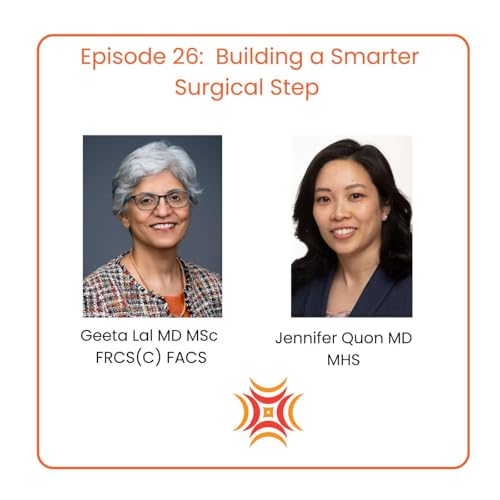
  • Building A Smarter Surgical Step with Pediatric Neurosurgeon Dr. Jennifer Quon
    Jan 26 2026

    Episode details:

    Dr. Jennifer Quon is a pediatric neurosurgeon at the Hospital for Sick Children and an Assistant Professor at the University of Toronto. She is also the Co-founder and Chief Medical Officer of Smartstep Surgical LLC. Dr. Quon completed medical school at Yale School of Medicine and neurosurgical training at Stanford Hospital. She did her pediatric neurosurgery fellowship at the Hospital for Sick Children prior to starting as faculty. Dr. Quon has broad clinical interests in pediatric neurosurgery, with expertise in skull base brain tumors, vascular disorders and fetal surgery. Her research program focuses machine learning applications in pediatric neurosurgery and neuroimaging, and surgical innovation.

    In this episode Dr. Quon:

    - Shares the challenges she faced using standing stools/steps in the operating room which in turn, inspired her ergonomics and innovation journey

    - Discusses how she started her innovation journey by thinking about what features she would want an ideal step stool to have

    - Explains that Surgistep is a motorized surgical stool/step which can adjust height in 1mm increments using a scissor-lift mechanism and allows surgeons the ability to make adjustments without asking other team members to stack steps https://www.smartstepsurgical.com/collections/surgistep

    - Elaborates on the various steps during her innovation journey i.e. background research, finding a partner familiar with devices, meeting with engineers, raising funding, getting additional partners, making a prototype and learning legal and regulatory requirements

    - Shares some of the frustrations during her innovator journey including the timelines being longer than anticipated and getting conflicting feedback to make engineering modifications

    - Describes the basics of getting funding for aspiring surgeon-innovators

    - Highlights that she is working on other safety products for the OR

    You can reach Dr. Quon directly via email: jennifer.quon@sickkids.ca

    Smart Step Surgical LLC is offering a 20% discount for listeners of the podcast which you can access here: https://www.smartstepsurgical.com/blogs/news/surgical-ergonomic-podcast-promotional-discount

    -

    Follow us on LinkedIn, X, Instagram and Facebook and please reach out to us if you have any suggestions regarding episode ideas and guests or if you'd like to be a guest on the show

    Show more Show less
    34 mins
  • Introduction to Cognitive Ergonomics and the OR Black Box with Dr. Patricia Trbovich
    Jan 12 2026

    This episode of the podcast is sponsored by Q-optics. You can learn about them, the special rates they are offering for podcast listerners and schedule a demo via : https://q-optics.com/pages/surgicalergonomics-drlal

    Disclosure:

    Q-optics is a paid sponsor and the affiliate link above supports the podcast at no cost to you. It also provides you with a discount and a giveaway to listeners of the podcast, so we hope that it is a win-win!

    Episode details:

    Dr. Patricia Trbovich is an Associate Professor in the Institute of Health Policy, Management and Evaluation and cross appointed at the Institute of Biomedical Engineering at the University of Toronto. She holds the Badeau Family Research Chair in Patient Safety and Quality Improvement at North York General Hospital. She is the Research and Scholarship lead, Centre for Quality Improvement & Patient Safety (C-QuIPS).

    Patricia leads HumanEra, a team dedicated to enhancing healthcare safety and performance through human factors research. With over 15 years of experience, she's implemented health technologies and trained professionals worldwide. Now, she’s focused on advancing surgical safety through innovative tools such as the OR Black Box to identify safety threats to provider and patient safety, apply human factors principles to operationalize resilience, and prototype and test human factors informed interventions.

    In this episode Dr. Trbovich:

    - Shares her training background and how she arrived at her current role

    - Defines cognitive ergonomics as a branch of Human Factors that focuses on how we design systems to support the way people think, the way they make decisions and how they manage information, especially under pressure

    - Describes the consequences of not paying attention to workers' cognitive ergonomics in the OR, such as, creating conditions where they are overloaded and forced into task-switching (often mistaken for multi-tasking) which then increases the risk of errors

    - Discusses her work where her team have identified the most interrupted time for anesthesiologists (i.e. emergence) and nurses (i.e. closing counts)

    - Elaborates on the OR black box and other tools (surveys such as the NASA-Task Load Index, observations, objective measures of physiologic responses and behavior markers) that are used to study interruptions and understand work as it is done, and not as it is imagined

    - Shares Black box data is useful to look at not only safety threats but also resilience supports and psychological safety.....

    - Discusses strategies for preserving cognitive bandwidth of various team members in the OR e.g. calling out increasing cognitive load prior to it reaching a critical point, using checklists and other visual indicators and looking at how often staff are task-switching

    You can learn more about the work references in this episode in these articles:

    1) https://bmjopen.bmj.com/content/15/10/e104713.long

    2)https://journals.lww.com/annalsofsurgery/fulltext/2024/07000/using_the_operating_room_black_box_to_assess.13.aspx

    You can reach Dr. Trbovich on Linked In


    Follow us on LinkedIn, X, Instagram and Facebook and please reach out to us if you have any suggestions regarding episode ideas and guests or if you'd like to be a guest on the show

    Show more Show less
    41 mins
  • Designing your practice to optimize physical wellbeing with Oral Maxillofacial Surgeon Dr. Erin Sheffield
    Dec 30 2025

    This episode of the podcast is sponsored by Q-optics. You can learn about them, the special rates they are offering for podcast listerners and schedule a demo via : https://q-optics.com/pages/surgicalergonomics-drlal

    Disclosure:

    Q-optics is a paid sponsor and the affiliate link above supports the podcast at no cost to you. It also provides you with a discount and a giveaway to listeners of the podcast, so we hope that it is a win-win!

    Episode details:

    Dr. Erin Sheffield is a board certified oral maxillofacial surgeon, speaker, educator, and advocate. Her passion is reshaping the culture of surgery by amplifying the voices of women and redefining what it means to thrive in this high demand profession. She is the founder of The Doctor Is ALL In (formerly known as Elevate Summit), a wellness and leadership retreat for women in Oral Maxillofacial Surgery, and co-host of The Resting Stitch Face Podcast, where she leads unfiltered conversations about the realities of life as a woman in surgery.
    As a content creator, she is known for her openness and authenticity, inspiring the next generation of doctors and empowering patients to make more informed and empowered healthcare choices. She practices at Quincy Medical Group, a large multispecialty physicians group in Illinois. She previously served as assistant professor at the Univeristy of Iowa and currently serves on institutional committees for antiobiotic stewardship and ambulatory surgery.

    In this episode of the podcast, Dr. Sheffield

    - Shares how although dentistry training does a better job than surgical training reminding trainees about optimal postures during procedures, dentists have high rates of MSK injury

    - Outlines how she tries to incorporate ergonomic best practices in her own practice and while training dental staff. These include adjusting the height of the chair, sitting during certain procedures, stretching in between cases to name a few

    - Describes other strategies that she has adopted over the years, including investing in good overhead lights to avoid using headlights, only using loupes when absolutely needed and adjusting workflow to offload physical strain

    - Expresses how working with a physical therapist was really helpful for overall physical health even though she initially sought them out for pelvic issues post-partum

    - Discusses how smaller handed dentists (more likely to be women) often have issues handling dental instruments e.g. syringes used to inject local anesthetics

    You can reach Dr. Sheffield on:

    LinkedIn : https://www.linkedin.com/in/erin-sheffield-dds-9ab281339/

    Instagram: https://www.instagram.com/drerinsheffield/

    Podcast: https://www.youtube.com/@TheRestingStitchFacePodcast

    Website: https://www.doctorisallin.com/

    Follow us on LinkedIn, X, Instagram and Facebook and please reach out to us if you have any suggestions regarding episode ideas and guests or if you'd like to be a guest on the show

    Show more Show less
    44 mins